
A2 June 2025 Q6
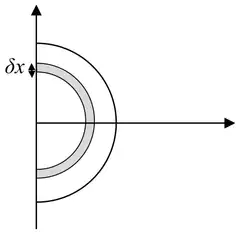
6. A uniform semicircular lamina has radius \(r\) and the midpoint of the diameter of the lamina is at \(O\). The distance of the centre of mass of the lamina from \(O\) is \(d\).
The uniform plane template \(T\), shown shaded in Figure 7, is formed from a rectangle and a semicircular ring.
The rectangle has \(AD = BC = 2a\) and \(AB = DC = 8a\).
The midpoint of \(CD\) is \(O\).
The semicircular ring has centre \(O\), outer radius \(OD = 4a\) and inner radius \(OE = 2a\).
The template is modelled as a uniform lamina.
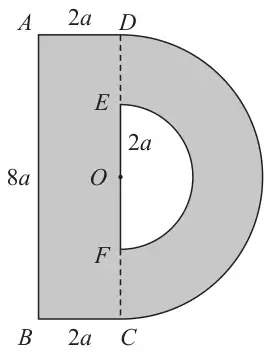
The template is freely suspended from \(A\). The weight of \(T\) is \(W\) newtons.
A horizontal force is applied to \(T\) at \(B\) so that \(T\) is held in equilibrium with \(AB\) vertical.
The force acts in the same vertical plane as \(T\) and has magnitude \(\lambda W\) newtons.
| Scheme | Marks | AO |
|---|---|---|
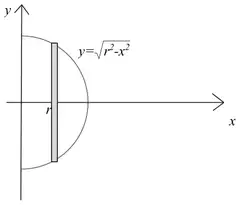 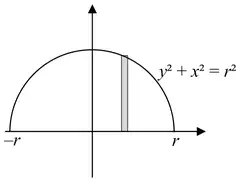 | ||
| \(\left(\dfrac{1}{2}\pi r^2 d =\right) \displaystyle\int_0^r 2yx\,\mathrm{d}x\) OR \(\left(\dfrac{1}{2}\pi r^2 d =\right) \displaystyle\int_{-r}^r \dfrac{1}{2}y^2\,\mathrm{d}x\) | M1 | 2.1 |
| \(\displaystyle\int_0^r 2xy\,\mathrm{d}x = \int_0^r 2x\sqrt{r^2 - x^2}\,\mathrm{d}x\) OR \(\displaystyle\int_{-r}^r \dfrac{1}{2}y^2\,\mathrm{d}x = \int_{-r}^r \dfrac{1}{2}\left(r^2 - x^2\right)\mathrm{d}x\) | M1 | 3.1a |
| \(= -\left[\dfrac{2}{3}\left(r^2 - x^2\right)^{\frac{3}{2}}\right]_0^r = \dfrac{2}{3}r^3\) OR \(= \left[\dfrac{1}{2}\left(r^2x - \dfrac{1}{3}x^3\right)\right]_{-r}^r = \dfrac{2}{3}r^3\) | A1ft | 1.1b |
| \(\Rightarrow d = \dfrac{\frac{2}{3}r^3}{\frac{1}{2}\pi r^2} = \dfrac{4r}{3\pi}\) * | A1* | 2.2a |
| (4) |
Notes
M1: Correct strategy to find \(d\) by integration
M1: Integrate a function of the form \(\lambda x\sqrt{r^2 - x^2}\) / \(\lambda\left(r^2 - x^2\right)\). Allow without limits.
A1ft: Follow their \(\lambda\). Allow without limits.
A1*: Obtain given answer including “\(d =\)” from correct exact working
(a) alt M1: Correct strategy to find \(d\) by integration
M1: Integrate a function of the form \(\lambda r^3\cos\theta\) or \(\lambda x^2\). Allow without limits.
A1ft: Follow their \(\lambda\)
A1: Obtain given answer including “\(d =\)” from correct working
Alternative (a)
| Scheme | Marks | AO |
|---|---|---|
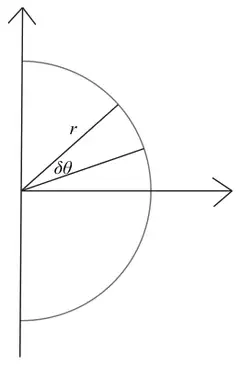  | ||
| CoM of “triangle” is \(\dfrac{2}{3}r\cos\theta\) from \(O\) OR CoM of “arc” is \(\dfrac{2x}{\pi}\) from \(O\) | M1 | 2.1 |
| \(\displaystyle\int_{-\frac{\pi}{2}}^{\frac{\pi}{2}} \dfrac{1}{2}r^2 \times \dfrac{2}{3}r\cos\theta\,\mathrm{d}\theta\) OR \(\displaystyle\int_0^r \pi x \times \dfrac{2x}{\pi}\,\mathrm{d}x\) | M1 | 3.1a |
| \(= \dfrac{1}{3}r^3\Big[\sin\theta\Big]_{-\frac{\pi}{2}}^{\frac{\pi}{2}} = \dfrac{2}{3}r^3\) OR \(= \left[\dfrac{2}{3}x^3\right]_0^r = \dfrac{2}{3}r^3\) | A1ft | 1.1b |
| \(\Rightarrow d = \dfrac{\frac{2}{3}r^3}{\frac{1}{2}\pi r^2} = \dfrac{4r}{3\pi}\) * | A1* | 2.2a |
| (4) |
| Scheme | Marks | AO | |||||||||||||||
|---|---|---|---|---|---|---|---|---|---|---|---|---|---|---|---|---|---|
| B1 B1 | 1.1b 1.1b | |||||||||||||||
| Moments about \(DC\) | M1 | 2.1 | |||||||||||||||
| \(8\pi \times \dfrac{16a}{3\pi} - 2\pi \times \dfrac{8a}{3\pi} - 16a = (16 + 6\pi)\bar{x}\) | A1 | 1.1b | |||||||||||||||
| \(\bar{x} = \dfrac{a\left(\dfrac{7 \times 16}{3} - 16\right)}{16 + 6\pi} = \dfrac{64a}{3(16 + 6\pi)} = \dfrac{32a}{3(8 + 3\pi)}\) * | A1* | 2.2a | |||||||||||||||
| (5) |
Notes
B1: Correct mass ratios
B1: Distances from \(DC\) or a parallel axis
M1: Moments about \(DC\) or a parallel axis. All terms required. Dimensionally correct.
A1: Correct unsimplified equation for their axis
A1*: Obtain given answer from correct working.
| Scheme | Marks | AO |
|---|---|---|
| Moments about \(A\): | M1 | 3.1a |
| \(W \times \left(2a + \dfrac{32a}{3(8 + 3\pi)}\right) = 8a\lambda W\) | A1 | 1.1b |
| \(\lambda = \left(\dfrac{(9\pi + 40)}{12(8 + 3\pi)}\right) = 0.33\) or better (0.3265…) | A1 | 1.1b |
| (3) | ||
| (12 marks) |
Notes
M1: Moments about \(A\). Dimensionally correct. Allow if \(a\) missing throughout.
A1: Correct unsimplified equation
A1: Correct only. Accept 0.33 or better (0.3265…).
Condone an exact answer in terms of \(\pi\) if given as a single fraction.