
A2 June 2023 Paper 2 Q10
10 In this question you must show detailed reasoning.
A region, \(R\), of the floor of an art gallery is to be painted for the purposes of an art installation. A suitable polar coordinate system is set up on the floor of the gallery with units in metres and radians. \(R\) is modelled as being the region enclosed by two curves, \(C_1\) and \(C_2\). The polar equations of \(C_1\) and \(C_2\) are
\[\begin{aligned} &C_1: r = 5, &&-\tfrac{1}{2}\pi \leqslant \theta \leqslant \tfrac{1}{2}\pi \\ &C_2: r = 3\cosh\theta, &&-\tfrac{1}{2}\pi \leqslant \theta \leqslant \tfrac{1}{2}\pi \end{aligned}\]
Both curves are shown in the diagram, with \(R\) indicated.
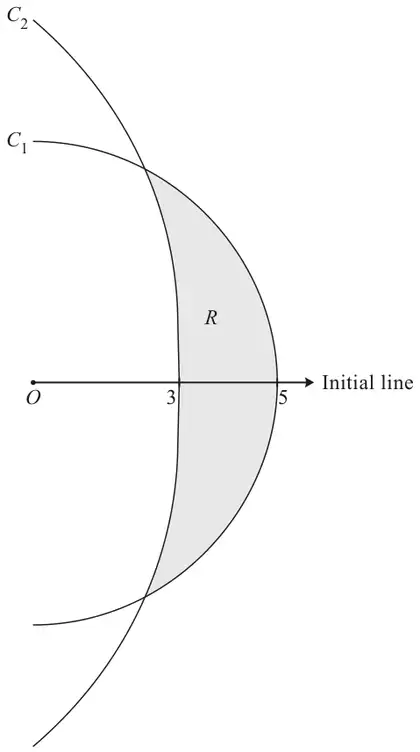
The gallery must buy tins of paint to paint \(R\). Each tin of paint can cover an area of \(0.5\,\text{m}^2\).
Determine the smallest number of tins of paint that the gallery must buy in order to be able to paint \(R\) completely. [7]
| Scheme | Marks | AO |
|---|---|---|
| DR \(C_1\) and \(C_2\) intersect when \(5 = 3\cosh\theta\) \(\therefore \theta = \cosh^{-1}\frac{5}{3}\) so intersection at \((\pm)\cosh^{-1}\frac{5}{3}\) or \((\pm)\ln 3\) or awrt \((\pm)1.10\) | B1 | 3.1a |
| \(A_{\text{sector}} = \dfrac{1}{2}5^2(\theta_2 - \theta_1) = 25\ln 3\) or \(25\cosh^{-1}\frac{5}{3}\) or awrt 27.5 | B1ft | 2.2a |
| \(\dfrac{1}{2}\displaystyle\int_{\theta_1}^{\theta_2}(3\cosh\theta)^2\,\mathrm{d}\theta\) or \(\dfrac{1}{2}\displaystyle\int_0^{\theta_2}(3\cosh\theta)^2\,\mathrm{d}\theta\) | M1 | 3.4 |
| \(\displaystyle\int\cosh^2\theta\,\mathrm{d}\theta = \int\left(\frac{\mathrm{e}^{\theta} + \mathrm{e}^{-\theta}}{2}\right)^2\mathrm{d}\theta = \frac{1}{4}\int\mathrm{e}^{2\theta} + \mathrm{e}^{-2\theta} + 2\,\mathrm{d}\theta\) | *M1 | 3.1a |
| \(\displaystyle\int_{-\ln 3}^{\ln 3}\mathrm{e}^{2\theta} + \mathrm{e}^{-2\theta} + 2\,\mathrm{d}\theta = \left[\frac{1}{2}\mathrm{e}^{2\theta} - \frac{1}{2}\mathrm{e}^{-2\theta} + 2\theta\right]_{-\ln 3}^{\ln 3}\) \(= \dfrac{1}{2} \times 9 - \dfrac{1}{2} \times \dfrac{1}{9} + 2\ln 3 - \left(\dfrac{1}{2} \times \dfrac{1}{9} - \dfrac{1}{2} \times 9 - 2\ln 3\right)\) \(= \dfrac{80}{9} + 4\ln 3\) or awrt 13.3 | dep*M1 | 1.1 |
| \(\therefore\) trapped area \(= 25\ln 3 - \left(10 + \dfrac{9}{2}\ln 3\right) = \dfrac{41}{2}\ln 3 - 10\) or awrt 12.5 (12.521…) | A1 | 1.1 |
| \(12.52 / 0.5 = 25.04\) so 26 tins of paint are needed | A1 | 3.2a |
| [7] |
Notes
B1: (1st) Correct condition for intersection of curves leading to a correct expression or value for an angle at a PoI
B1ft: For finding (\(\pm\)) the correct area of the sector (or half of it) either using \(\frac{1}{2}r^2\theta\) or \(\frac{1}{2}\int_{\theta_1}^{\theta_2}(5)^2\,\mathrm{d}\theta\). Accept lower limit of 0. May be embedded in a calculation for total area.
Here \(\theta_1 = -\cosh^{-1}\frac{5}{3}\), \(\theta_2 = \cosh^{-1}\frac{5}{3}\) or \((\theta_1 = -\ln 3), (\theta_2 = \ln 3)\), i.e. may later evaluate integral… for some \(k\)
M1: (1st) Correct use of area formula with \(\pm\)their value for limits. Condone lower limit of 0. Here \(\theta_1 = -\cosh^{-1}\frac{5}{3}\), \(\theta_2 = \cosh^{-1}\frac{5}{3}\). Limits can be seen later. Later doubling may be seen
*M1: Correct conversion of \(\cosh^2\theta\) into a form which can be integrated, or \(\int\cosh^2\theta\,\mathrm{d}\theta = \frac{1}{2}\int 1 + \cosh 2\theta\,\mathrm{d}\theta\)
dep*M1: Correctly integrating \(\cosh^2\theta\) and substituting their limits. Could be embedded.
Or \(\displaystyle\int_{-\ln 3}^{\ln 3}\cosh^2\theta\,\mathrm{d}\theta = \frac{1}{2}\int_{-\ln 3}^{\ln 3}1 + \cosh 2\theta\,\mathrm{d}\theta = \frac{1}{2}\left[\theta + \frac{1}{2}\sinh 2\theta\right]_{-\ln 3}^{\ln 3} = \frac{20}{9} + \ln 3\)
NB \(A_{C_2} = \dfrac{9}{2} \times \dfrac{1}{4}\left(\dfrac{80}{9} + 4\ln 3\right) = 10 + \dfrac{9}{2}\ln 3\)
A1: (1st) Accept unsimplified form. If B1B1M1M0M0 can score ScB1 both here and in the next line for correct answers