
A2 June 2023 Paper 1 Q4
4 The transformations \(\mathrm{T_A}\) and \(\mathrm{T_B}\) are represented by the matrices \(\mathbf{A}\) and \(\mathbf{B}\) respectively, where
\[\mathbf{A} = \begin{pmatrix} 0 & -1 \\ 1 & 0 \end{pmatrix} \text{ and } \mathbf{B} = \begin{pmatrix} 0 & 1 \\ 1 & 0 \end{pmatrix}.\]
The transformation \(\mathrm{T_C}\) is represented by the matrix \(\mathbf{C}\), where
\[\mathbf{C} = \begin{pmatrix} \frac{1}{2} & 0 \\ 0 & \frac{1}{3} \end{pmatrix}.\]
The region \(R\) is defined by the set of points \((x, y)\) satisfying the inequality \(x^2 + y^2 \leqslant 36\).
The region \(R^{\prime}\) is defined as the image of \(R\) under \(\mathrm{T_C}\).
| Scheme | Marks |
|---|---|
| \(\mathbf{BA} = \begin{pmatrix} 0 & 1 \\ 1 & 0 \end{pmatrix}\begin{pmatrix} 0 & -1 \\ 1 & 0 \end{pmatrix} = \begin{pmatrix} 1 & 0 \\ 0 & -1 \end{pmatrix}\) | M1 |
| i.e. a reflection in the \(x\)-axis | A1 |
| [2] |
Notes
M1: Multiplication in correct order
A1: Or reflection in the line \(y = 0\)
Answer with no working B2
Alternative method
| Scheme | Marks |
|---|---|
| A represents a rotation anti-clockwise of \(90^\circ\) B represents a reflection in the line \(y = x\) | M1 |
| Taken one after the other gives a reflection in the \(x\)- axis | A1 |
| Scheme | Marks |
|---|---|
| \(\mathrm{T_A}\) is a rotation 90 degrees (anti-clockwise about \(O\)) | B1 |
| (423 has remainder 3 when divided by 4) so \(\mathbf{A}^{423} = \mathbf{A}^3\) | M1 |
| So \(\mathbf{A}^{423} = \mathbf{A}^3 = \begin{pmatrix} 0 & 1 \\ -1 & 0 \end{pmatrix}\) | A1 |
| [3] |
Notes
M1: For \(\mathbf{A}^4 = \mathbf{I}\) or \(\mathrm{T_A}\) repeated four times is a 360 degree rotation. Condone clockwise instead of anticlockwise for \(\mathrm{T_A}\) so notes that 423 is divisible by 4 with remainder 3 so \(\mathbf{A}^{423} = \mathbf{A}^3\)
A1: As \(\mathbf{A}^3\) represents a 270 degrees rotation anti-clockwise (or 90 degrees clockwise) or by direct calculation of \(\mathbf{A}^3\).
| Scheme | Marks |
|---|---|
| (i) \(\operatorname{Det}\mathbf{C} = \dfrac{1}{6}\) | M1 |
| \(\Rightarrow \text{Area of } R^{\prime} = \dfrac{1}{6} \times 36\pi = 6\pi\) | A1 |
| [2] | |
(ii) 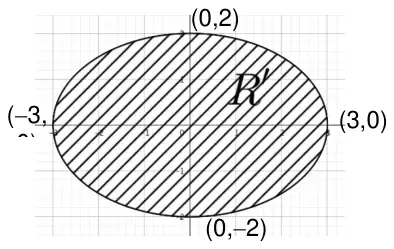 | M1 A1 A1 A1 |
| [4] |
Notes
(c)(i)
M1: \(\frac{1}{3} \times \frac{1}{2}\) or \(\frac{1}{6}\) seen.
Or area of ellipse \(= \pi ab = \pi \times 2 \times 3\)
A1: cao
(c)(ii)
M1: Correct shape, (approximately elliptical, possibly identified by scales, closed, radius on horizontal axis > radius on vertical axis)
A1: Intercepts labelled at \(x = \pm 3\)
A1: and \(y = \pm 2\) (Give A1 only rather than A2 if only positive intercepts are labelled on both)
Give A1 if \(x\) and \(y\) axes interchanged.
A1: Correctly shaded or labelled \(R^{\prime}\) and everything else correct.
The label at the left-hand intercept is cut off in the printed mark scheme; it is \((-3, 0)\).