
AS June 2018 Q3
3.
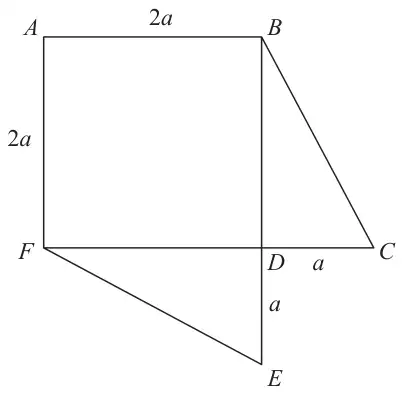
The lamina \(L\), shown in Figure 2, consists of a uniform square lamina \(ABDF\) and two uniform triangular laminas \(BDC\) and \(FDE\). The square has sides of length \(2a\). The two triangles are identical.
The straight lines \(BDE\) and \(FDC\) are perpendicular with \(BD = DF = 2a\) and \(DC = DE = a\).
The mass per unit of area of the square is \(M\).
The mass per unit area of each triangle is \(3M\).
The centre of mass of \(L\) is at the point \(G\).
The lamina \(L\) is freely suspended from \(B\) and hangs in equilibrium.
| Scheme | Marks | AO |
|---|---|---|
| \(L\) is symmetrical about \(AD\) | B1 | 2.4 |
| (1) |
Notes
B1: Any equivalent statement about the symmetry
| Scheme | Marks | AO | |||||||||||||||
|---|---|---|---|---|---|---|---|---|---|---|---|---|---|---|---|---|---|
| |||||||||||||||||
| Mass ratios | B1 | 1.2 | |||||||||||||||
| Distances from \(BE\) | B1 | 1.2 | |||||||||||||||
| Moments equation | M1 | 2.1 | |||||||||||||||
| \(-a \times 4a^2M + \dfrac{a}{3} \times 3a^2M - \dfrac{2a}{3} \times 3a^2M = 10a^2M \times x\) \((-4a + a - 2a = 10x)\) | A1 | 1.1b | |||||||||||||||
| \(x = -\dfrac{5a}{10} = -\dfrac{a}{2}\) | A1 | 1.1b | |||||||||||||||
| Use symmetry and Pythagoras | M1 | 1.1a | |||||||||||||||
| Distance from \(D = \sqrt{\dfrac{a^2}{4} + \dfrac{a^2}{4}} = \dfrac{\sqrt{2}}{2}a\) * | A1* | 2.2a | |||||||||||||||
| (7) |
Notes
B1: Correct mass ratios
B1: Distance ratios from any horizontal or vertical axis
M1: Moments equation for complete lamina about any horizontal or vertical axis. Must be dimensionally correct
A1: Correct unsimplified equation for their axes
A1: Correct horizontal or vertical distance from \(D\)
M1: Use of Pythagoras with their distance
A1*: Obtain given answer from correct working.
| Scheme | Marks | AO |
|---|---|---|
 | ||
| Trig ratio of a relevant angle | M1 | 1.2 |
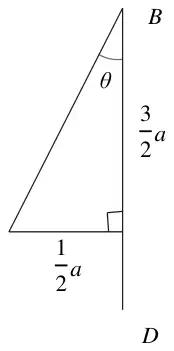
| \(\tan\theta = \dfrac{1}{3}\) or \(\cos\theta = \dfrac{\dfrac{10}{4}a^2 + 4a^2 - \dfrac{2}{4}a^2}{2 \times \dfrac{\sqrt{10}}{2}a \times 2a} = \dfrac{6}{2\sqrt{10}}\) | A1ft | 1.1b |
| \(\theta = 18.4^\circ\) | A1 | 1.1b |
| (3) | ||
| (11 marks) |
Notes
M1: Trig ratio of \(\theta\) or \(90^\circ - \theta\) or equivalent
A1ft: Correct unsimplified expression using their \(\dfrac{a}{2}\)
A1: Correct angle. Accept 0.322 radians