
A2 June 2024 Paper 2 Q6
6 In polar coordinates, the equation of a curve, \(C\), is \(r = 6\sin(2\theta)\sinh\left(\frac{1}{3}\theta\right)\) for \(0 \leqslant \theta \leqslant \frac{1}{2}\pi\).
The pole of the polar coordinate system corresponds to the origin of the cartesian system and the initial line corresponds to the positive \(x\)-axis.
The incomplete table below shows values of \(r\) for various values of \(\theta\).
| \(\theta\) | \(0\) | \(\dfrac{1}{12}\pi\) | \(\dfrac{1}{6}\pi\) | \(\dfrac{1}{4}\pi\) | \(\dfrac{1}{3}\pi\) | \(\dfrac{5}{12}\pi\) | \(\dfrac{1}{2}\pi\) |
| \(r\) | 0 | 0.262 | 1.851 |
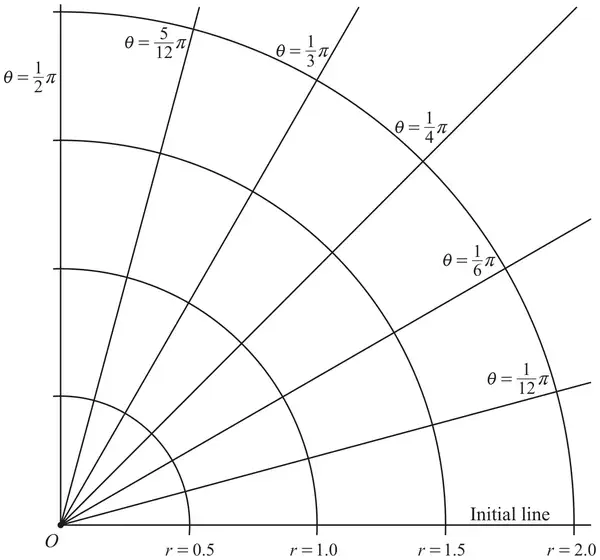
The point on \(C\) which is furthest away from the pole is denoted by \(A\) and the value of \(\theta\) at \(A\) is denoted by \(\phi\).
Find the distance from \(A\) to the pole. Give your answer correct to 3 significant figures. [1]
| Scheme | Marks | AO |
|---|---|---|
| \(r = 0\) when \(\theta = 0\) and when \(\theta = \pi/2\) (and the function is continuous so there is a loop). | B1 | 2.4 |
| Must be in 1st quadrant since \(\theta\) only takes values between 0 and \(\frac{1}{2}\pi\). | B1 | 2.1 |
| There are only two values of \(\theta\) for which \(r = 0\), therefore there is only one loop (two loops require three values of \(\theta\)/tangents at the pole). | B1 | 2.2a |
| [3] |
Notes
B1: Condone use of “origin” rather than “pole” in explanations.
B1: Must link domain of \(\theta\) with quadrant.
B1: Convincingly explaining why it is a single loop. \(\theta\) values/\(r = 0\) must be linked to loop.
or “There are no other solutions to \(r = 0\) (in the domain)”.
| Scheme | Marks | AO | ||||||||
|---|---|---|---|---|---|---|---|---|---|---|
| B1* | 1.1 | ||||||||
 | M1 A1dep* | 1.1 2.2a | ||||||||
| [3] |
Notes
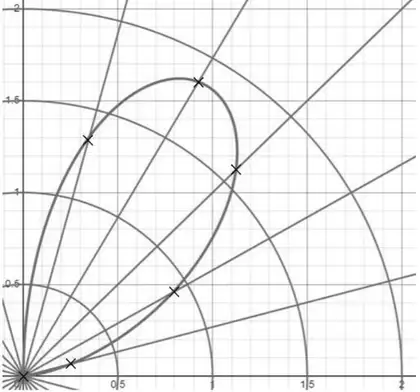
B1*: All 4 entries correct and non-zero ones correct to at least 3 sf. ie awrt 0.912, 1.59, 1.35.
M1: All points, theirs and given, plotted approximately correctly (ie on the \(\theta\) = constant lines and in the correct half between the appropriate \(r\) = constant lines)
Points can be inferred by curve
A1dep*: Smooth curve plotted between correctly plotted points (see criteria above) joining at the pole.
Single maximum \(r\) at some angle between \(\pi/4\) and \(5\pi/12\) (it might be on the wrong side of \(\theta = \pi/3\).
Curve needs to be: smooth (except at pole); curved (not line segments); closed; single loop; cusp at pole
| Scheme | Marks | AO |
|---|---|---|
| \(\dfrac{\mathrm{d}r}{\mathrm{d}\theta} = 6\sinh\frac{1}{3}\theta \times \dfrac{\mathrm{d}}{\mathrm{d}\theta}(\sin 2\theta) + 6\sin 2\theta \times \dfrac{\mathrm{d}}{\mathrm{d}\theta}\left(\sinh\frac{1}{3}\theta\right)\) | M1 | 3.1a |
| \(\dfrac{\mathrm{d}r}{\mathrm{d}\theta} = 12\cos 2\theta\sinh\frac{1}{3}\theta + 2\sin 2\theta\cosh\frac{1}{3}\theta\) | A1 | 1.1 |
| \(\therefore\) at \(A\), \(12\cos 2\phi\sinh\frac{1}{3}\phi + 2\sin 2\phi\cosh\frac{1}{3}\phi = 0\) \(\therefore 12\cos 2\phi\sinh\frac{1}{3}\phi = -2\sin 2\phi\cosh\frac{1}{3}\phi\) \(\therefore 6\tanh\frac{1}{3}\phi = -\tan 2\phi\) | M1 | 1.1 |
| \(\therefore \frac{1}{3}\phi = \tanh^{-1}\left(-\frac{1}{6}\tan 2\phi\right)\) \(= \dfrac{1}{2}\ln\left(\dfrac{1 + \left(-\frac{1}{6}\tan 2\phi\right)}{1 - \left(-\frac{1}{6}\tan 2\phi\right)}\right)\) \(\therefore \phi = \dfrac{3}{2}\ln\left(\dfrac{6 - \tan 2\phi}{6 + \tan 2\phi}\right)\) | A1 | 2.2a |
| [4] |
Notes
M1: Attempting to differentiate \(r(\theta)\) using the product rule.
\(a\sinh\frac{1}{3}\theta\cos 2\theta + b\sin 2\theta\cosh\frac{1}{3}\theta\) where \(a\), \(b\) are non-zero constants
A1: All correct (any form)
M1: Setting their derivative to 0 and rearranging to a form containing tan and tanh only.
If using exponential form, must reach tan and reduce to one exponential term.
eg \(\mathrm{e}^{\frac{2}{3}\phi}(6 + \tan 2\phi) = 6 - \tan 2\phi\)
A1: AG so intermediate step must be shown.
Condone use of \(\theta\) rather than \(\phi\) but final answer must be in terms of \(\phi\) (or explicitly stating “\(\theta = \phi\)”).
| Scheme | Marks | AO |
|---|---|---|
| \(r\ (= 6\sin(2 \times 1.0207) \times \sinh(1.0207/3))\) \(= 1.85\) (3 sf) cao | B1 | 1.1 |
| [1] |
Notes
B1: 0.0741 comes from using degrees.