
A2 June 2024 Paper 1 Q2
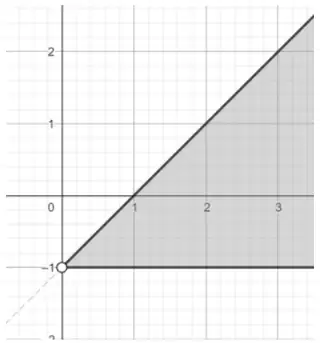
2 The locus \(C_1\) is defined by \(C_1 = \left\{z : 0 \leqslant \arg(z + \mathrm{i}) \leqslant \tfrac{1}{4}\pi\right\}\).
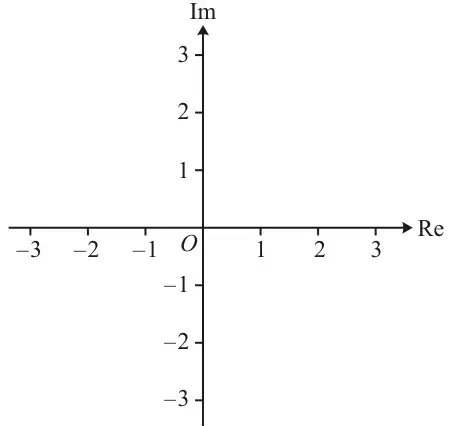
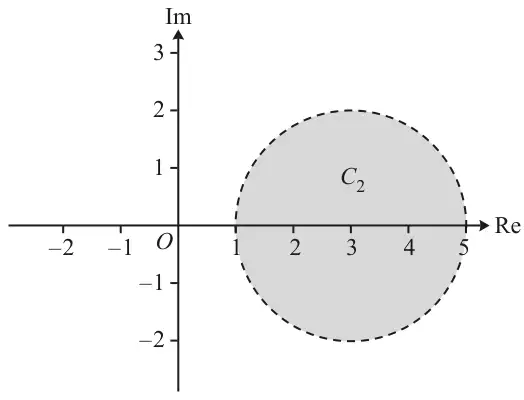
The locus \(C_2\) is the set of complex numbers represented by the interior of the circle with radius 2 and centre 3. The locus \(C_2\) is illustrated on the Argand diagram below.
| Scheme | Marks | AO |
|---|---|---|
 | M1 A1 | 1.1 1.1 |
| [2] |
Notes
M1: Half-line starting at one of \((-1, 0), (1, 0)\) \((0, 1)\), or \((0, -1)\) at an angle of approx. \(\frac{\pi}{4}\) to the positive horizontal. This mark can be awarded if the line is shown dashed rather than solid. This mark can be implied by shading that begins/ends where this line is meant to be even if the line is not explicitly shown.
A1: Solid half-line starting at \((0, -1)\) passing through \((1, 0)\) with region between half-line and \(y = -1\) shaded. Neither line needs to be shown if the shading alone exactly defines the correct region. Condone dashed line for \(y = -1\). If shading the outside, then must label the inside as \(C_1\).
| Scheme | Marks | AO |
|---|---|---|
| \(\arg(1.2 + 0.8\mathrm{i} + \mathrm{i}) = \arctan\left(\dfrac{1.8}{1.2}\right)\) | M1 | 1.1 |
| \(= 0.98\ldots \gt \dfrac{\pi}{4}\) so no, \(1.2 + 0.8\mathrm{i}\) is not in \(C_1\). | A1 | 2.2a |
| [2] |
Notes
M1: Correct calculation for \(\arg(1.2 + 1.8\mathrm{i})\) – allow \(\tan\theta = \frac{1.8}{1.2}\) (oe) for M1.
A1: Correct justification and conclusion. Evaluation of arctan must be given to at least 2 d.p. rot (0.982793…). For reference: \(\frac{\pi}{4} = 0.78(5398\ldots)\). ‘No’ is sufficient as a conclusion. Award A1 for both values (0.98… and 0.78…) together with correct conclusion but if \(\frac{\pi}{4}\) not evaluated must see comparison with 0.98… e.g. \(0.98\ldots \gt \dfrac{\pi}{4}\)
Alternative method
| Scheme | Marks |
|---|---|
| Cartesian equation of half-line is \(y = x - 1\) so when \(x = 1.2, y = \ldots\) | M1 |
| \(0.2 \lt 0.8\) so no, \(1.2 + 0.8\mathrm{i}\) is not in \(C_1\). | A1 |
| [2] |
M1: Substitutes \(x = 1.2\) into \(y = x - 1\)
A1: Correct justification and conclusion. Must see comparison of 0.2 and 0.8 for this mark.
SC B2 For stating that \(1.8 \gt 1.2\) or \(1.5 \gt 1\) and ‘no’ cwo.
| Scheme | Marks | AO |
|---|---|---|
| \(\{z : |z - 3| \lt 2\}\) | M1 A1 | 1.1 2.5 |
| [2] |
Notes
M1: For \(|z - 3|\) and 2 seen. Allow any letter for \(z\). Allow use of \(\operatorname{mod}(z - 3)\) for both marks.
A1: Set notation and inequality must be correct. Allow any letter for \(z\).
Condone \(\{z : |z - 3|^2 \lt 2^2\}\)
SC1 for \(\{z : |z + 3| \lt 2\}\) or \(\{z : |z - 3| \lt 4\}\)
| Scheme | Marks | AO |
|---|---|---|
| \(|1.2 + 0.8\mathrm{i} - 3| = \sqrt{(-1.8)^2 + 0.8^2} \left(= \sqrt{3.24 + 0.64} = \sqrt{3.88}\right)\) | M1 | 1.1 |
| \(\sqrt{3.88} \lt 2\), so yes, \(1.2 + 0.8\mathrm{i}\) is in \(C_2\). | A1 | 2.2a |
| [2] |
Notes
M1: Calculating \(|1.2 + 0.8\mathrm{i} \pm 3|\) or \(|1.2 + 0.8\mathrm{i} \pm 3|^2\) correctly for their 3 (which must be real) from part (c). Or for calculating \(|\pm(3 - (1.2 + 0.8\mathrm{i}))|\).
A1: Comparing modulus with 2 (or modulus squared with 4) and concluding that \(1.2 + 0.8\mathrm{i}\) is contained in \(C_2\). Allow just \(\sqrt{3.88} \lt 2\) as a comparison. For reference \(\sqrt{3.88} = 1.96(977\ldots)\). Allow \(\sqrt{3.88} \leqslant 2\). ‘Yes’ is sufficient as a conclusion. Allow other correct surds for comparison e.g. \(\frac{\sqrt{97}}{5}\).