
A2 October 2021 Paper 2 Q6
6. The curve \(C\) has equation
\[r = a(p + 2\cos\theta) \qquad 0 \leqslant \theta \lt 2\pi\]where \(a\) and \(p\) are positive constants and \(p \gt 2\)
There are exactly four points on \(C\) where the tangent is perpendicular to the initial line.
John digs a hole in his garden in order to make a pond.
The pond has a uniform horizontal cross section that is modelled by the curve with equation
\[r = 20(3 + 2\cos\theta) \qquad 0 \leqslant \theta \lt 2\pi\]where \(r\) is measured in centimetres.
The depth of the pond is 90 centimetres.
Water flows through a hosepipe into the pond at a rate of 50 litres per minute.
Given that the pond is initially empty,
| Scheme | Marks | AO |
|---|---|---|
| \(x = r\cos\theta = a(p + 2\cos\theta)\cos\theta\) Leading to \(\dfrac{\mathrm{d}x}{\mathrm{d}\theta} = \alpha\sin\theta\cos\theta + \beta\sin\theta(p + 2\cos\theta)\) or \(\dfrac{\mathrm{d}x}{\mathrm{d}\theta} = \alpha\sin\theta\cos\theta + \beta\sin\theta\) or \(x = a\left(p\cos\theta + 2\cos^2\theta\right) = a\left(\cos 2\theta + p\cos\theta + 1\right)\) leading to \(\dfrac{\mathrm{d}x}{\mathrm{d}\theta} = \alpha\sin 2\theta + \beta\sin\theta\) | M1 | 3.1a |
| \(\dfrac{\mathrm{d}x}{\mathrm{d}\theta} = a\left[-2\sin\theta\cos\theta - \sin\theta(p + 2\cos\theta)\right]\) or \(\dfrac{\mathrm{d}x}{\mathrm{d}\theta} = -4a\sin\theta\cos\theta - ap\sin\theta\) or \(\dfrac{\mathrm{d}x}{\mathrm{d}\theta} = -2a\sin 2\theta - ap\sin\theta\) | A1 | 1.1b |
| \(a\left[-2\sin\theta\cos\theta - \sin\theta(p + 2\cos\theta)\right] = 0\) \(\pm a\left(4\sin\theta\cos\theta + p\sin\theta\right) = 0\) \(a\sin\theta(4\cos\theta + p) = 0\) Either \(\sin\theta = 0\) or \(\cos\theta = -\dfrac{p}{4}\) | M1 | 3.1a |
| \(\sin\theta = 0\) implies 2 solutions (tangents which are perpendicular to the initial line) e.g. \(\theta = 0, \pi\) | B1 | 2.2a |
| Therefore two solutions to \(\cos\theta = -\dfrac{p}{4}\) are required \(-\dfrac{p}{4} \gt -1 \Rightarrow p \lt 4\) as \(p\) is a positive constant \(2 \lt p \lt 4\) * | A1* | 2.4 |
| (5) |
Notes
(a)
M1: Complete method to find the correct form for \(\dfrac{\mathrm{d}x}{\mathrm{d}\theta}\)
A1: Correct \(\dfrac{\mathrm{d}x}{\mathrm{d}\theta}\)
M1: Sets \(\dfrac{\mathrm{d}x}{\mathrm{d}\theta} = 0\) and factorises to find values for either \(\sin\theta\) or \(\cos\theta\).
B1: Deduces that as \(\sin\theta = 0\) this provides two tangents. This can be implied by 2 values for \(\theta\)
A1*: Concludes that as \(\cos\theta = -\dfrac{p}{4} \gt -1 \Rightarrow p \lt 4\) and \(p\) is a positive constant \(\therefore 2 \lt p \lt 4\)
(corrected from the printed mark scheme: the conclusion in this note is printed as \(0 \lt p \lt 4\); the scheme and the question give \(2 \lt p \lt 4\))
| Scheme | Marks | AO |
|---|---|---|
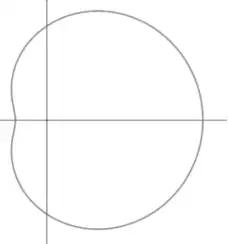 Condone cusp | B1 | 2.2a |
| (1) |
Notes
(b)
B1: Correct shape and position.
| Scheme | Marks | AO |
|---|---|---|
Area \(= 2 \times \dfrac{1}{2}\displaystyle\int_0^{\pi}\left[20(3 + 2\cos\theta)\right]^2\,\mathrm{d}\theta = 400\int_0^{\pi}\left(9 + 12\cos\theta + 4\cos^2\theta\right)\mathrm{d}\theta\) or \(= \displaystyle\int_0^{\pi}\left(3600 + 4800\cos\theta + 1600\cos^2\theta\right)\mathrm{d}\theta\) or \(\dfrac{1}{2}\displaystyle\int_0^{2\pi}\left[20(3 + 2\cos\theta)\right]^2\,\mathrm{d}\theta = 200\int_0^{2\pi}\left(9 + 12\cos\theta + 4\cos^2\theta\right)\mathrm{d}\theta\) or \(= \displaystyle\int_0^{2\pi}\left(1800 + 2400\cos\theta + 800\cos^2\theta\right)\mathrm{d}\theta\) | M1 | 3.4 |
| \(\cos^2\theta = \dfrac{1}{2} + \dfrac{1}{2}\cos 2\theta \Rightarrow\) \(A = \ldots\displaystyle\int\left(9 + 12\cos\theta + 2 + 2\cos 2\theta\right)\mathrm{d}\theta = \alpha\theta \pm \beta\sin\theta \pm \lambda\sin 2\theta\) | M1 | 3.1a |
| \(= 400\left[11\theta + 12\sin\theta + \sin 2\theta\right]\) or \(= 200\left[11\theta + 12\sin\theta + \sin 2\theta\right]\) | A1 | 1.1b |
| Using limits \(\theta = 0\) and \(\theta = \pi\) or \(\theta = 0\) and \(\theta = 2\pi\) as appropriate and subtracts the correct way round provided there is an attempt at integration \(= 400\left[11\pi - 0\right] = 4400\pi = 13823.0\ \left(\text{cm}^2\right)\) or \(= 200\left[11(2\pi) - 0\right] = 4400\pi = 13823.0\ \left(\text{cm}^2\right)\) | M1 | 1.1b |
| Volume \(=\) area \(\times 90 = 396\,000\pi = 1\,244\,070.691\ \left(\text{cm}^3\right)\) | M1 | 3.4 |
| time \(= \dfrac{1\,244\,070.691}{50\,000} = \ldots\) or volume \(= 1244\) litres therefore time \(= \dfrac{1244}{50} = \ldots\) | M1 | 2.2b |
| 25 (minutes) | A1 | 3.2a |
| (7) |
Notes
(c)
M1: Uses the model to find the area of the cross section \(2 \times \dfrac{1}{2}\displaystyle\int_0^{\pi}\left[20(3 + 2\cos\theta)\right]^2\,\mathrm{d}\theta\) or \(\dfrac{1}{2}\displaystyle\int_0^{2\pi}\left[20(3 + 2\cos\theta)\right]^2\,\mathrm{d}\theta\)
M1: Uses the identity \(\cos 2\theta = 2\cos^2\theta - 1\) to integrate to the required form.
A1: Correct integration.
M1: Uses limits \(\theta = 0\) and \(\theta = \pi\) or \(\theta = 0\) and \(\theta = 2\pi\) as appropriate and subtracts the correct way around provided there is an attempt at integration.
Note if first M1 is not awarded for incorrect limits then award this mark for their limits used.
M1: Multiplies their area by 90 (cm).
M1: Divides their volume by 50000
A1: 25 (minutes)
| Scheme | Marks | AO |
|---|---|---|
| For example Polar equation is not likely to be accurate. Some comment that the sides will not be smooth and draws an appropriate conclusion. The hole may not be uniform depth The pond may leak/ ground may absorb some water | B1 | 3.5b |
| (1) | ||
| (14 marks) |
Notes
(d)
B1: See scheme for examples. Any reference to the flow of water is B0