
A2 October 2020 Paper 1 Q1
1.
\[\mathrm{f}(z) = 3z^3 + pz^2 + 57z + q\]where \(p\) and \(q\) are real constants.
Given that \(3 - 2\sqrt{2}\,\mathrm{i}\) is a root of the equation \(\mathrm{f}(z) = 0\)
| Scheme | Marks | AO |
|---|---|---|
| \(\beta = 3 + 2\sqrt{2}\,\mathrm{i}\) is also a root | B1 | 1.2 |
| \(\alpha\beta = 17,\ \alpha + \beta = 6\) | B1 | 1.1b |
| \(\alpha\beta + \alpha\gamma + \beta\gamma = \dfrac{57}{3}\) | M1 | 1.1b |
| \(\alpha\gamma + \beta\gamma = \dfrac{57}{3} - 17 = \gamma(\alpha + \beta) = 6\gamma \Rightarrow \gamma = \ldots\) | M1 | 3.1a |
| \(\gamma = \dfrac{1}{3}\) | A1 | 2.2a |
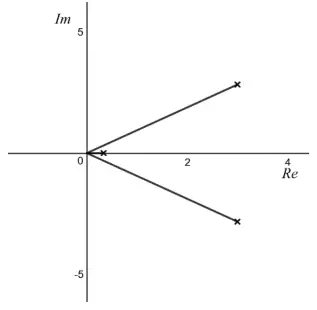 | B1 B1ft | 1.1b 1.1b |
| (7) |
Notes
(a)
B1: Identifies the correct complex conjugate as another root
B1: Correct values for the sum and product for the conjugate pair
M1: Correct application of the pair sum
M1: Identifies a complete and correct strategy for identifying the third root
A1: Deduces the correct third root
B1: \(3 \pm 2\sqrt{2}\,\mathrm{i}\) plotted correctly, in quadrants 1 and 4 which are reflections in the real axis. Do not be concerned about labelling or scaling.
B1ft: Their real root plotted correctly, in correct relative position to the two complex roots. Scales are not needed but if correct, the real root must be close to the origin compared to the complex roots.
(a) Alternative:
| Scheme | Marks | AO |
|---|---|---|
| \(\beta = 3 + 2\sqrt{2}\,\mathrm{i}\) is also a root | B1 | 1.2 |
| \(\left(z - \left(3 + 2\sqrt{2}\,\mathrm{i}\right)\right)\left(z - \left(3 - 2\sqrt{2}\,\mathrm{i}\right)\right) = z^2 - 6z + 17\) | B1 | 1.1b |
| \(\mathrm{f}(z) = \left(z^2 - 6z + 17\right)(3z + a) = 3z^3 + az^2 - 18z^2 - 6az + 51z + 17a\) | M1 | 1.1b |
| \(\Rightarrow 51 - 6a = 57 \Rightarrow a = -1 \Rightarrow \gamma = \ldots\) | M1 | 3.1a |
| \(\gamma = \dfrac{1}{3}\) | A1 | 2.2a |
| Then B1 B1ft as above | ||
| (7) |
Alternative:
B1: Identifies the correct complex conjugate as another root
B1: Correct quadratic factor obtained
M1: Expands their quadratic\(\times\)(\(3z\) + “\(a\)”) or attempts to factor out the quadratic, or use long division, leading to a factor (\(3z\) + “\(a\)”). Implied by seeing \(\left(z^2 - 6z + 17\right)(3z + a)\) with any value of \(a\) (or with their quadratic).
M1: Proceeds to extract the root from their third factor of from (\(3z\) + “\(a\)”).
A1: Deduces the correct third root. If not explicitly stated, look for it on their diagram.
B1: \(3 \pm 2\sqrt{2}\,\mathrm{i}\) plotted correctly, as above
B1ft: Their real root plotted correctly as above.
Note: some may attempt to use the factor theorem with the complex root.
\(\mathrm{f}\left(3 - 2\mathrm{i}\sqrt{2}\right) = 36 + p + q + \mathrm{i}\left(-228\sqrt{2} - 12\sqrt{2}p\right) = 0\)
2nd B1: equate real and imaginary components to 0 to get correct equations
\(36 + p + q = 0,\ -228\sqrt{2} - 12\sqrt{2}p = 0\)
1st M1: solves their equations \(\Rightarrow p = -19,\ q = -17\)
2nd M1: Solves the cubic (may be from calculator). The 1st B1 may then be implied for the second complex root, and the rest as main scheme.
| Scheme | Marks | AO |
|---|---|---|
| \(3 - 2\sqrt{2}\,\mathrm{i} + 3 + 2\sqrt{2}\,\mathrm{i} + \dfrac{1}{3} = -\dfrac{p}{3} \Rightarrow p = \ldots\) or \(\left(3 - 2\sqrt{2}\,\mathrm{i}\right)\left(3 + 2\sqrt{2}\,\mathrm{i}\right) \times \dfrac{1}{3} = -\dfrac{q}{3} \Rightarrow q = \ldots\) | M1 | 3.1a |
| \(p = -19\) or \(q = -17\) | A1 | 1.1b |
| \(p = -19\) and \(q = -17\) | A1 | 1.1b |
| (3) | ||
| (10 marks) |
Notes
(b)
M1: Correct strategy used for identifying at least one of \(p\) or \(q\)
A1: At least one value correct
A1: Both values correct
(b) Alternative:
| Scheme | Marks | AO |
|---|---|---|
| \(\mathrm{f}(z) = \left(z^2 - 6z + 17\right)(3z - 1) = 3z^3 + pz^2 + 57z + q\) \(\Rightarrow p = \ldots,\ q = \ldots\) | M1 | 3.1a |
| \(p = -19\) or \(q = -17\) | A1 | 1.1b |
| \(p = -19\) and \(q = -17\) | A1 | 1.1b |
| (3) |
Alternative:
M1: Correct strategy by expanding their quadratic and linear factors to identifying at least one of \(p\) or \(q\)
A1: At least one value correct
A1: Both values correct