
AS June 2024 Q4
4.
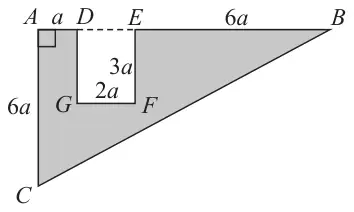
The uniform triangular lamina \(ABC\) has \(AB\) perpendicular to \(AC\), \(AB = 9a\) and \(AC = 6a\). The point \(D\) on \(AB\) is such that \(AD = a\).
The rectangle \(DEFG\), with \(DE = 2a\) and \(EF = 3a\), is removed from the lamina to form the template shown shaded in Figure 3.
The distance of the centre of mass of the template from \(AC\) is \(d\).
The template is freely suspended from \(A\) and hangs in equilibrium with \(AB\) at an angle \(\theta^\circ\) to the downward vertical through \(A\).
A new piece, of exactly the same size and shape as the template, is cut from a lamina of a different uniform material. The template and the new piece are joined together to form the model shown in Figure 4. Both parts of the model lie in the same plane.
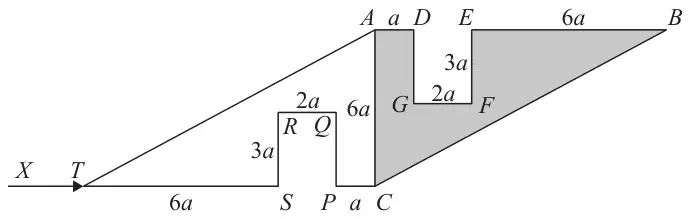
The weight of \(CPQRSTA\) is \(W\)
The weight of \(ADGFEBC\) is \(4W\)
The model is freely suspended from \(A\).
A horizontal force of magnitude \(X\), acting in the same vertical plane as the model, is now applied to the model at \(T\) so that \(AC\) is vertical, as shown in Figure 4.
| Scheme | Marks | AO |
|---|---|---|
| M(\(AC\)) | M1 | 2.1 |
| \((27-6)a^2 d = 27a^2 \times 3a - 6a^2 \times 2a\ \left(= 69a^3\right)\) | A1 | 1.1b |
| \(\Rightarrow d = \dfrac{69}{21}a = \dfrac{23}{7}a\) * | A1* | 2.2a |
| (3) |
Notes
M1: Take moments about \(AC\) or a parallel axis. Dimensionally correct terms. Correct number of terms.
A1: Correct unsimplified equation
A1*: Obtain the given answer including “\(d =\)” from correct working
| Scheme | Marks | AO |
|---|---|---|
| M(\(AB\)) | M1 | 3.1a |
| \((27-6)a^2\bar{y} = 27a^2 \times 2a - 6a^2 \times 1.5a\ \left(= 45a^3\right)\) | A1 | 1.1b |
| \(\bar{y} = \dfrac{45}{21}a = \dfrac{15}{7}a\) | A1 | 1.1b |
| \(\tan\theta^\circ = \dfrac{15}{23}\) | M1 | 3.1a |
| \(\theta = 33\) \((\theta = 33.111..)\) | A1 | 1.1b |
| (5) |
Notes
M1: Take moments about \(AB\) or a parallel axis. Dimensionally correct terms. Correct number of terms.
A1: Correct unsimplified equation
A1: Correct vertical distance. Any equivalent form
M1: Correct use of trig to find a relevant angle
A1: 2 sf or better (33.111…)
| Scheme | Marks | AO |
|---|---|---|
| M(\(A\)) | M1 | 3.1a |
| \(6aX + \dfrac{23}{7}a \times W = \dfrac{23}{7}a \times 4W\) | A1 A1 | 1.1b 1.1b |
| \(X = \dfrac{23}{14}W\) | A1 | 1.1b |
| (4) | ||
| (12 marks) |
Notes
M1: Complete method to form an equation in \(X\) e.g by taking moments about \(A\).
\(5W\) must be split correctly and equation must be dimensionally correct.
A1: Unsimplified equation with at most one error
A1: Correct unsimplified equation
A1: \(1.6W\) or better \((1.6428\ldots W)\) (corrected from the printed mark scheme: it prints “\(3.1W\) or better \((3.1428\ldots W)\)”, which does not match \(X = \dfrac{23}{14}W\))