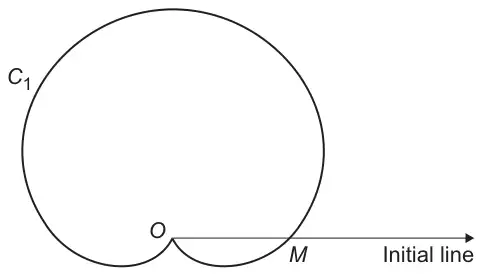
17 The curve \(C_1\) has polar equation \(r = 2a(1 + \sin\theta)\) for \(-\pi \lt \theta \leqslant \pi\) where \(a\) is a positive constant.
The point \(M\) lies on \(C_1\) and the initial line.
(a) Write down, in terms of \(a\), the polar coordinates of \(M\) [1 mark]
(b) \(N\) is the point on \(C_1\) that is furthest from the pole \(O\)
Find, in terms of \(a\), the polar coordinates of \(N\) [2 marks]
(c) The curve \(C_2\) has polar equation \(r = 3a\) for \(-\pi \lt \theta \leqslant \pi\) \(C_2\) intersects \(C_1\) at points \(P\) and \(Q\)
Show that the area of triangle \(NPQ\) can be written in the form
\[m\sqrt{3}a^2\]
where \(m\) is a rational number to be determined. [5 marks]
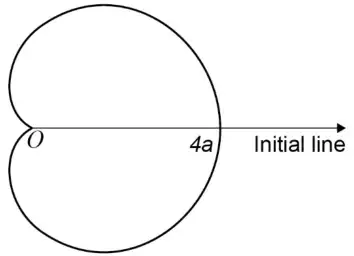
(d) On the initial line below, sketch the graph of \(r = 2a(1 + \cos\theta)\) for \(-\pi \lt \theta \leqslant \pi\)
Include the polar coordinates, in terms of \(a\), of any intersection points with the initial line. [2 marks]
Mark scheme (a)
Scheme
Marks
AO
States correct polar coordinates. Condone \((0, 2a)\) after seeing \(r = 2a\) and \(\theta = 0\)
B1
1.1b
(1)
Typical solution
\[r = 2a(1 + \sin 0) = 2a\]\[M = (2a, 0)\]
Mark scheme (b)
Scheme
Marks
AO
Substitutes \(\sin\theta = 1\) PI by \(r = 4a\) or \(\theta = \frac{\pi}{2}\)
M1
3.1a
Obtains the correct polar coordinates. Condone \(\left(\frac{\pi}{2}, 4a\right)\) after \(r = 4a\) and \(\theta = \frac{\pi}{2}\) Condone \(\left(\frac{\pi}{2}, 4a\right)\) if \((0, 2a)\) has been penalised in (a).
Forms an equation by equating the two polar equations.
M1
3.1a
Obtains at least one correct \(\theta\) value for \(P\) or \(Q\) Implied by a correct area.
A1
1.1b
Calculates the \(x\)-coordinate of \(P\) or \(Q\), ie \(x = 3a\cos\theta\) Implied by \(6a\cos\theta\) for the length \(PQ\). Or calculates the \(y\)-coordinate of \(P\) or \(Q\), ie \(y = 3a\sin\theta\)
M1
1.1a
Calculates the required area (or half of the required area). ie \(\frac{1}{2} \times (y_N - y_P) \times 6a\cos\theta\)