
AS October 2020 Q3
3. Two teams, A and B, each have three team members. One member of Team A will compete against one member of Team B for 10 rounds of a competition. None of the rounds can end in a draw.
Table 1 shows, for each pairing, the expected number of rounds that the member of Team A will win minus the expected number of rounds that the member of Team B will win. These numbers are the scores awarded to Team A. This competition between Teams A and B is a zero-sum game. Each team must choose one member to play. Each team wants to choose the member who will maximise its score.
| Team B | ||||
|---|---|---|---|---|
| Paul | Qaasim | Rashid | ||
| Team A | Mischa | \(4\) | \(-6\) | \(2\) |
| Noel | \(0\) | \(-2\) | \(6\) | |
| Olive | \(-6\) | \(2\) | \(0\) | |
Table 1
Table 1 models this zero-sum game.
At the last minute, Rashid is ill and is therefore unavailable for selection by Team B.
| Scheme | Marks | AO |
|---|---|---|
| (i) 7 | B1 | 3.4 |
| (ii) 6 | B1 | 3.4 |
| (2) |
Notes
(i) B1: cao
(ii) B1: cao
| Scheme | Marks | AO |
|---|---|---|
| (i) Row minima: \(-6, -2, -6\) max is \(-2\) Column maxima: \(4, 2, 6\) min is \(2\) | M1 A1 | 1.1b 1.1b |
| Play-safe for Team A is Noel and play-safe for Team B is Qaasim | A1 | 1.1b |
| (ii) Row(maximin) \(\neq\) Col(minimax) therefore game is not stable | B1 | 2.4 |
| (4) |
Notes
(i) M1: finding row minimums and column maximums – condone one error
A1: row minima and column maxima correct
A1: correct play safes for both teams
(ii) B1: row maximin (\(-2\)) \(\neq\) col minimax (2) so not stable
| Scheme | Marks | AO |
|---|---|---|
| e.g. If Team A plays safe then Team B should also play their play-safe option which is Qaasim as by playing Qaasim they will gain 2 compared to gaining zero (if playing Paul) or losing 6 (if playing Rashid) | B1 | 2.4 |
| (1) |
Notes
B1: cao (or equivalent – e.g. Qaasim because \(-2\) is the lowest value in Noel’s row) – explanation must involve consideration of values and not just (for example) a general statement that Qaasim will gain the most
| Scheme | Marks | AO |
|---|---|---|
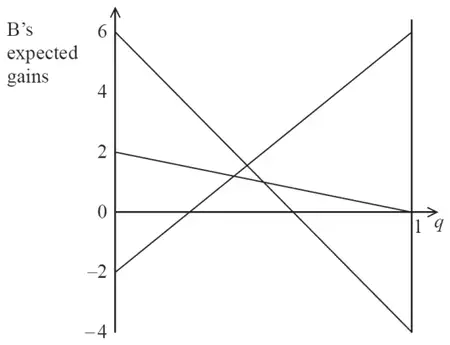
| Let B play Paul with probability \(q\) and Qaasim with probability \(1 - q\) | B1 | 3.3 |
| If \(A\) plays Mischa, \(B\)’s gains are \(-\left(4q + (-6)(1-q)\right) = 6 - 10q\) If \(A\) plays Noel, \(B\)’s gains are \(-\left(-2(1-q)\right) = 2 - 2q\) If \(A\) plays Olive, \(B\)’s gains are \(-\left(-6q + 2(1-q)\right) = -2 + 8q\) | M1 A1 | 1.1b 1.1b |
 | M1 A1 | 1.1b 1.1b |
| \(2 - 2q = -2 + 8q \Rightarrow q = 2/5\) | A1 | 1.1b |
| Team B should play Paul with probability 0.4 and play Qaasim with probability 0.6 | A1ft | 3.2a |
| (7) | ||
| (14 marks) |
Notes
B1: defining variable \(q\)
M1: setting up three expressions in terms of \(q\)
A1: all three expressions correct – allow correct un-simplified expressions for this mark
M1: axes correct, at least one line correctly drawn for their expressions
A1: correct graph
A1: using the graph to obtain the correct probability expressions leading to the correct value of \(q\)
A1ft: interpret their value of \(q\) in the context of the question – must refer to play/choose and the two players
Note that in (d) candidates may use \(p\) (or another letter) instead of \(q\) which is fine for full marks. Also, the three expressions may be the negative of what is giving in the main scheme (e.g. \(10q - 6\), \(2q - 2\) and \(-8q + 2\)) and this is fine for the first 5 marks in (d). For the final two marks though they would need to consider the optimal point reading from the top (rather than the bottom) of their graph. No follow through for the final mark if they do not read off their graph correctly.