
AS October 2020 Q5
5.
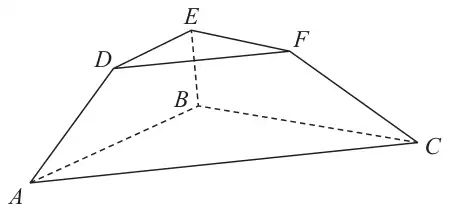
Figure 3 shows a solid display stand with parallel triangular faces \(ABC\) and \(DEF\).
Triangle \(DEF\) is similar to triangle \(ABC\).
With respect to a fixed origin \(O\),
the points \(A\), \(B\) and \(C\) have coordinates \((3, -3, 1)\), \((-5, 3, 3)\) and \((1, 7, 5)\) respectively and the points \(D\), \(E\) and \(F\) have coordinates \((2, -1, 8)\), \((-2, 2, 9)\) and \((1, 4, 10)\) respectively.
The units are in centimetres.
| Scheme | Marks | AO |
|---|---|---|
| \(\pm\overrightarrow{DE} = \pm\begin{pmatrix}-4\\ 3\\ 1\end{pmatrix},\ \pm\overrightarrow{DF} = \pm\begin{pmatrix}-1\\ 5\\ 2\end{pmatrix},\ \pm\overrightarrow{EF} = \pm\begin{pmatrix}3\\ 2\\ 1\end{pmatrix}\) | M1 | 1.1b |
| Area \(= \dfrac{1}{2}\left|\overrightarrow{DE} \times \overrightarrow{DF}\right| = \begin{vmatrix}\mathbf{i} & \mathbf{j} & \mathbf{k}\\ -4 & 3 & 1\\ -1 & 5 & 2\end{vmatrix} = \dfrac{1}{2}\begin{vmatrix}1\\ 7\\ -17\end{vmatrix} = \dfrac{1}{2}\sqrt{1^2 + 7^2 + 17^2}\) | M1 | 1.1b |
| \(= \dfrac{1}{2}\sqrt{339}\,(\text{cm}^2)\ *\) | A1* | 2.2a |
| (3) |
Notes
M1: Attempts to find 2 edges of triangle \(DEF\). Must be subtracting components.
M1: Uses the correct process of the vector product to attempt the area including use of Pythagoras
A1*: Deduces the correct area with no errors
Alternative for (a) using trigonometry
| Scheme | Marks | AO |
|---|---|---|
| \(\pm\overrightarrow{DE} = \pm\begin{pmatrix}-4\\ 3\\ 1\end{pmatrix},\ \pm\overrightarrow{DF} = \pm\begin{pmatrix}-1\\ 5\\ 2\end{pmatrix},\ \pm\overrightarrow{EF} = \pm\begin{pmatrix}3\\ 2\\ 1\end{pmatrix}\) | M1 | 1.1b |
| \(DE = \sqrt{26},\ DF = \sqrt{30},\ EF = \sqrt{14}\) \(\cos DEF = \dfrac{26 + 14 - 30}{2\sqrt{26}\sqrt{14}} \Rightarrow DEF = \cos^{-1}\dfrac{5}{\sqrt{26}\sqrt{14}}\) \(\Rightarrow \text{Area } DEF = \dfrac{1}{2} \times \sqrt{26}\sqrt{14}\sqrt{1 - \dfrac{25}{364}} = \ldots\) | M1 | 1.1b |
| \(= \dfrac{1}{2} \times \sqrt{26}\sqrt{14}\dfrac{\sqrt{339}}{\sqrt{26}\sqrt{14}} = \dfrac{1}{2}\sqrt{339}\ *\) | A1 | 2.2a |
M1: Attempts to find 3 edges of triangle \(DEF\). Must be subtracting components.
M1: A complete method for the area. Allow work in decimals for this mark but must work in exact terms to obtain the A mark
A1*: Deduces the correct area with no errors and no decimal work
| Scheme | Marks | AO |
|---|---|---|
| Attempt to find “\(T\)”, the 4th vertex of the tetrahedron e.g. \(\begin{pmatrix}2\\ -1\\ 8\end{pmatrix} + \lambda\overrightarrow{AD} = \begin{pmatrix}1\\ 4\\ 10\end{pmatrix} + \mu\overrightarrow{CF} \Rightarrow \lambda = \ldots \text{ or } \mu = \ldots\) or e.g. \(DF = \sqrt{30},\ AC = \sqrt{120} \Rightarrow \text{ Linear SF} = 2\) \(AT = 2AD \Rightarrow T \text{ is } \ldots\) | M1 | 3.1b |
| \(T(1, 1, 15)\) | A1 | 1.1b |
| e.g. \(\overrightarrow{AT} = \begin{pmatrix}-2\\ 4\\ 14\end{pmatrix},\ \overrightarrow{BT} = \begin{pmatrix}6\\ -2\\ 12\end{pmatrix},\ \overrightarrow{CT} = \begin{pmatrix}0\\ -6\\ 10\end{pmatrix}\) \(\overrightarrow{AT} \times \overrightarrow{BT} \bullet \overrightarrow{CT} = \begin{vmatrix}-2 & 4 & 14\\ 6 & -2 & 12\\ 0 & -6 & 10\end{vmatrix} = \ldots\) | M1 | 1.1b |
| e.g. \(V = \dfrac{1}{6}\left|-2(-20 + 72) - 4(60) + 14(-36)\right| \left(= \dfrac{424}{3}\right)\) | A1 | 1.1b |
| \(\dfrac{1}{6}\overrightarrow{DT} \times \overrightarrow{ET} \bullet \overrightarrow{FT} = \begin{vmatrix}-1 & 2 & 7\\ 3 & -1 & 6\\ 0 & -3 & 5\end{vmatrix} = \dfrac{1}{6}\left|-1(13) - 2(15) + 7(-9)\right| \left(= \dfrac{53}{3}\right)\) or length scale factor \(= 2 \Rightarrow\) volume scale factor \(= 8\) | M1 | 3.1b |
| e.g. Volume \(= \dfrac{424}{3} - \dfrac{53}{3} = \ldots\) or Volume \(= \dfrac{7}{8} \times \dfrac{424}{3} = \ldots\) or Volume \(= 7 \times \dfrac{53}{3} = \ldots\) | dM1 | 3.1a |
| \(= \dfrac{371}{3}\ \text{cm}^3\) | A1 | 1.1b |
| (7) | ||
| (10 marks) |
Notes
M1: Adopts a correct strategy to find the fourth vertex of the tetrahedron e.g. finding where two edges intersect or uses the linear scale factor
A1: Correct coordinates for the other vertex
M1: Uses the information from the design to attempt a scalar triple product between appropriate vectors to find the volume of the smaller or larger tetrahedron.
A1: Correct volume for either tetrahedron
M1: Makes further progress with the solution by finding the volume of the other tetrahedron or calculates the volume scale factor using an appropriate method. E.g. using ratios or by finding the area of triangle \(DEF\) and comparing with triangle \(ABC\)
dM1: Completes the problem by finding the required volume of the frustum. Depends on all previous method marks
A1: Correct answer
Alternative for part (b) – splits into 4 tetrahedra
This example takes \(M\) as the midpoint of \(AC\) and finds the volume of \(ABMD\), \(MBFC\), \(DMFB\), \(EDFB\)
| Scheme | Marks | AO |
|---|---|---|
| \(Vol_{ABMD} = \dfrac{1}{6}\overrightarrow{AB} \times \overrightarrow{AD} \bullet \overrightarrow{AM} = \ldots\) | M1 | 3.1b |
| \(= \dfrac{106}{3}\) | A1 | 1.1b |
| \(Vol_{MBFC} = \dfrac{1}{6}\overrightarrow{BF} \times \overrightarrow{BC} \bullet \overrightarrow{BM} = \ldots\left(\dfrac{106}{3}\right)\) \(Vol_{DMFB} = \dfrac{1}{6}\overrightarrow{DF} \times \overrightarrow{DM} \bullet \overrightarrow{DB} = \ldots\left(\dfrac{106}{3}\right)\) | M1 A1 | 1.1b 1.1b |
| \(Vol_{EDFB} = \dfrac{1}{6}\overrightarrow{ED} \times \overrightarrow{EF} \bullet \overrightarrow{EB} = \ldots\left(\dfrac{53}{3}\right)\) | M1 | 3.1b |
| \(ABMD + MBFC + DMFB + EDFB = 3 \times \dfrac{106}{3} + \dfrac{53}{3}\) | dM1 | 3.1a |
| \(= \dfrac{371}{3}\ \text{cm}^3\) | A1 | 1.1b |
M1: Adopts a correct strategy to find the volume of one tetrahedron
A1: Any correct volume
M1: Adopts a correct strategy to find the volumes of at least 2 other tetrahedra
A1: Correct volumes
M1: Makes further progress with the solution by finding the volume of all relevant tetrahedra
dM1: Completes the problem by finding the required volume of the frustum. Depends on all previous method marks
A1: Correct answer