
AS June 2024 Paper 1 Q5
5. Given that on an Argand diagram the locus of points defined by \(|z + 5 - 12\mathrm{i}| = 10\) is a circle,
The set of points \(A\) is defined by
\[A = \left\{z : 0 \leqslant \arg(z + 5 - 20\mathrm{i}) \leqslant \pi\right\} \cap \left\{z : |z + 5 - 12\mathrm{i}| \leqslant 10\right\}\]| Scheme | Marks | AO |
|---|---|---|
| (i) \((-5, 12)\) or \(-5 + 12\mathrm{i}\) | B1 | 1.1b |
| (ii) \(r = 10\) | B1 | 1.1b |
| (2) |
Notes
(a)(i) B1: Correct centre, condone \((-5, 12\mathrm{i})\)
(a)(ii) B1: Correct radius
| Scheme | Marks | AO |
|---|---|---|
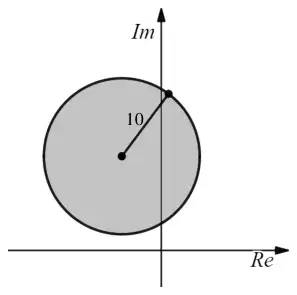 | B1ft | 1.1b |
| (1) |
Notes
B1ft: A circle drawn with the inside shaded. Follow through their centre and radius.
The centre must be in the correct quadrant and intercept the axes as appropriate.
If they have the correct centre and radius then the centre must be in the second quadrant and the circle must only intercept the imaginary-axis. If diagram is correct consider this a restart B1.
| Scheme | Marks | AO |
|---|---|---|
| \(OC = \sqrt{5^2 + 12^2}\) | M1 | 1.1b |
| \(|z|_{\max} = \sqrt{5^2 + 12^2} + 10\) | M1 | 3.1a |
| = 23 | A1 | 1.1b |
| (3) |
Notes
M1: Calculates the distance from \(O\) to the centre of their circle.
M1: Fully correct strategy for the maximum. E.g. Finds distance from \(O\) to centre of their circle and adds their radius.
A1: Correct answer.
Correct answer with no working and following a correct centre and radius scores M1M1A1
Alternative
| Scheme | Marks | AO |
|---|---|---|
| \(y = -\dfrac{12}{5}x\) and \((x + 5)^2 + (y - 12)^2 = 10^2\) \((x + 5)^2 + \left(-\dfrac{12}{5}x - 12\right)^2 = 10^2 \Rightarrow x = \ldots\) Or \(\tan\theta = \dfrac{5}{12} \Rightarrow \theta = \ldots\{22.61..\}\quad x = -5 - 10\sin\theta = \ldots\) | M1 | 1.1b |
| \(x = \text{‘}-\dfrac{115}{13}\text{’} \Rightarrow y = \ldots\left\{\dfrac{276}{13}\right\}\) \(|z|_{\max} = \sqrt{\left(-\dfrac{115}{13}\right)^2 + \left(\dfrac{276}{13}\right)^2}\) Or \(x = \text{‘}-\dfrac{15}{13}\text{’} \Rightarrow y = \ldots\left\{\dfrac{36}{13}\right\}\) \(|z|_{\max} = \sqrt{\left(-\dfrac{15}{13}\right)^2 + \left(\dfrac{36}{13}\right)^2} + 2 \times 10\) | M1 | 3.1a |
| = 23 | A1 | 1.1b |
| (3) |
M1: Finds the equation of the line from the origin to centre and the Cartesian equation of the circle. Solves simultaneously to find the \(x\) values (or \(y\)) where the line intersects the circle.
M1: Selects the \(x\) coordinate to give the largest distance, find the corresponding \(y\) value and then the distance from the origin.
Selects the \(x\) coordinate to give the smallest distance, find the corresponding \(y\) value and then adds on 2 times the radius.
A1: Correct answer
| Scheme | Marks | AO |
|---|---|---|
| \(\left\{z : 0 \leqslant \arg(z + 5 - 20\mathrm{i}) \leqslant \pi\right\} \Rightarrow y = 20\) \(\Rightarrow (x + 5)^2 + 8^2 = 100 \Rightarrow x = \ldots\) AND finds an angle \(\cos\theta = \dfrac{10^2 + 10^2 - 12^2}{2 \times 10 \times 10} = 0.28\) Or \(a^2 = 10^2 - 8^2 \Rightarrow a = \ldots\{6\}\quad \sin\left(\dfrac{1}{2}\theta\right) = \dfrac{6}{10}\) Or \(\cos\left(\dfrac{1}{2}\theta\right) = \dfrac{8}{10}\) 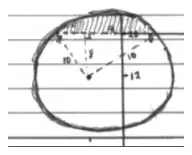 | M1 | 3.1a |
| \(\theta = 1.287\ldots\) or 73.7° or \(\dfrac{1}{2}\theta = 0.6435\ldots\) or 36.9° | A1 | 1.1b |
| Area \(= \dfrac{1}{2} \times 10^2 \times \theta - \dfrac{1}{2} \times 12 \times 8\) angle in radians Area \(= \pi \times 10^2 \times \dfrac{\theta}{360} - \dfrac{1}{2} \times 12 \times 8\) angle in degrees or Area \(= \dfrac{1}{2} \times 10^2 \times \theta - \dfrac{1}{2} \times 10 \times 10 \times \sin\theta\) angle in radians Area \(= \pi \times 10^2 \times \dfrac{\theta}{360} - \dfrac{1}{2} \times 10 \times 10 \times \sin\theta\) angle in degrees Or Area \(= 2\left[\dfrac{1}{2} \times 10^2 \times \theta - \dfrac{1}{2} \times 8 \times 6\right]\) | M1 | 3.1a |
| = awrt 16.4 | A1 | 1.1b |
| (4) | ||
| (10 marks) |
Notes
M1: Recognises that \(\left\{z : 0 \leqslant \arg(z + 5 - 20\mathrm{i}) \leqslant \pi\right\}\) represents the line \(y = 20\) and uses this with the circle in an attempt to find the angle or half angle at the centre.
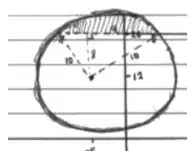
A1: Correct value for the angle or half angle at the centre.
M1: Fully correct strategy for the area of the segment using their values.
A1: Awrt 16.4
Note: finding the area of the major segment using \(100\pi - 16.4 = \ldots\) scores M1A1M1A0