
AS June 2025 Paper 1 Q5
5. A complex number \(z\) is represented by the point \(P\) in the complex plane.
Given that \(z\) satisfies
\[|z - 1| = 1\]Given that \(z\) also satisfies
\[\arg(z + 1) = \theta\]| Scheme | Marks | AO |
|---|---|---|
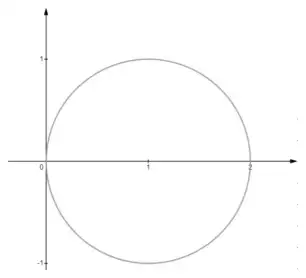 Circle Circle with clear indication that the centre is (1, 0) and the radius is 1 | M1 A1 | 1.2 1.1b |
| (2) |
Notes
M1: Recalls that the locus represents a circle
A1: Circle with centre (1, 0) and radius 1, ignore any tangents drawn
| Scheme | Marks | AO |
|---|---|---|
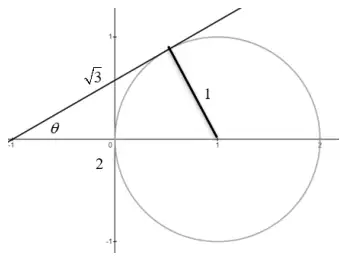 \(\sin\theta = \dfrac{1}{2} \Rightarrow \theta = \ldots\) | M1 | 3.1a |
| Alternative 1 May use \(m = \tan\theta\) \(y = \tan\theta(x + 1)\) and \((x - 1)^2 + y^2 = 1\) \(x^2 - 2x + 1 + \left[\tan\theta(x + 1)\right]^2 = 1\) \(x^2 - 2x + 1 + x^2\tan^2\theta + 2x\tan^2\theta + \tan^2\theta = 1\) \(\left(\tan^2\theta + 1\right)x^2 + \left(2\tan^2\theta - 2\right)x + \tan^2\theta = 0\) \(b^2 - 4ac = \left(2\tan^2\theta - 2\right)^2 - 4\left(\tan^2\theta + 1\right)\left(\tan^2\theta\right) = 0\) \(\tan^2\theta = \dfrac{1}{3} \Rightarrow \tan\theta = \dfrac{1}{\sqrt{3}} \Rightarrow \theta = \ldots\) | ||
| \(\{\theta =\}\ \dfrac{\pi}{6}\) or 30 or \(\arg(z + 1) = \dfrac{\pi}{6}\) or 30 | A1 | 1.1b |
| \(\{\theta =\}\ -\dfrac{\pi}{6}\) or \(\dfrac{11\pi}{6}\) or \(-30\) or 330 or \(\arg(z + 1) = -\dfrac{\pi}{6}\) or \(\dfrac{11\pi}{6}\) or \(-30\) or 330 | A1 | 2.2a |
| (3) |
Notes
(Corrected from the printed mark scheme: in Alternative 1 the term \(2x\tan^2\theta\) is printed as \(2x\tan^2 x\).)
M1: Complete method to find one possible value of \(\theta\)
Alternative 1: condone slips with algebra as long as intention is clear
A1: One correct value \(\theta\)
A1: Deduces the other correct value of \(\theta\) and no other incorrect angles
| Scheme | Marks | AO |
|---|---|---|
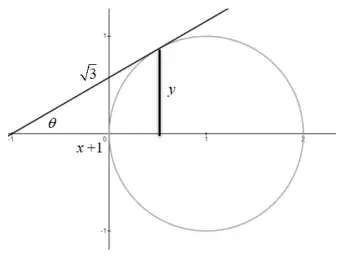 \(\sin\theta = \dfrac{y}{\sqrt{3}} \Rightarrow y = \ldots\) Alternative 1 Alternative 2 | M1 | 3.1a |
| \(z = \dfrac{1}{2} + \dfrac{\sqrt{3}}{2}\mathrm{i}\) | A1 | 1.1b |
| \(z = \dfrac{1}{2} - \dfrac{\sqrt{3}}{2}\mathrm{i}\) | A1ft | 2.2a |
| (3) | ||
| (8 marks) |
Notes
M1: A correct method to find a complex number using one of their values of \(\theta\)
A1: One correct complex number check special case for coordinates only
A1ft: Deduces the other correct complex number. Follow through on \(z = a + b\mathrm{i}\) so scored for \(z = a - b\mathrm{i}\) as long as the method mark is scored
Special case:
If leave as two correct coordinates or give values for \(x\) and \(y\) then SC M1 A1 A0
Alternative
| Scheme | Marks | AO |
|---|---|---|
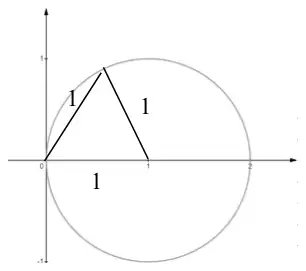 Using equilateral triangles to find \(z = \ldots\) \[z = 1\left(\cos\left(\pm\frac{\pi}{3}\right) + \mathrm{i}\sin\left(\pm\frac{\pi}{3}\right)\right)\] | M1 | 3.1a |
| \(z = \dfrac{1}{2} + \dfrac{\sqrt{3}}{2}\mathrm{i}\) | A1 | 1.1b |
| \(z = \dfrac{1}{2} - \dfrac{\sqrt{3}}{2}\mathrm{i}\) | A1ft | 2.2a |