
A2 October 2021 Paper 1 Q9
9.
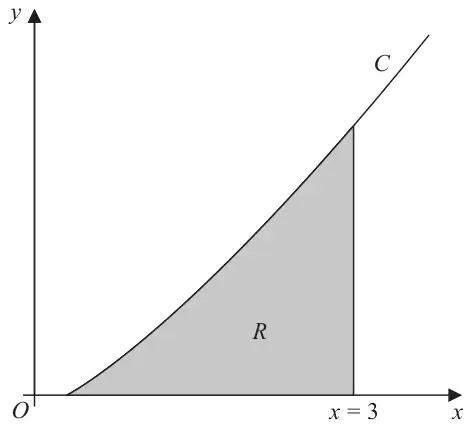
Figure 1 shows a sketch of part of the curve \(C\) with equation
\[y = \frac{4}{15}x\operatorname{arcosh} x \qquad\qquad x \geqslant 1\]The finite region \(R\), shown shaded in Figure 1, is bounded by the curve \(C\), the \(x\)-axis and the line with equation \(x = 3\)
| Scheme | Marks | AO |
|---|---|---|
| \(\displaystyle\int\frac{x^2}{\sqrt{x^2 - 1}}\,\mathrm{d}x \to \int\mathrm{f}(u)\,\mathrm{d}u\) Uses the substitution \(x = \cosh u\) fully to achieve an integral in terms of \(u\) only, including replacing the \(\mathrm{d}x\) | M1 | 3.1a |
| \(\displaystyle\int\frac{\cosh^2 u}{\sqrt{\cosh^2 u - 1}}\sinh u\,(\mathrm{d}u)\) | A1 | 1.1b |
| Uses correct identities \(\cosh^2 u - 1 = \sinh^2 u\) and \(\cosh 2u = 2\cosh^2 u - 1\) to achieve an integral of the form \(A\displaystyle\int(\cosh 2u \pm 1)\,\mathrm{d}u \qquad A \gt 0\) | M1 | 3.1a |
| Integrates to achieve \(A\left(\pm\dfrac{1}{2}\sinh 2u \pm u\right)(+c) \qquad A \gt 0\) | M1 | 1.1b |
| Uses the identity \(\sinh 2u = 2\sinh u\cosh u\) and \(\cosh^2 u - 1 = \sinh^2 u\) \(\to \sinh 2u = 2x\sqrt{x^2 - 1}\) | M1 | 2.1 |
| \(\dfrac{1}{2}\left[x\sqrt{x^2 - 1} + \operatorname{arcosh} x\right] + k\) * cso | A1* | 1.1b |
| (6) |
Notes
M1: Uses the substitution \(x = \cosh u\) fully to achieve an integral in terms of \(u\) only. Must have replaced the \(\mathrm{d}x\) but allow if the \(\mathrm{d}u\) is missing.
A1: Correct integral in terms of \(u\). (Allow if the \(\mathrm{d}u\) is missing.)
M1: Uses correct identities \(\cosh^2 u - 1 = \sinh^2 u\) and \(\cosh 2u = 2\cosh^2 u - 1\) to achieve an integrand of the required form
M1: Integrates to achieve the correct form, may be sign errors.
M1: Uses the identities \(\sinh 2u = 2\sinh u\cosh u\) and \(\cosh^2 u - 1 = \sinh^2 u\) to attempt to find \(\sinh 2u\) in terms of \(x\). If using exponentials there must be a full and complete method to attempt the correct form.
A1*: Achieves the printed answer with no errors seen, cso
NB attempts at integration by parts are not likely to make progress – to do so would need to split the integrand as \(x\dfrac{x}{\sqrt{x^2 - 1}}\). If you see any attempts that you feel merit credit, use review.
| Scheme | Marks | AO |
|---|---|---|
| Uses integration by parts the correct way around to achieve \(\displaystyle\int\frac{4}{15}x\operatorname{arcosh} x\,\mathrm{d}x = Px^2\operatorname{arcosh} x - Q\int\frac{x^2}{\sqrt{x^2 - 1}}\,\mathrm{d}x\) | M1 | 2.1 |
| \(= \dfrac{4}{15}\left(\dfrac{1}{2}x^2\operatorname{arcosh} x - \dfrac{1}{2}\displaystyle\int\frac{x^2}{\sqrt{x^2 - 1}}\,\mathrm{d}x\right)\) | A1 | 1.1b |
| \(= \dfrac{4}{15}\left(\dfrac{1}{2}x^2\operatorname{arcosh} x - \dfrac{1}{2}\left(\dfrac{1}{2}\left[x\sqrt{x^2 - 1} + \operatorname{arcosh} x\right]\right)\right)\) | B1ft | 2.2a |
| Uses the limits \(x = 1\) and \(x = 3\) the correct way around and subtracts \(= \dfrac{4}{15}\left(\dfrac{1}{2}(3)^2\operatorname{arcosh} 3 - \dfrac{1}{2}\left(\dfrac{1}{2}\left[3\sqrt{(3)^2 - 1} + \operatorname{arcosh} 3\right]\right)\right) - \dfrac{4}{15}(0)\) | dM1 | 1.1b |
| \(= \dfrac{4}{15}\left(\dfrac{9}{2}\ln\left(3 + \sqrt{8}\right) - \dfrac{3\sqrt{8}}{4} - \dfrac{1}{4}\ln\left(3 + \sqrt{8}\right)\right)\) \(= \dfrac{1}{15}\left[17\ln\left(3 + 2\sqrt{2}\right) - 6\sqrt{2}\right]\) * | A1* | 1.1b |
| (5) | ||
| (11 marks) |
Notes
M1: Uses integration by parts the correct way around to achieve the required form.
A1: Correct integration by parts
B1ft: Deduces the integral by using the result from part (a). Follow through on their ‘\(uv\)’
dM1: Dependent on previous method mark. Uses the limits \(x = 1\) and \(x = 3\) the correct way around and subtracts
A1*cso: Achieves the printed answer with at least one intermediate step showing the evaluation of the arcosh 3, and no errors seen.