
A2 June 2022 Paper 1 Q1
1.
\[\mathrm{f}(z) = z^3 + az + 52 \qquad \text{where } a \text{ is a real constant}\]Given that \(2 - 3\mathrm{i}\) is a root of the equation \(\mathrm{f}(z) = 0\)
| Scheme | Marks | AO |
|---|---|---|
| \(2 + 3\mathrm{i}\) | B1 | 1.1b |
| (1) |
Notes
B1: \(2 + 3\mathrm{i}\)
| Scheme | Marks | AO |
|---|---|---|
| (i) \(z^* = 2 + 3\mathrm{i}\) so \(z + z^* = 4,\ zz^* = 13\) \(z + z^* + \alpha = 0 \Rightarrow \alpha = \ldots\) or \(\alpha zz^* = -52 \Rightarrow \alpha = -\dfrac{52}{\text{``}13\text{''}} = \ldots\) or \(z^2 - (\text{sum roots})z + (\text{product roots}) = 0\) or \(\bigl(z - (2 + 3\mathrm{i})\bigr)\bigl(z - (2 - 3\mathrm{i})\bigr) = \ldots\) \(\Rightarrow \left(z^2 - 4z + 13\right)\underline{(z + 4)} \Rightarrow z = \ldots\) | M1 | 3.1a |
| \(z = 2 \pm 3\mathrm{i},\ -4\) | A1 | 1.1b |
| (ii) \(\left(z^2 - 4z + 13\right)(z + 4)\) expands the brackets to find value for \(a\) Or \(a\) = pair sum \(= -4(2 + 3\mathrm{i} + 2 - 3\mathrm{i}) + 13 = \ldots\) Or \(\mathrm{f}(-4)/\mathrm{f}(2 \pm 3\mathrm{i}) = 0 \Rightarrow \ldots \Rightarrow a = \ldots\) | M1 | 1.1b |
| \(a = -3\) | A1 | 2.2a |
| (4) |
Notes
(i)
M1: A complete method to find the third root. E.g. forms the quadratic factor and uses this to find the linear factor leading to roots. Alternatively uses sum of roots \(= 0\) or product of roots \(= \pm 52\) (condone sign error) with their complex roots to find the third. Note they may have used the factor theorem to find \(a\) first, which is fine. If they have found \(a\) first, then the correct third root seen implies this mark. The method may be implied by the third root seen on the diagram.
A1: Correct roots, all three must be clearly stated somewhere in (b), not just seen on a diagram in part (c).
(ii)
M1: Complete method to find a value for \(a\) e.g. multiplies out their quadratic and linear factors to find the coefficient of \(z\), or uses pair sum, or uses factor theorem with one of the roots (may be done before finding the third root) but must reach a value for \(a\).
A1: Deduces the correct value of \(a\). May be seen as the \(z\) coefficient in the cubic (need not be extracted, but if it is it must be correct).
| Scheme | Marks | AO |
|---|---|---|
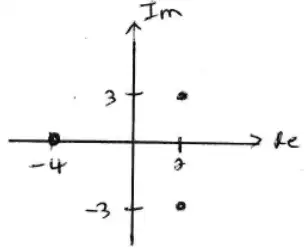 | B1ft | 1.1b |
| (1) | ||
| (6 marks) |
Notes
B1ft: Correctly plots all three roots following through their third root in part (b). Must be labelled with the \(\text{``}{-4}\text{''}\) further from \(O\) than 2, but don’t be concerned about \(x\) and \(y\) scale. If correct look for one root on the negative real axis, with the other two symmetric about real axis in quadrants 1 and 4, but follow through their real root if positive. Accept \((0, -4)\) labelled on the real axis in correct place as a label.