
AS June 2022 Q3
3. Terry and June play a zero-sum game. The pay-off matrix shows the number of points that Terry scores for each combination of strategies.
| June | |||
|---|---|---|---|
| Option X | Option Y | ||
| Terry | Option A | \(1\) | \(4\) |
| Option B | \(-2\) | \(6\) | |
| Option C | \(-1\) | \(5\) | |
| Option D | \(8\) | \(-4\) | |
Let Terry play option A with probability \(t\).
| Scheme | Marks | AO |
|---|---|---|
| In a ‘zero-sum’ game each participant’s gain or loss (of utility) is exactly balanced by the losses or gains (of the utility) of the other participant. | B1 | 1.2 |
| (1) |
Notes
B1: cao (give bod but must get the idea across that one person’s losses are equal to the other’s gains)
| Scheme | Marks | AO |
|---|---|---|
| Row minima: \(1, -2, -1, -4\) so max is 1 Column maxima: 8, 6 so min is 6 | M1 | 1.1b |
| Row(maximin) \(\neq\) Col(minimax) therefore game is not stable | A1 | 2.4 |
| (2) |
Notes
M1: finding row minimums and column maximums – condone one error
A1: row maximin (1) \(\neq\) col minimax (6) (so not stable) – dependent on all correct 6 values
| Scheme | Marks | AO |
|---|---|---|
| \(\begin{pmatrix} -1 & 2 & 1 & -8 \\ -4 & -6 & -5 & 4 \end{pmatrix}\) | B1 | 1.1b |
| (1) |
Notes
B1: cao
| Scheme | Marks | AO |
|---|---|---|
| (i) Let June play X with probability \(p\) and Y with probability \(1 - p\) | B1 | 3.3 |
| If Terry plays A June’s gains are \(-p + (-4)(1-p) = 3p - 4\) If Terry plays B June’s gains are \(2p + (-6)(1-p) = 8p - 6\) If Terry plays C June’s gains are \(p + (-5)(1-p) = 6p - 5\) If Terry plays D June’s gains are \(-8p + 4(1-p) = -12p + 4\) | M1 A1 | 1.1b 1.1b |
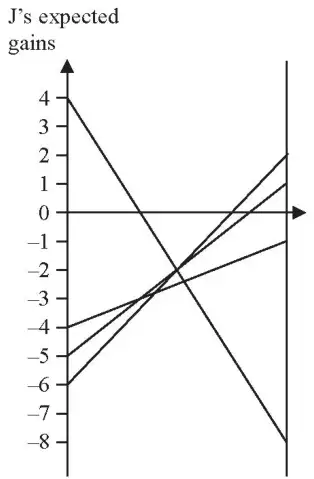 | M1 | 1.1b |
| \(3p - 4 = -12p + 4 \Rightarrow p = 8/15\) | M1 | 1.1b |
| June should play X with probability 8/15 and play Y with probability 7/15 | A1 | 3.2a |
| (ii) Value of the game to Terry is 2.4 | A1 | 3.4 |
| (7) |
Notes
(d)(i)
B1: defining variable \(p\) (or any other letter e.g., \(q\)) – must use the word ‘probability’ (do not have to mention ‘June’ so as a minimum accept ‘X with probability \(p\) and Y with probability \(1 - p\)’)
M1: setting up four expressions in terms of their \(p\)
A1: all four expressions correctly simplified
M1: at least three lines correctly drawn for their expressions – if values on at least one vertical axis not given then lines must be in the right position relative to each other
M1: using their graph to obtain their correct probability equation leading to a value of \(p\) (dependent on both previous M marks)
A1: interpret the correct value of \(p\) in the context of the question – must refer to ‘play’ and the associated probabilities (need not say ‘probability’ again). This mark is dependent on a completely correct graph (so if no scaling on the vertical axis assume that 1 line = 1 unit, and lines must not extend past \(p \lt 0\) and/or \(p \gt 1\))
(d)(ii)
A1: cao (2.4) oe (dependent on all previous M marks)
| Scheme | Marks | AO |
|---|---|---|
| \(-t + (-8)(1-t) = -4t + 4(1-t)\) (oe e.g., \(t + 8(1-t) = 4t - 4(1-t)\)) or \(-t + (-8)(1-t) = -\dfrac{12}{5}\) (oe) or \(-4t + 4(1-t) = -\dfrac{12}{5}\) (oe) | M1 | 3.1a |
| \(t = \dfrac{4}{5}\) | A1 | 1.1b |
| Terry should play option A with probability 0.8, never play options B and C, and play option D with probability 0.2 | A1ft | 3.2a |
| (3) | ||
| (14 marks) |
Notes
M1: Setting up a linear equation in \(t\) (with possibly their value from (d)(ii)), using only the two valid options from their graph in (d)(i) (so if the graph was correct in (d) they must be using Terry’s options A and D) – allow sign slips only (allow any other choice of letter)
A1: cao (0.8)
A1ft: interpret their value of \(t\) in the context of the question – do not penalise a lack of ‘play’ twice. Must also include the two options that are never played