
A2 June 2025 Paper 1 Q16
16 In this question you must show detailed reasoning.
The diagram shows the curve with equation \(y = \dfrac{x + 3}{\sqrt{x^2 + 9}}\).
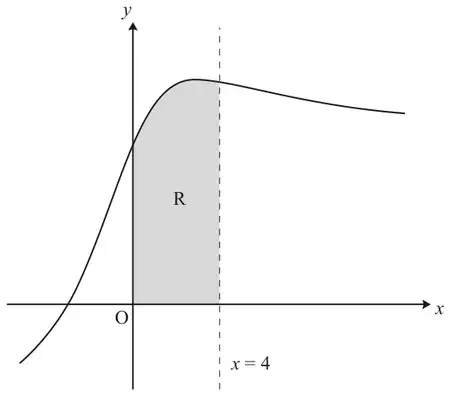
The region R, shown shaded in the diagram, is bounded by the curve, the \(x\)-axis, the \(y\)-axis, and the line \(x = 4\).
The region R is rotated through \(2\pi\) radians about the \(x\)-axis.
| Scheme | Marks | AO |
|---|---|---|
| DR \(A = \displaystyle\int_0^4 \frac{x + 3}{\sqrt{x^2 + 9}}\,\mathrm{d}x = \int_0^4 \frac{x}{\sqrt{x^2 + 9}}\,\mathrm{d}x + \int_0^4 \frac{3}{\sqrt{x^2 + 9}}\,\mathrm{d}x\) | M1* | 3.1a |
| \(= \left[\frac{1}{2} \cdot 2\sqrt{x^2 + 9} + 3\ln\left(x + \sqrt{x^2 + 9}\right)\right]_0^4\) | M1 A1 B1 | 1.1 1.1 1.1 |
| \(= 5 + 3\ln 9 - 3 - 3\ln 3\) or \(= 5 + 3\ln 3 - 3[-0]\) | M1dep | 1.1 |
| \(= 2 + \ln 27\) | A1cao | 2.1 |
| [6] |
Notes
M1*: splitting fraction, allow one numerical slip only
M1: \(k\sqrt{x^2 + 9}\) or substituting \(u = x^2 + 9\) and reaching \(ku^{\frac{1}{2}}\)
A1: \(k = 1\)
B1: \(3\ln\left(x + \sqrt{x^2 + 9}\right)\) or \(3\,\mathrm{arsinh}\left(\frac{x}{3}\right)\)
M1dep: substituting limits into an integrated expression and converting to lns if required. Condone missing \(\ln 1\) term.
A1cao: no acceptable equivalents. www.
Alternative method 1
| Scheme | Marks |
|---|---|
| let \(x = 3\sinh u\), \(\mathrm{d}x = 3\cosh u\,\mathrm{d}u\) | M1* |
| \(A = \displaystyle\int_0^{\mathrm{arsinh}\frac{4}{3}} \frac{3\sinh u + 3}{3\cosh u}\,3\cosh u\,\mathrm{d}u\) | A1 |
| \(= \left[3\cosh u + 3u\right]_0^{\mathrm{arsinh}\frac{4}{3}}\) | A1 |
| \(= 3\sqrt{1 + \frac{16}{9}} + 3\ln\left(\frac{4}{3} + \sqrt{1 + \frac{16}{9}}\right) - 3\) | M1dep B1 |
| \(= 2 + \ln 27\) | A1cao |
M1*: substituting \(x = 3\sinh u\) and \(\mathrm{d}x = 3\cosh u\,\mathrm{d}u\)
A1: \(\int \frac{3\sinh u + 3}{3\cosh u}3\cosh u\,\mathrm{d}u\)
A1: \(\left[3\cosh u + 3u\right]\). Ignore incorrect limits until the point of substitution.
M1dep: substituting correct limits and converting \(\mathrm{arsinh}\frac{4}{3}\) to lns
B1: \(\cosh\left(\mathrm{arsinh}\frac{4}{3}\right) = \sqrt{1 + \frac{16}{9}}\)
A1cao: no acceptable equivalents. www.
Alternative method 2
| Scheme | Marks |
|---|---|
| \(A = \displaystyle\int_0^4 \frac{x + 3}{\sqrt{x^2 + 9}}\,\mathrm{d}x\) \(= \left[(x + 3)\,\mathrm{arsinh}\frac{x}{3}\right]_0^4 - \displaystyle\int_0^4 \mathrm{arsinh}\frac{x}{3}\,\mathrm{d}x\) \(= \left[(x + 3)\,\mathrm{arsinh}\frac{x}{3} - x\,\mathrm{arsinh}\frac{x}{3}\right]_0^4 + \displaystyle\int_0^4 \frac{x}{\sqrt{x^2 + 9}}\,\mathrm{d}x\) | M1* |
| \(= \left[3\,\mathrm{arsinh}\frac{x}{3} + \frac{1}{2} \cdot 2\sqrt{x^2 + 9}\right]_0^4\) | M1 A1 B1 |
| \(= 5 + 3\ln 9 - 3 - 3\ln 3\) or \(= 5 + 3\ln 3 - 3[-0]\) | M1dep |
| \(= 2 + \ln 27\) | A1cao |
M1*: integrating by parts twice until an integral of the form \(k\int \frac{x}{\sqrt{x^2 + 9}}\,\mathrm{d}x\) remains
M1: \(k\sqrt{x^2 + 9}\) or substituting \(u = x^2 + 9\)
A1: \(k = 1\)
B1: \(3\ln\left(x + \sqrt{x^2 + 9}\right)\) or \(3\,\mathrm{arsinh}\left(\frac{x}{3}\right)\)
M1dep: substituting limits into an integrated expression and converting to lns if required. Condone missing \(\ln 1\) term.
A1cao: no acceptable equivalents. www.
Alternative method 3
| Scheme | Marks |
|---|---|
| let \(x = 3\tan u\), \(\mathrm{d}x = 3\sec^2 u\,\mathrm{d}u\) | M1* |
| \(A = \displaystyle\int_0^{\arctan\frac{4}{3}} \frac{3\tan u + 3}{3\sec u}\,3\sec^2 u\,\mathrm{d}u\) | A1 |
| \(= \left[3\sec u + 3\ln|\sec u + \tan u|\right]_0^{\arctan\frac{4}{3}}\) | A1 |
| \(= 3\left(\frac{5}{3}\right) + 3\ln 3 - 3 - 3\ln 1\) | M1dep B1 |
| \(= 2 + \ln 27\) | A1cao |
M1*: substituting \(x = 3\tan u\) and \(\mathrm{d}x = 3\sec^2 u\,\mathrm{d}u\)
A1: \(\int \frac{3\tan u + 3}{3\sec u}3\sec^2 u\,\mathrm{d}u\) or \(\int (3\sec u\tan u + 3\sec u)\,\mathrm{d}u\)
A1: \(\left[3\sec u + 3\ln|\sec u + \tan u|\right]\). Ignore incorrect limits until the point of substitution
M1dep: substituting correct limits. Condone missing \(\ln 1\) term.
B1: \(\sec\left(\arctan\frac{4}{3}\right) = \frac{5}{3}\)
A1cao: no acceptable equivalents. www.
| Scheme | Marks | AO |
|---|---|---|
| DR \(V = \pi\displaystyle\int_0^4 \frac{(x + 3)^2}{x^2 + 9}\,[\mathrm{d}x]\) | B1 | 3.1a |
| \(= [\pi]\displaystyle\int_0^4 \left(1 + \frac{6x}{x^2 + 9}\right)[\mathrm{d}x]\) | M1* | 1.1 |
| \(= [\pi]\left[x + 3\ln(x^2 + 9)\right]_0^4\) | M1 A1 | 1.1 1.1 |
| \(= \pi\left[4 + 3\ln 25 - 3\ln 9\right]\) | M1dep | 1.1 |
| \(= \pi\left[4 + 3\ln\dfrac{25}{9}\right]\) | A1cao | 2.1 |
| [6] |
Notes
B1: correct integral and limits (could be seen later)
M1*: writing as sum of proper fractions; ignore incorrect multiples of \(\pi\). soi by correct integral.
M1: inspection or substituting \(u = x^2 + 9\), \(\mathrm{d}u = 2x\,\mathrm{d}x\); ignore incorrect multiples of \(\pi\)
A1: \([\pi]\left[x + 3\ln(x^2 + 9)\right]\)
M1dep: substituting limits with function fully integrated
A1cao: oe but must be in the form \(\pi\left(a + b\ln\left(\frac{c}{d}\right)\right)\). Accept e.g. \(a = 4\), \(b = 3\), \(c = 25\), \(d = 9\).
Alternative method 1
| Scheme | Marks |
|---|---|
| \(V = \pi\displaystyle\int_0^4 \frac{(x + 3)^2}{x^2 + 9}\,\mathrm{d}x\) | B1 |
| let \(x = 3\tan u\), \(\mathrm{d}x = 3\sec^2 u\,\mathrm{d}u\) \(= [\pi]\displaystyle\int_0^{\arctan\frac{4}{3}} \frac{(3\tan u + 3)^2}{9\sec^2 u}\,3\sec^2 u\,\mathrm{d}u\) | M1* |
| \(= [\pi]\displaystyle\int_0^{\arctan\frac{4}{3}} (3\sec^2 u + 6\tan u)\,\mathrm{d}u\) | M1 |
| \(= [\pi]\left[3\tan u + 6\ln(\sec u)\right]_0^{\arctan\frac{4}{3}}\) | A1 |
| \(= [\pi]\left(3\tan\left(\arctan\frac{4}{3}\right) + 6\ln\left|\sec\left(\arctan\frac{4}{3}\right)\right|\right)\) | M1dep |
| \(= \pi\left[4 + 6\ln\dfrac{5}{3}\right]\) | A1cao |
B1: correct integral and limits
M1*: substitution
M1: expanding and using \(1 + \tan^2 u = \sec^2 u\)
A1: \(= \left[3\tan u + 6\ln(\sec u)\right]\)
M1dep: substituting limits
A1cao: oe but must be in the form \(\pi\left(a + b\ln\left(\frac{c}{d}\right)\right)\). Accept e.g. \(a = 4\), \(b = 6\), \(c = 5\), \(d = 3\).
Alternative method 2
| Scheme | Marks |
|---|---|
| \(V = \pi\displaystyle\int_0^4 \frac{(x + 3)^2}{x^2 + 9}\,\mathrm{d}x\) | B1 |
| Let \(x = 3\sinh u\), \(\mathrm{d}x = 3\cosh u\,\mathrm{d}u\) \(= [\pi]\displaystyle\int_0^{\mathrm{arsinh}\frac{4}{3}} \frac{(3\sinh u + 3)^2}{9\cosh^2 u}\,3\cosh u\,\mathrm{d}u\) | M1* |
| \(= [\pi]\displaystyle\int_0^{\mathrm{arsinh}\frac{4}{3}} (3\cosh u + 6\tanh u)\,\mathrm{d}u\) | M1 |
| \(= [\pi]\left[3\sinh u + 6\ln(\cosh u)\right]_0^{\mathrm{arsinh}\frac{4}{3}}\) | A1 |
| \(= 3\left(\frac{4}{3} + 2\ln\left|\cosh\left(\mathrm{arsinh}\frac{4}{3}\right)\right|\right)\) | M1dep |
| \(= 4 + 6\ln\frac{5}{3}\) | A1 |
B1: correct integral and limits
M1*: substitution
M1: expanding and using \(\sinh u\tanh u = \cosh u - \mathrm{sech}\,u\)
A1: \(= \left[3\sinh u + 6\ln(\cosh u)\right]\)
M1dep: substituting limits
A1: oe but must be in the form \(\pi\left(a + b\ln\left(\frac{c}{d}\right)\right)\). Accept e.g. \(a = 4\), \(b = 6\), \(c = 5\), \(d = 3\).