
June 2018 Paper 2 Q13
13.
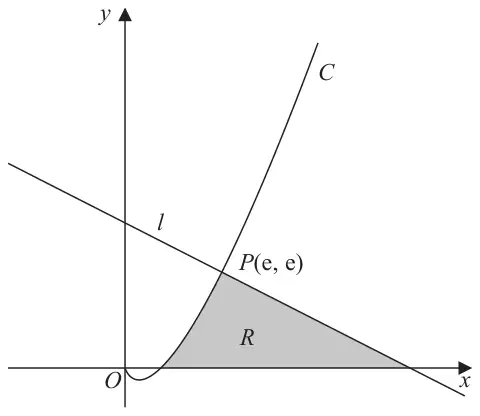
Figure 2 shows a sketch of part of the curve \(C\) with equation \(y = x\ln x,\ \ x \gt 0\)
The line \(l\) is the normal to \(C\) at the point \(P(\mathrm{e}, \mathrm{e})\)
The region \(R\), shown shaded in Figure 2, is bounded by the curve \(C\), the line \(l\) and the \(x\)-axis.
Show that the exact area of \(R\) is \(A\mathrm{e}^2 + B\) where \(A\) and \(B\) are rational numbers to be found. (10)
| Scheme | Marks | AO |
|---|---|---|
| Let \(x_A\) be the \(x\)-coordinate of where \(l\) cuts the \(x\)-axis | ||
| \(\dfrac{\mathrm{d}y}{\mathrm{d}x} = \ln x + x\left(\dfrac{1}{x}\right)\ \ \{= 1 + \ln x\}\) | M1 A1 | 2.1 1.1b |
| \(x = \mathrm{e},\ m_T = 2 \Rightarrow m_N = -\dfrac{1}{2} \Rightarrow y - \mathrm{e} = -\dfrac{1}{2}(x - \mathrm{e})\) \(y = 0 \Rightarrow -\mathrm{e} = -\dfrac{1}{2}(x - \mathrm{e}) \Rightarrow x = \ldots\) | M1 | 3.1a |
| \(l\) meets \(x\)-axis at \(x = 3\mathrm{e}\) (allow \(x = 2\mathrm{e} + \mathrm{e}\ln\mathrm{e}\)) | A1 | 1.1b |
| {Areas:} either \(\displaystyle\int_1^{\mathrm{e}} x\ln x\,\mathrm{d}x = \Big[\ \ldots\ \Big]_1^{\mathrm{e}} = \ldots\) or \(\dfrac{1}{2}\left((\text{their } x_A) - \mathrm{e}\right)\mathrm{e}\) | M1 | 2.1 |
| \(\left\{\displaystyle\int x\ln x\,\mathrm{d}x =\right\}\ \dfrac{1}{2}x^2\ln x - \displaystyle\int \dfrac{1}{x}\cdot\left(\dfrac{x^2}{2}\right)\{\mathrm{d}x\}\) | M1 | 2.1 |
| \(\left\{= \dfrac{1}{2}x^2\ln x - \displaystyle\int \dfrac{1}{2}x\,\{\mathrm{d}x\}\right\} = \dfrac{1}{2}x^2\ln x - \dfrac{1}{4}x^2\) | dM1 A1 | 1.1b 1.1b |
| \(\text{Area}(R_1) = \displaystyle\int_1^{\mathrm{e}} x\ln x\,\mathrm{d}x = \Big[\ \ldots\ \Big]_1^{\mathrm{e}} = \ldots;\ \ \text{Area}(R_2) = \dfrac{1}{2}\left((\text{their } x_A) - \mathrm{e}\right)\mathrm{e}\) and so, \(\text{Area}(R) = \text{Area}(R_1) + \text{Area}(R_2)\ \ \left\{= \tfrac{1}{4}\mathrm{e}^2 + \tfrac{1}{4} + \mathrm{e}^2\right\}\) | M1 | 3.1a |
| \(\text{Area}(R) = \tfrac{5}{4}\mathrm{e}^2 + \tfrac{1}{4}\) | A1 | 1.1b |
| (10) | ||
| (10 marks) |
Notes
M1: Differentiates by using the product rule to give \(\ln x + x(\text{their } \mathrm{g}^{\prime}(x))\), where \(\mathrm{g}(x) = \ln x\)
A1: Correct differentiation of \(y = x\ln x\), which can be un-simplified or simplified
M1: Complete strategy to find the \(x\) coordinate where their normal to \(C\) at \(P(\mathrm{e}, \mathrm{e})\) meets the \(x\)-axis
i.e. Sets \(y = 0\) in \(y - \mathrm{e} = m_N(x - \mathrm{e})\) to find \(x = \ldots\)
Note: \(m_T\) is found by using calculus and \(m_N \neq m_T\)
A1: \(l\) meets \(x\)-axis at \(x = 3\mathrm{e}\), allowing un-simplified values for \(x\) such as \(x = 2\mathrm{e} + \mathrm{e}\ln\mathrm{e}\)
Note: Allow \(x = \text{awrt } 8.15\)
M1: Scored for either
- Area under curve \(= \displaystyle\int_1^{\mathrm{e}} x\ln x\,\mathrm{d}x = \Big[\ \ldots\ \Big]_1^{\mathrm{e}} = \ldots\), with limits of e and 1 and some attempt to substitute these and subtract
- or Area under line \(= \dfrac{1}{2}\left((\text{their } x_A) - \mathrm{e}\right)\mathrm{e}\), with a valid attempt to find \(x_A\)
M1: Integration by parts the correct way around to give \(Ax^2\ln x - \displaystyle\int B\left(\dfrac{x^2}{x}\right)\{\mathrm{d}x\};\ A \neq 0, B \gt 0\)
dM1: dependent on the previous M mark
Integrates the second term to give \(\pm\lambda x^2;\ \lambda \neq 0\)
A1: \(\dfrac{1}{2}x^2\ln x - \dfrac{1}{4}x^2\)
M1: Complete strategy of finding the area of \(R\) by finding the sum of two key areas. See scheme.
A1: \(\tfrac{5}{4}\mathrm{e}^2 + \tfrac{1}{4}\)
Note: \(\text{Area}(R_2)\) can also be found by integrating the line \(l\) between limits of e and their \(x_A\)
i.e. \(\text{Area}(R_2) = \displaystyle\int_{\mathrm{e}}^{\text{their } x_A} \left(-\dfrac{1}{2}x + \dfrac{3}{2}\mathrm{e}\right)\mathrm{d}x = \Big[\ \ldots\ \Big]_{\mathrm{e}}^{\text{their } x_A} = \ldots\)
Note: Calculator approach with no algebra, differentiation or integration seen:
- Finding \(l\) cuts through the \(x\)-axis at awrt 8.15 is 2nd M1 2nd A1
- Finding area between curve and the \(x\)-axis between \(x = 1\) and \(x = \mathrm{e}\) to give awrt 2.10 is 3rd M1
- Using the above information (must be seen) to apply \(\text{Area}(R) = 2.0972\ldots + 7.3890\ldots = 9.4862\ldots\) is final M1
Therefore, a maximum of 4 marks out of the 10 available.