
June 2018 Paper 2 Q8
8.
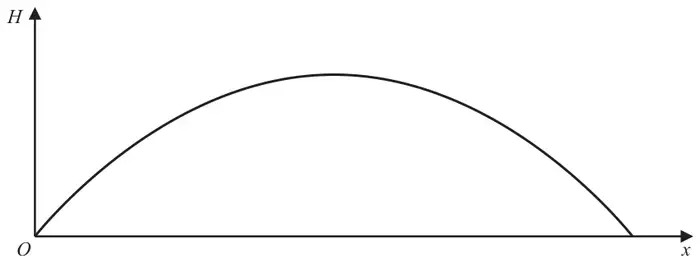
Figure 1 is a graph showing the trajectory of a rugby ball.
The height of the ball above the ground, \(H\) metres, has been plotted against the horizontal distance, \(x\) metres, measured from the point where the ball was kicked.
The ball travels in a vertical plane.
The ball reaches a maximum height of 12 metres and hits the ground at a point 40 metres from where it was kicked.
The ball passes over the horizontal bar of a set of rugby posts that is perpendicular to the path of the ball. The bar is 3 metres above the ground.
| Scheme | Marks | AO |
|---|---|---|
| Way 1: \(H = Ax(40 - x)\ \{\text{or } H = Ax(x - 40)\}\) | M1 | 3.3 |
| \(x = 20,\ H = 12 \Rightarrow 12 = A(20)(40 - 20) \Rightarrow A = \dfrac{3}{100}\) | dM1 | 3.1b |
| \(H = \dfrac{3}{100}x(40 - x)\) or \(H = -\dfrac{3}{100}x(x - 40)\) | A1 | 1.1b |
| (3) |
Notes
(a) Way 2
| Scheme | Marks | AO |
|---|---|---|
| \(H = 12 - \lambda(x - 20)^2\ \ \{\text{or } H = 12 + \lambda(x - 20)^2\}\) | M1 | 3.3 |
| \(x = 40,\ H = 0 \Rightarrow 0 = 12 - \lambda(40 - 20)^2 \Rightarrow \lambda = \dfrac{3}{100}\) | dM1 | 3.1b |
| \(H = 12 - \dfrac{3}{100}(x - 20)^2\) | A1 | 1.1b |
| (3) |
(a) Way 3
| Scheme | Marks | AO |
|---|---|---|
| \(H = ax^2 + bx + c\) (or deduces \(H = ax^2 + bx\)) Both \(x = 0,\ H = 0 \Rightarrow 0 = 0 + 0 + c \Rightarrow c = 0\) and either \(x = 40,\ H = 0 \Rightarrow 0 = 1600a + 40b\) or \(x = 20,\ H = 12 \Rightarrow 12 = 400a + 20b\) or \(\dfrac{-b}{2a} = 20\ \{\Rightarrow b = -40a\}\) | M1 | 3.3 |
| \(b = -40a \Rightarrow 12 = 400a + 20(-40a) \Rightarrow a = -0.03\) so \(b = -40(-0.03) = 1.2\) | dM1 | 3.1b |
| \(H = -0.03x^2 + 1.2x\) | A1 | 1.1b |
| (3) |
M1: Translates the situation given into a suitable equation for the model. E.g.
Way 1: {Uses \((0, 0)\) and \((40, 0)\) to write} \(H = Ax(40 - x)\) o.e. {or \(H = Ax(x - 40)\)}
Way 2: {Uses \((20, 12)\) to write} \(H = 12 - \lambda(x - 20)^2\) or \(H = 12 + \lambda(x - 20)^2\)
Way 3: Writes \(H = ax^2 + bx + c\), and uses \((0, 0)\) to deduce \(c = 0\) and an attempt at using either \((40, 0)\) or \((20, 12)\)
Special Case: Allow SC M1dM0A0 for not deducing \(c = 0\) but attempting to apply both \((40, 0)\) and \((20, 12)\)
dM1: Applies a complete strategy with appropriate constraints to find all constants in their model.
Way 1: Uses \((20, 12)\) on their model and finds \(A = \ldots\)
Way 2: Uses either \((40, 0)\) or \((0, 0)\) on their model to find \(\lambda = \ldots\)
Way 3: Uses \((40, 0)\) and \((20, 12)\) on their model to find \(a = \ldots\) and \(b = \ldots\)
A1: Finds a correct equation linking \(H\) to \(x\)
E.g. \(H = \dfrac{3}{100}x(40 - x),\ H = 12 - \dfrac{3}{100}(x - 20)^2\) or \(H = -0.03x^2 + 1.2x\)
Note: Condone writing \(y\) in place of \(H\) for the M1 and dM1 marks.
Note: Give final A0 for \(y = -0.03x^2 + 1.2x\)
Note: Give special case M1dM0A0 for writing down any of \(H = 12 - (x - 20)^2\) or \(H = x(40 - x)\) or \(H = x(x - 40)\)
Note: Give M1 dM1 for finding \(-0.03x^2 + 1.2x\) or \(a = -0.03, b = 1.2, c = 0\) in an implied \(ax^2 + bx\) or \(ax^2 + bx + c\) (with no indication of \(H = \ldots\))
| Scheme | Marks | AO |
|---|---|---|
| \(\{H = 3 \Rightarrow\}\ 3 = \dfrac{3}{100}x(40 - x) \Rightarrow x^2 - 40x + 100 = 0\) or \(\{H = 3 \Rightarrow\}\ 3 = 12 - \dfrac{3}{100}(x - 20)^2 \Rightarrow (x - 20)^2 = 300\) | M1 | 3.4 |
| e.g. \(x = \dfrac{40 \pm \sqrt{1600 - 4(1)(100)}}{2(1)}\) or \(x = 20 \pm \sqrt{300}\) | dM1 | 1.1b |
| \(\left\{\text{chooses } 20 + \sqrt{300} \Rightarrow\right\}\) greatest distance \(= \text{awrt } 37.3\text{ m}\) | A1 | 3.2a |
| (3) |
Notes
M1: Substitutes \(H = 3\) into their quadratic equation and proceeds to obtain a 3TQ or a quadratic in the form \((x \pm \alpha)^2 = \beta;\ \alpha, \beta \neq 0\)
Note: E.g. \(1.2x - 0.03x^2 = 3\) or \(40x - x^2 = 100\) are acceptable for the 1st M mark
Note: Give M0 dM0 A0 for \((\text{their } A)x^2 = 3 \Rightarrow x = \ldots\) or their \((\text{their } A)x^2 + (\text{their } k) = 3 \Rightarrow x = \ldots\)
dM1: Correct method of solving their quadratic equation to give at least one solution
A1: Interprets their solution in the original context by selecting the larger correct value and states correct units for their value. E.g. Accept awrt 37.3 m or \(\left(20 + \sqrt{300}\right)\) m or \(\left(20 + 10\sqrt{3}\right)\) m
Note: Condone the use of inequalities for the method marks in part (b)
| Scheme | Marks | AO |
|---|---|---|
Gives a limitation of the model. Accept e.g.
| B1 | 3.5b |
| (1) | ||
| (7 marks) |
Notes
B1: See scheme
Note: Give no credit for the following reasons
- \(H\) (or the height of ball) is negative when \(x \gt 40\)
- Bounce of the ball should be considered after hitting the ground
- Model will not be true for a different rugby ball
- Ball may not be kicked in the same way each time