
June 2018 Paper 1 Q9
9.
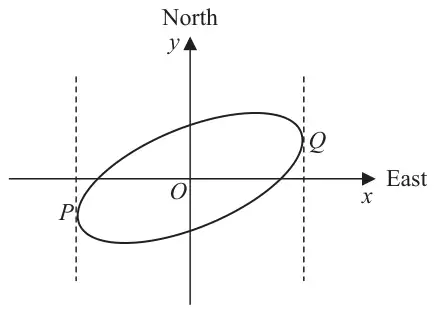
Figure 4 shows a sketch of the curve with equation \(x^2 - 2xy + 3y^2 = 50\)
The curve is used to model the shape of a cycle track with both \(x\) and \(y\) measured in km.
The points \(P\) and \(Q\) represent points that are furthest west and furthest east of the origin \(O\), as shown in Figure 4.
Using part (a),
| Scheme | Marks | AO |
|---|---|---|
| Either \(3y^2 \rightarrow Ay\dfrac{\mathrm{d}y}{\mathrm{d}x}\) or \(2xy \rightarrow 2x\dfrac{\mathrm{d}y}{\mathrm{d}x} + 2y\) | M1 | 2.1 |
| \(2x - 2x\dfrac{\mathrm{d}y}{\mathrm{d}x} - 2y + 6y\dfrac{\mathrm{d}y}{\mathrm{d}x} = 0\) | A1 | 1.1b |
| \((6y - 2x)\dfrac{\mathrm{d}y}{\mathrm{d}x} = 2y - 2x\) | M1 | 2.1 |
| \(\dfrac{\mathrm{d}y}{\mathrm{d}x} = \dfrac{2y - 2x}{6y - 2x} = \dfrac{y - x}{3y - x}\) * | A1* | 1.1b |
| (4) |
Notes
M1: For selecting the appropriate method of differentiating either \(3y^2 \rightarrow Ay\dfrac{\mathrm{d}y}{\mathrm{d}x}\) or \(2xy \rightarrow 2x\dfrac{\mathrm{d}y}{\mathrm{d}x} + 2y\)
It may be quite difficult awarding it for the product rule but condone \(-2xy \rightarrow -2x\dfrac{\mathrm{d}y}{\mathrm{d}x} + 2y\) unless you see evidence that they have used the incorrect law \(vu^{\prime} - uv^{\prime}\)
A1: Fully correct derivative \(2x - 2x\dfrac{\mathrm{d}y}{\mathrm{d}x} - 2y + 6y\dfrac{\mathrm{d}y}{\mathrm{d}x} = 0\)
Allow attempts where candidates write \(2x\mathrm{d}x - 2x\mathrm{d}y - 2y\mathrm{d}x + 6y\mathrm{d}y = 0\)
but watch for students who write \(\dfrac{\mathrm{d}y}{\mathrm{d}x} = 2x - 2x\dfrac{\mathrm{d}y}{\mathrm{d}x} - 2y + 6y\dfrac{\mathrm{d}y}{\mathrm{d}x}\) This, on its own, is A0 unless you are convinced that this is just their notation. Eg \(\dfrac{\mathrm{d}y}{\mathrm{d}x} = 2x - 2x\dfrac{\mathrm{d}y}{\mathrm{d}x} - 2y + 6y\dfrac{\mathrm{d}y}{\mathrm{d}x} = 0\)
M1: For a valid attempt at making \(\dfrac{\mathrm{d}y}{\mathrm{d}x}\) the subject. with two terms in \(\dfrac{\mathrm{d}y}{\mathrm{d}x}\) coming from \(3y^2\) and \(2xy\)
Look for \((\ldots \pm \ldots)\dfrac{\mathrm{d}y}{\mathrm{d}x} = \ldots\ldots\) It is implied by \(\dfrac{\mathrm{d}y}{\mathrm{d}x} = \dfrac{2y - 2x}{6y - 2x}\)
This cannot be scored from attempts such as \(\dfrac{\mathrm{d}y}{\mathrm{d}x} = 2x - 2x\dfrac{\mathrm{d}y}{\mathrm{d}x} - 2y + 6y\) which only has one correct term.
A1*: \(\dfrac{\mathrm{d}y}{\mathrm{d}x} = \dfrac{y - x}{3y - x}\) with no errors or omissions.
The previous line \(\dfrac{\mathrm{d}y}{\mathrm{d}x} = \dfrac{2y - 2x}{6y - 2x}\) or equivalent must be seen.
| Scheme | Marks | AO |
|---|---|---|
| \(\left(\text{At } P \text{ and } Q\ \dfrac{\mathrm{d}y}{\mathrm{d}x} \rightarrow \infty \Rightarrow\right)\) Deduces that \(3y - x = 0\) | M1 | 2.2a |
| Solves \(y = \dfrac{1}{3}x\) and \(x^2 - 2xy + 3y^2 = 50\) simultaneously | M1 | 3.1a |
| \(\Rightarrow x = (\pm)5\sqrt{3}\) OR \(\Rightarrow y = (\pm)\dfrac{5}{3}\sqrt{3}\) | A1 | 1.1b |
| Using \(y = \dfrac{1}{3}x \Rightarrow x = ..\) AND \(y = ..\) | dM1 | 1.1b |
| \(P = \left(-5\sqrt{3},\ -\dfrac{5}{3}\sqrt{3}\right)\) | A1 | 2.2a |
| (5) |
Notes
M1: Deduces that \(3y - x = 0\) oe
M1: Attempts to find either the \(x\) or \(y\) coordinates of \(P\) and \(Q\) by solving their \(y = \dfrac{1}{3}x\) with \(x^2 - 2xy + 3y^2 = 50\) simultaneously. Allow for finding a quadratic equation in \(x\) or \(y\) and solving to find at least one value for \(x\) or \(y\).
This may be awarded when candidates make the numerator = 0 ie using \(y = x\)
A1: \(\Rightarrow x = (\pm)5\sqrt{3}\) OR \(\Rightarrow y = (\pm)\dfrac{5}{3}\sqrt{3}\)
dM1: Dependent upon the previous M, it is for finding the \(y\) coordinate from their \(x\) (or vice versa)
This may also be scored following the numerator being set to 0 ie using \(y = x\)
A1: Deduces that \(P = \left(-5\sqrt{3},\ -\dfrac{5}{3}\sqrt{3}\right)\) OE. Allow to be \(x = \ldots\ \ y = \ldots\)
| Scheme | Marks | AO |
|---|---|---|
| Explains that you need to solve \(y = x\) and \(x^2 - 2xy + 3y^2 = 50\) simultaneously and choose the positive solution | B1ft | 2.4 |
| (1) | ||
| (10 marks) |
Notes
B1ft: Explains that this is where \(\dfrac{\mathrm{d}y}{\mathrm{d}x} = 0\) and so you need to solve \(y = x\) and \(x^2 - 2xy + 3y^2 = 50\) simultaneously and choose the positive solution (or larger solution).
Allow a follow through for candidates who mix up parts (b) and (c)
Alternatively candidates could complete the square \((x - y)^2 + 2y^2 = 50\) and state that \(y\) would reach a maximum value when \(x = y\) and choose the positive solution from \(2y^2 = 50\)