
A2 June 2025 Paper 2 Q7
7.
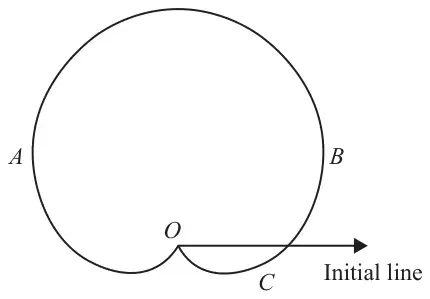
The curve \(C\) shown in Figure 1 has polar equation
\[r = a(1 + \sin\theta) \qquad -\pi \lt \theta \leqslant \pi\]where \(a\) is a constant.
The tangents to \(C\) at the points \(A\) and \(B\) are perpendicular to the initial line.
The curve \(C\) models the perimeter of the surface of a swimming pool.
Given that, according to the model, the distance across the pool from \(A\) to \(B\) is 10 m,
| Scheme | Marks | AO |
|---|---|---|
| \(x = r\cos\theta = a(1 + \sin\theta)\cos\theta = a(\cos\theta + \sin\theta\cos\theta)\) \(\dfrac{\mathrm{d}x}{\mathrm{d}\theta} = A\cos\theta\cos\theta + B(1 + \sin\theta)\sin\theta\) or \(A\sin\theta + B\cos^2\theta + C\sin^2\theta\) or \(x = r\cos\theta = a(1 + \sin\theta)\cos\theta = a(\cos\theta + 0.5\sin 2\theta)\) \(\dfrac{\mathrm{d}x}{\mathrm{d}\theta} = A\sin\theta + B\cos 2\theta\) | M1 | 3.1a |
| \(\dfrac{\mathrm{d}x}{\mathrm{d}\theta} = a(-\sin\theta + \cos 2\theta)\) or \(a\left(\cos^2\theta - (1 + \sin\theta)\sin\theta\right)\) or \(a\left(-\sin\theta + \cos^2\theta - \sin^2\theta\right)\) | A1 | 1.1b |
| \(\dfrac{\mathrm{d}x}{\mathrm{d}\theta} = a(-\sin\theta + \cos 2\theta) = 0 \Rightarrow -\sin\theta + 1 - 2\sin^2\theta = 0\) \(2\sin^2\theta + \sin\theta - 1 \Rightarrow \sin\theta = \ldots\) or \(\dfrac{\mathrm{d}x}{\mathrm{d}\theta} = a\left(-\sin\theta + \cos^2\theta - \sin^2\theta\right) = 0 \Rightarrow -\sin\theta + 1 - \sin^2\theta - \sin^2\theta = 0\) \(2\sin^2\theta + \sin\theta - 1 = 0 \Rightarrow \sin\theta = \ldots\) | M1 | 3.1a |
| \(\sin\theta = \dfrac{1}{2}\{-1\}\) | A1 | 1.1b |
| \(r = a\left(1 + \dfrac{1}{2}\right)\) and \(\theta = \sin^{-1}\left(\dfrac{1}{2}\right)\) | M1 | 1.1b |
| \(\left(\dfrac{3}{2}a,\ \dfrac{\pi}{6}\right)\) and \(\left(\dfrac{3}{2}a,\ \dfrac{5\pi}{6}\right)\) | A1 | 2.2a |
| (6) |
Notes
M1: Substitutes the equation of \(C\) into \(x = r\cos\theta\) and differentiates to the required form. The \(\dfrac{\mathrm{d}x}{\mathrm{d}\theta}\) need not be seen – if it is a clear attempt at differentiation allow the marks.
A1: Fully correct differentiation.
M1: Uses correct trig work to solve \(\dfrac{\mathrm{d}x}{\mathrm{d}\theta} = 0\) to achieve a value for \(\sin\theta\) via a 3 TQ in sin (oe)
A1: Correct values for \(\sin\theta\). The \(-1\) need not be stated but any other values found will be A0.
M1: Uses \(r = a(1 + \sin\theta)\) and their \(\theta = \sin^{-1}(\ldots)\) (or \(\cos^{-1}\) if by error they ended up with a value for \(\cos\theta\) – and may have come from \(\dfrac{\mathrm{d}y}{\mathrm{d}\theta} = 0\)) to find a polar coordinate. May be implied by a correct coordinate following \(\sin\theta = \dfrac{1}{2}\) having been found.
A1: Deduces the correct polar coordinates from correct work for \(A\) and \(B\) with no incorrect extras. May be listed, or may given as \((\theta,\ r)\). You may ignore values from \(\sin\theta = -1\) that are not used.
NB: Allow the final two marks in (a) if it is initially forgotten but the correct work is done as part of answering part (b).
| Scheme | Marks | AO |
|---|---|---|
| E.g. \(x = \dfrac{3}{2}a\cos\left(\dfrac{\pi}{6}\right) \Rightarrow 2 \times \dfrac{3\sqrt{3}}{4}a = 10 \Rightarrow a = \ldots\) or \(\sin\dfrac{\pi}{3} = \dfrac{5}{3a/2} \Rightarrow a = \ldots\) or \(\Rightarrow 10^2 = \left(\dfrac{3a}{2}\right)^2 + \left(\dfrac{3a}{2}\right)^2 - 2\left(\dfrac{3a}{2}\right)^2\cos\dfrac{2\pi}{3} \Rightarrow a = \ldots\) or \(\dfrac{10}{\sin\frac{2\pi}{3}} = \dfrac{\frac{3a}{2}}{\sin\frac{\pi}{6}} \Rightarrow a = \ldots\) or \(y = \dfrac{3}{2}a\sin\dfrac{\pi}{6} \Rightarrow 5^2 + \left(\dfrac{3a}{4}\right)^2 = \left(\dfrac{3a}{2}\right)^2 \Rightarrow a = \ldots\) | M1 | 3.3 |
| \(a = \dfrac{20\sqrt{3}}{9}\) * | A1* | 2.1 |
| (2) |
Notes
M1: Uses \(2x = 10\) where \(x = r\cos\theta\) to find a value for \(a\) by any valid method. Several are shown in the scheme, there may be variations on these.
A1: Correct value achieved with no errors cso. Must see a correct unsimplified equation in \(a\) with trig terms evaluated before the final answer.
| Scheme | Marks | AO |
|---|---|---|
| \(\left(\dfrac{1}{2}\right)\displaystyle\int r^2\,\mathrm{d}\theta = K\displaystyle\int \left(1 + 2\sin\theta + \sin^2\theta\right)\mathrm{d}\theta\) \(= K\displaystyle\int \left(1 + 2\sin\theta + \left[\dfrac{1}{2} - \dfrac{1}{2}\cos 2\theta\right]\right)\mathrm{d}\theta = K[p\theta \pm q\cos\theta \pm r\sin 2\theta]\) | M1 | 3.4 |
| \(= \left(\dfrac{1}{2} \times\right)\dfrac{400}{27}\left[\dfrac{3}{2}\theta - 2\cos\theta - \dfrac{1}{4}\sin 2\theta\right]\) | A1 | 1.1b |
| Area bounded by the curve \(= \dfrac{1}{2}\displaystyle\int_{-\pi}^{\pi} \left[\dfrac{20\sqrt{3}}{9}(1 + \sin\theta)\right]^2\mathrm{d}\theta\) or \(= \dfrac{1}{2}\displaystyle\int_{0}^{2\pi} \left[\dfrac{20\sqrt{3}}{9}(1 + \sin\theta)\right]^2\mathrm{d}\theta\) \(\dfrac{200}{27}\left[\left(\dfrac{3}{2}(2\pi) - 2\cos(2\pi) - \dfrac{1}{4}\sin(4\pi)\right) - \left(\dfrac{3}{2}(0) - 2\cos(0) - \dfrac{1}{4}\sin(0)\right)\right]\) or \(\dfrac{200}{27}\left[\left(\dfrac{3}{2}(\pi) - 2\cos(\pi) - \dfrac{1}{4}\sin(2\pi)\right) - \left(\dfrac{3}{2}(-\pi) - 2\cos(-\pi) - \dfrac{1}{4}\sin(-\pi)\right)\right]\) | dM1 | 3.4 |
| \(\dfrac{200}{9}\pi\) or awrt 69.8 (m\(^2\)) | A1 | 1.1b |
| (4) | ||
| (12 marks) |
Notes
M1: Attempts to use the model and area \(= \left(\dfrac{1}{2}\right)\displaystyle\int r^2\,\mathrm{d}\theta\), multiplies out, uses the identity \(\sin^2\theta = \dfrac{1}{2}(\pm 1 \pm \cos 2\theta)\) to get into an integrable form and integrates. Limits are not required and the \(\dfrac{1}{2}\) may be missing for this mark. Condone the \(a\) not being squared.
NB: There may be less direct methods attempted (e.g. integration by parts). Such attempts must be complete attempts reaching an integral of the correct form. If you are unsure in any cases then use the review system.
A1: Correct integration of \(\left(\dfrac{1}{2}\right)\displaystyle\int r^2\,\mathrm{d}\theta\) condoning the \(\dfrac{1}{2}\) not being present at this stage. Allow with \(a^2\) used instead of the value.
dM1: Dependent on the first method mark. Full method for the area, with correct \(\dfrac{1}{2}\displaystyle\int_\alpha^\beta r^2\,\mathrm{d}\theta\) and applies correct limits over \(2\pi\) (\(\theta = 0\) and \(\theta = 2\pi\) or \(\theta = -\pi\) and \(\theta = \pi\)), or applies \(\displaystyle\int_\alpha^\beta r^2\,\mathrm{d}\theta\) with limits \(-\dfrac{\pi}{2}\) to \(\dfrac{\pi}{2}\). Accept equivalent combinations of limits split as two integrals and summed, but must be a full method. If no evidence of the substitution of limits is seen accept answers following the integral as long as suitable limits were linked to the integral. Condone if just \(-0\) is shown for a lower limit of 0 substituted.
A1: Correct area. Must have substituted for the \(a\).