
A2 June 2025 Paper 1 Q7
7.
| Scheme | Marks | AO |
|---|---|---|
| \(\dfrac{2x^3 + 10x^2 + 9x + 22}{(x + 2)\left(x^2 + 3\right)} = A + \dfrac{B}{x + 2} + \dfrac{Cx + D}{x^2 + 3}\) | M1 | 1.1a |
| \(2x^3 + 10x^2 + 9x + 22 = A(x + 2)\left(x^2 + 3\right) + B\left(x^2 + 3\right) + (Cx + D)(x + 2)\) Correct method to find at least 3 of the values \(A\), \(B\), \(C\) and \(D\) for example \(x = -2 \Rightarrow B = \ldots\{28 = 7B\}\) coeff \(x^3 \Rightarrow A = \ldots\{2 = A\}\) coeff \(x^2 \Rightarrow C = \ldots\{10 = 2A + B + C\}\) coeff \(x \Rightarrow D = \ldots\{9 = 3A + 2C + D\}\) \(x = 0 \Rightarrow D = \ldots\{22 = 6A + 3B + 2D\}\) | dM1 | 3.1a |
| \(A = 2\) | B1 | 1.1b |
| \(2 + \dfrac{4}{x + 2} + \dfrac{2x - 1}{x^2 + 3}\) | A1 | 1.1b |
| (4) |
Notes
M1: Selects the correct form for partial fractions.
Must be of the form \(A + \dfrac{B}{x + 2} + \dfrac{Cx + D}{x^2 + 3}\) so do not award if their \(A\) is not present.
Allow if they set up an expression of the form \(A + \dfrac{\mu x + B}{x + 2} + \dfrac{Cx + D}{x^2 + 3}\) or \(A + \mu x + \dfrac{B}{x + 2} + \dfrac{Cx + D}{x^2 + 3}\) provided they then go on to show their \(\mu = 0\)
dM1: Dependent on having the correct form for the partial fractions.
Complete method for finding the value of at least 3 constants in \(A + \dfrac{B}{x + 2} + \dfrac{Cx + D}{x^2 + 3}\)
Allow slips, provided their intention is clear.
B1: Correct value for \(A\). This is independent of any method and should be awarded regardless of an incorrect use of partial fractions.
A1: Correct solution written as partial fractions, but not for listing values for constants.
Alternative: long division
| Scheme | Marks | AO |
|---|---|---|
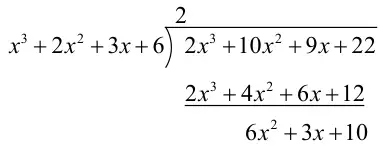 or states \(2 + \dfrac{\ldots}{2x^3 + 10x^2 + 9x + 22}\) \(\dfrac{6x^2 + 3x + 10}{(x + 2)\left(x^2 + 3\right)} = \dfrac{P}{x + 2} + \dfrac{Qx + R}{x^2 + 3}\) | M1 | 1.1a |
| \(6x^2 + 3x + 10 = P\left(x^2 + 3\right) + (Qx + R)(x + 2)\) Correct method to find at least two of the values \(P\), \(Q\) and \(R\) for example \(x = -2 \Rightarrow P = \ldots\{28 = 7P\}\) coeff \(x^2 \Rightarrow Q = \ldots\{6 = P + Q\}\) \(x = 0 \Rightarrow R = \ldots\{10 = 3P + 2R\}\) coeff \(x \Rightarrow R = \ldots\{3 = 2Q + R\}\) | dM1 | 3.1a |
or states \(2 + \dfrac{\ldots}{2x^3 + 10x^2 + 9x + 22}\) | B1 | 1.1b |
| \(2 + \dfrac{4}{x + 2} + \dfrac{2x - 1}{x^2 + 3}\) | A1 | 1.1b |
| (4) |
M1: Selects the correct form for partial fractions, (following an attempt at algebraic long division which led to an integer quotient, which may or may not be 2, and their remainder must be a 3TQ)
Their partial fractions must be of the form \(\dfrac{P}{x + 2} + \dfrac{Qx + R}{x^2 + 3}\)
dM1: Complete method for finding the value of at least 2 constants. Dependent on having the correct form for the partial fractions. Allow slips, provided their intention is clear.
B1: Correct constant 2, may be seen in their long division and is likely to appear at the beginning of their workings. This is independent of any method and should be awarded regardless of any incorrect use of partial fractions.
A1: Correct solution written as partial fractions, but not for listing values for constants.
| Scheme | Marks | AO |
|---|---|---|
| \(\cdots + \displaystyle\int \dfrac{4}{x + 2} + \dfrac{2x - 1}{x^2 + 3}\,\mathrm{d}x = \cdots + \displaystyle\int \dfrac{4}{x + 2} + \dfrac{2x}{x^2 + 3} - \dfrac{1}{x^2 + 3}\,\mathrm{d}x\) \(= \alpha\ln(x + 2) + \beta\ln\left(x^2 + 3\right) + \lambda\arctan\left(\dfrac{x}{\sqrt{3}}\right)\) | M1 | 3.1a |
| \(= 2x + 4\ln(x + 2) + \ln\left(x^2 + 3\right) - \dfrac{1}{\sqrt{3}}\arctan\left(\dfrac{x}{\sqrt{3}}\right)\) | A1 | 2.1 |
| \(= \left[2(1) + 4\ln(1 + 2) + \ln\left(1^2 + 3\right) - \dfrac{1}{\sqrt{3}}\arctan\left(\dfrac{1}{\sqrt{3}}\right)\right] - \left[2(0) + 4\ln(0 + 2) + \ln\left(0^2 + 3\right) - \dfrac{1}{\sqrt{3}}\arctan\left(\dfrac{0}{\sqrt{3}}\right)\right]\) \(= \left[2 + 4\ln(3) + \ln(4) - \dfrac{1}{\sqrt{3}}\arctan\left(\dfrac{1}{\sqrt{3}}\right)\right] - [4\ln 2 + \ln 3] = \ldots\) | dM1 | 1.1b |
| \(2 + \ln\left(\dfrac{27}{4}\right) - \dfrac{\pi}{6\sqrt{3}}\) * cso | A1* | 2.1 |
| (4) | ||
| (8 marks) |
Notes
M1: Rewrites the integral (without the constant term) into an integrable form and integrates to the correct form \(\alpha\ln(x + 2) + \beta\ln\left(x^2 + 3\right) + \lambda\arctan\left(\dfrac{x}{\sqrt{3}}\right)\), where \(\alpha\), \(\beta\) and \(\lambda\) are non-zero constants.
A1: Fully correct integration for the whole expression.
dM1: Uses the limits of 0 and 1, subtracts the correct way round and combines their ln terms correctly.
A1*: Correct answer cso (but can be written in any order)