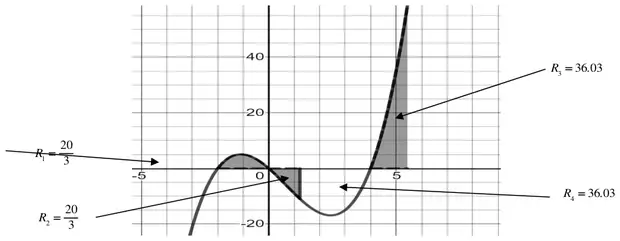
June 2019 Paper 1 Q8
8.
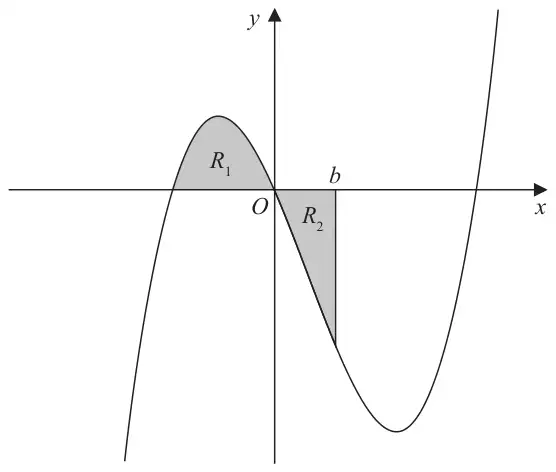
Figure 2 shows a sketch of part of the curve with equation \(y = x(x+2)(x-4)\).
The region \(R_1\) shown shaded in Figure 2 is bounded by the curve and the negative \(x\)-axis.
The region \(R_2\) also shown shaded in Figure 2 is bounded by the curve, the positive \(x\)-axis and the line with equation \(x = b\), where \(b\) is a positive constant and \(0 \lt b \lt 4\)
Given that the area of \(R_1\) is equal to the area of \(R_2\)
The roots of the equation \(3b^2 - 20b + 20 = 0\) are 1.225 and 5.442 to 3 decimal places.
The value of \(b\) is therefore 1.225 to 3 decimal places.
| Scheme | Marks | AO |
|---|---|---|
| \(y = x(x+2)(x-4) = x^3 - 2x^2 - 8x\) | B1 | 1.1b |
| \(\displaystyle\int x^3 - 2x^2 - 8x\,\mathrm{d}x \to \dfrac{1}{4}x^4 - \dfrac{2}{3}x^3 - 4x^2\) | M1 | 1.1b |
| Attempts area using the correct strategy \(\displaystyle\int_{-2}^{0} y\,\mathrm{d}x\) | dM1 | 2.2a |
| \(\left[\dfrac{1}{4}x^4 - \dfrac{2}{3}x^3 - 4x^2\right]_{-2}^{0} = (0) - \left(4 - \dfrac{-16}{3} - 16\right) = \dfrac{20}{3}\ *\) | A1* | 2.1 |
| (4) |
Notes
B1: Expands \(x(x+2)(x-4)\) to \(x^3 - 2x^2 - 8x\) (They may be in a different order)
M1: Correct attempt at integration of their cubic seen in at least two terms.
Look for an expansion to a cubic and \(x^n \to x^{n+1}\) seen at least twice
dM1: For a correct strategy to find the area of R1
It is dependent upon the previous M and requires a substitution of \(-2\) into \(\pm\) their integrated function.
The limit of 0 may not be seen. Condone \(\left[\dfrac{1}{4}x^4 - \dfrac{2}{3}x^3 - 4x^2\right]_{-2}^{0} = \dfrac{20}{3}\) oe for this mark
A1*: For a rigorous argument leading to area of \(R_1 = \dfrac{20}{3}\) For this to be awarded the integration must be correct and the limits must be the correct way around and embedded or calculated values must be seen.
Eg. Look for \(-\left(4 + \dfrac{16}{3} - 16\right)\) or \(-\left(\dfrac{1}{4}(-2)^4 - \dfrac{2}{3}(-2)^3 - 4(-2)^2\right)\) oe before you see the \(\dfrac{20}{3}\)
Note: It is possible to do this integration by parts.
| Scheme | Marks | AO |
|---|---|---|
| For setting ‘their’ \(\dfrac{1}{4}b^4 - \dfrac{2}{3}b^3 - 4b^2 = \pm\dfrac{20}{3}\) | M1 | 1.1b |
| For correctly deducing that \(3b^4 - 8b^3 - 48b^2 + 80 = 0\) | A1 | 2.2a |
| Attempts to factorise \(3b^4 - 8b^3 - 48b^2 \pm 80 = (b+2)(b+2)(3b^2 \ldots b \ldots 20)\) | M1 | 1.1b |
| Achieves \((b+2)^2(3b^2 - 20b + 20) = 0\) with no errors | A1* | 2.1 |
| (4) |
Notes
M1: For setting their \(\dfrac{1}{4}b^4 - \dfrac{2}{3}b^3 - 4b^2 = \pm\dfrac{20}{3}\) or \(\left[\dfrac{1}{4}x^4 - \dfrac{2}{3}x^3 - 4x^2\right]_{-2}^{b} = 0\)
A1: Deduces that \(3b^4 - 8b^3 - 48b^2 + 80 = 0\). Terms may be in a different order but expect integer coefficients.
It must have followed \(\dfrac{1}{4}b^4 - \dfrac{2}{3}b^3 - 4b^2 = -\dfrac{20}{3}\) oe.
Do not award this mark for \(\dfrac{1}{4}b^4 - \dfrac{2}{3}b^3 - 4b^2 + \dfrac{20}{3} = 0\) unless they attempt the second part of this question by expansion and then divide the resulting expanded expression by 12
M1: Attempts to factorise \(3b^4 - 8b^3 - 48b^2 \pm 80 = (b+2)(b+2)(3b^2 \ldots b \ldots 20)\) via repeated division or inspection. FYI \(3b^4 - 8b^3 - 48b^2 + 80 = (b+2)(3b^3 - 14b^2 - 20b + 40)\) Allow an attempt via inspection \(3b^4 - 8b^3 - 48b^2 \pm 80 = (b^2 + 4b + 4)(3b^2 \ldots b \ldots 20)\) but do not allow candidates to just write out \(3b^4 - 8b^3 - 48b^2 \pm 80 = (b+2)^2(3b^2 - 20b + 20)\) which is really just copying out the given answer.
Alternatively attempts to expand \((b+2)^2(3b^2 - 20b + 20)\) achieving terms of a quartic expression
A1*: Correctly reaches \((b+2)^2(3b^2 - 20b + 20) = 0\) with no errors and must have \(= 0\)
In the alternative obtains both equations in the same form and states that they are same. Allow ✓ QED etc here.
| Scheme | Marks | AO |
|---|---|---|
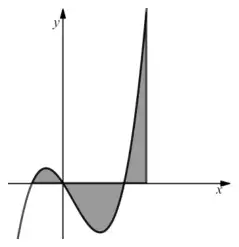 | ||
| States that between \(x = -2\) and \(x = 5.442\) the area above the \(x\)-axis = area below the \(x\)-axis | B1 B1 | 1.1b 2.4 |
| (2) | ||
| (10 marks) |
Notes
(c) Please watch for candidates who answer this on Figure 2 which is fine
B1: Sketches the curve and a vertical line to the right of 4 (\(x = 5.442\) may not be labelled.)
B1: Explains that (between \(x = -2\) and \(x = 5.442\)) the area above the \(x\)-axis = area below the \(x\)-axis with appropriate areas shaded or labelled.
Alternatively states that the area between 1.225 and 4 is the same as the area between 4 and 5.442
Another correct statement is that the net area between 0 and 5.442 is \(-\dfrac{20}{3}\)
Look carefully at what is written. There are many correct statements/ deductions.
Eg. " (area between 0 and 4) - (area between 4 and 5.442) = 20/3". Diagram below for your information.