
June 2019 Paper 2 Q5
5.
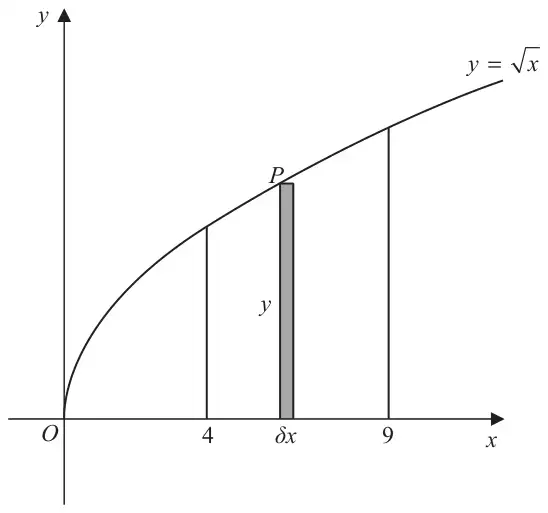
Figure 3 shows a sketch of the curve with equation \(y = \sqrt{x}\)
The point \(P(x, y)\) lies on the curve.
The rectangle, shown shaded on Figure 3, has height \(y\) and width \(\delta x\).
Calculate
\[\lim_{\delta x \to 0} \sum_{x=4}^{9} \sqrt{x}\,\delta x\](3)
| Scheme | Marks | AO |
|---|---|---|
| States \(\left\{\displaystyle\lim_{\delta x \to 0} \sum_{x=4}^{9} \sqrt{x}\,\delta x \text{ is}\right\}\ \displaystyle\int_4^9 \sqrt{x}\,\mathrm{d}x\) | B1 | 1.2 |
| \(= \left[\dfrac{2}{3}x^{\frac{3}{2}}\right]_4^9\) | M1 | 1.1b |
| \(= \dfrac{2}{3} \times 9^{\frac{3}{2}} - \dfrac{2}{3} \times 4^{\frac{3}{2}} = \dfrac{54}{3} - \dfrac{16}{3}\) | ||
| \(= \dfrac{38}{3}\ \text{ or }\ 12\dfrac{2}{3}\ \text{ or awrt } 12.7\) | A1 | 1.1b |
| (3) | ||
| (3 marks) |
Notes
B1: States \(\displaystyle\int_4^9 \sqrt{x}\,\mathrm{d}x\) with or without the ‘\(\mathrm{d}x\)’
M1: Integrates \(\sqrt{x}\) to give \(\lambda x^{\frac{3}{2}};\ \lambda \neq 0\)
A1: See scheme
Note: You can imply B1 for \(\left[\lambda x^{\frac{3}{2}}\right]_4^9\) or for \(\lambda \times 9^{\frac{3}{2}} - \lambda \times 4^{\frac{3}{2}}\)
Note: Give B0 for \(\displaystyle\int_1^9 \sqrt{x}\,\mathrm{d}x - \int_1^3 \sqrt{x}\,\mathrm{d}x\) or for \(\displaystyle\int_3^9 \sqrt{x}\,\mathrm{d}x\) without reference to a correct \(\displaystyle\int_4^9 \sqrt{x}\,\mathrm{d}x\)
Note: Give B1 M1 A1 for no working leading to a correct \(\dfrac{38}{3}\ \text{ or }\ 12\dfrac{2}{3}\ \text{ or awrt } 12.7\)
Note: Give B1 M1 A1 for \(\displaystyle\int_4^9 \sqrt{x}\,\mathrm{d}x = \dfrac{38}{3}\ \text{ or }\ 12\dfrac{2}{3}\ \text{ or awrt } 12.7\)
Note: Give B1 M1 A1 for \(\left[\dfrac{2}{3}x^{\frac{3}{2}} + c\right]_4^9 = \dfrac{38}{3}\ \text{ or }\ 12\dfrac{2}{3}\ \text{ or awrt } 12.7\)
Note: Give B1 M1 A1 for no working followed by an answer \(\dfrac{38}{3}\ \text{ or }\ 12\dfrac{2}{3}\ \text{ or awrt } 12.7\)
Note: Give M0 A0 for use of a trapezium rule method to give an answer of awrt 12.7,
but allow B1 if \(\displaystyle\int_4^9 \sqrt{x}\,\mathrm{d}x\) is seen in a trapezium rule method
Note: Otherwise, give B0 M0 A0 for using the trapezium rule to give an answer of awrt 12.7
Alt
The following method is correct:
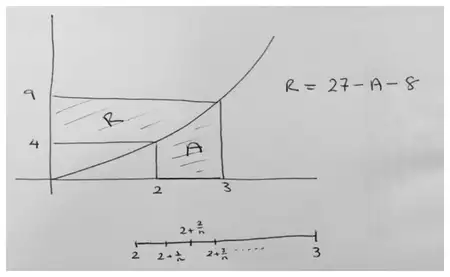
(corrected from the printed mark scheme: the first term on the fifth line is printed as \(\dfrac{4}{n}\); it should be \(\dfrac{4n}{n}\), as on the line above)
\[\text{So, } \lim_{\delta x \to 0}\sum_{x=4}^{9}\sqrt{x}\,\delta x = \text{Area}(R) = (3 \times 9) - (2 \times 4) - \frac{19}{3} = \frac{38}{3}\ \text{ or }\ 12\frac{2}{3}\ \text{ or awrt } 12.7\]