
June 2019 Paper 3 Q4
4
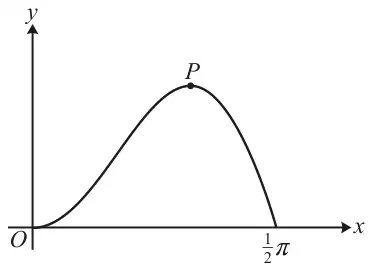
The diagram shows the part of the curve \(y = 3x\sin 2x\) for which \(0 \leqslant x \leqslant \frac{1}{2}\pi\).
The maximum point on the curve is denoted by \(P\).
Show that the result can be expressed as \(k\pi^2(\sqrt{2} + 1)\), where \(k\) is a rational number to be determined. [4]
| Scheme | Marks | AO |
|---|---|---|
| \(\dfrac{\mathrm{d}y}{\mathrm{d}x} = 3\sin 2x + 6x\cos 2x\) | M1* | 2.1 |
| \(\sin 2x + 2x\cos 2x = 0\) | M1dep* | 1.1 |
| \(\left(\dfrac{\sin 2x}{\cos 2x}\right) + 2x\left(\dfrac{\cos 2x}{\cos 2x}\right) = 0 \Rightarrow \tan 2x + 2x = 0\) | A1 | 2.2a |
| [3] |
Notes
M1*: Attempt use of product rule – answer of the form \(\lambda\sin 2x + \mu x\cos 2x\)
\(\lambda, \mu \neq 0\)
M1dep*: Sets derivative equal to zero
A1: AG – at least one step of correct intermediate working (e.g. \(\cos 2x\tan 2x + 2x\cos 2x = 0\)) from previous M mark to given answer (If \(\cos 2x = 0\) and \(\tan 2x + 2x = 0\) seen from \(\cos 2x(\tan 2x + 2x) = 0\) then \(\cos 2x = 0\) must be rejected)
Must be convincing as AG (must be = 0) – must see division by \(\cos 2x\) (or stating the need to divide by this term but not just divide by cos)
| Scheme | Marks | AO | |||||||||||||||||||||||||||||||||||||||
|---|---|---|---|---|---|---|---|---|---|---|---|---|---|---|---|---|---|---|---|---|---|---|---|---|---|---|---|---|---|---|---|---|---|---|---|---|---|---|---|---|---|
| \(\mathrm{f}'(x) = 2\sec^2 2x + 2\) | B1 | 1.1 | |||||||||||||||||||||||||||||||||||||||
| \(x_{n+1} = x_n - \dfrac{\tan 2x_n + 2x_n}{2\sec^2 2x_n + 2}\) | M1 | 2.1 | |||||||||||||||||||||||||||||||||||||||
| A1 | 1.1 | |||||||||||||||||||||||||||||||||||||||
| \(x\)-coordinate of \(P\) is 1.0144 | A1 | 2.2a | |||||||||||||||||||||||||||||||||||||||
| [4] |
Notes
B1: Correct derivative
M1: Substitute their derivative (of the form \(\alpha\sec^2 2x + 2\)) into correct N-R formula
Need not be simplified and allow in terms of \(x\) only
A1: First two values correct (\(x_1\) and \(x_2\)) stated to at least 4 decimal places (truncated or rounded) – the table is not exhaustive and any other values used as a starting value in the interval given in the second guidance column will need to be checked - If no evidence of using NR (e.g. correct answer with no working) then no marks in this part. Dependent on correct NR formula (so must have scored B1)
Starting value must be in the interval \(\dfrac{\pi}{4} \lt x_0 \lt \dfrac{3\pi}{4}\) \((0.786 \leqslant x_0 \leqslant 2.35)\)
A1: Independent of previous A mark (but must have scored B1M1) – must be stated to exactly 4 decimal places
1.014 378 911 …
Alternative (ALT)
| Scheme | Marks | ||||||||||||||||||||||||||||||||||||||||||
|---|---|---|---|---|---|---|---|---|---|---|---|---|---|---|---|---|---|---|---|---|---|---|---|---|---|---|---|---|---|---|---|---|---|---|---|---|---|---|---|---|---|---|---|
| \(\mathrm{f}'(x) = 2\cos 2x + 2\cos 2x - 4x\sin 2x\) or \(\mathrm{f}'(x) = 6\cos 2x + 6\cos 2x - 12x\sin 2x\) | B1 | ||||||||||||||||||||||||||||||||||||||||||
| \(x_{n+1} = x_n - \dfrac{\sin 2x_n + 2x_n\cos 2x_n}{4\cos 2x_n - 4x_n\sin 2x_n}\) | M1 | ||||||||||||||||||||||||||||||||||||||||||
| A1 | ||||||||||||||||||||||||||||||||||||||||||
| \(x\)-coordinate of \(P\) is 1.0144 | A1 [4] |
B1: Correct derivative of either \(\sin 2x + 2x\cos 2x\) or \(3\sin 2x + 6x\cos 2x\)
M1: Substitute their derivative (of the form \(\alpha\cos 2x + \beta x\sin 2x\)) into correct formula for N-R
Need not be simplified and allow in terms of \(x\) only
A1: First two values correct (\(x_1\) and \(x_2\)) stated to at least 4 decimal places – the table is not exhaustive and any other values used as a starting value in the interval given in the second guidance column will need to be checked - If no evidence of using NR (e.g. correct answer with no working) then no marks in this part. Dependent on correct NR formula (so must have scored B1)
Starting values must be in interval \(0.65 \leqslant x_0 \leqslant 1.61\)
A1: Independent of previous A mark (but must have scored B1M1) – must be stated to exactly 4 decimal places
1.014 378 911 …
| Scheme | Marks | AO |
|---|---|---|
| \(h = \dfrac{\pi}{8}\) | B1 | 1.1 |
| \(\frac{1}{2}h\left[0 + 2\left(3\left(\frac{\pi}{8}\right)\sin\left(\frac{\pi}{4}\right) + 3\left(\frac{\pi}{4}\right)\sin\left(\frac{\pi}{2}\right) + 3\left(\frac{3\pi}{8}\right)\sin\left(\frac{3\pi}{4}\right)\right) + 0\right]\) \(\left(= \frac{1}{2}h\left[0 + 2\left(\frac{3}{16}\pi\sqrt{2} + \frac{3}{4}\pi + \frac{9}{16}\pi\sqrt{2}\right) + 0\right]\right)\) | M1 | 2.1 |
| \(\frac{1}{16}\pi\left(\frac{3}{8}\pi\sqrt{2} + \frac{3}{2}\pi + \frac{9}{8}\pi\sqrt{2}\right)\) | A1 | 1.1 |
| \(\frac{3}{32}\pi^2\left(\sqrt{2} + 1\right)\) | A1 | 2.2a |
| [4] |
Notes
B1: For using \(\frac{1}{2} \times \frac{\pi}{8}\) or \(\frac{\pi}{16}\) or exact equivalent or for stating \(h\)
Not just for \(\dfrac{\pi}{8}\) seen
M1: Correct […] structure including multiplying the middle terms by 2. The zeros may be omitted. Allow one incorrect \(y\) value only. Any additional values or repeated values is M0. M0 if using \(x\) values or if only non-exact values seen but allow for the M mark if left in terms of sin
Ignore \(\frac{1}{2}h\) term for this mark
Note first 0 might be \(3(0)\sin(2(0))\) and second 0 might be \(3\left(\frac{\pi}{2}\right)\sin\pi\)
A1: Correct (possibly un-simplified) exact expression for integral
Not in terms of sin and correct value of \(h\) used
A1: \(k = \frac{3}{32}\) www
| Scheme | Marks | AO |
|---|---|---|
| (i) \(\displaystyle\int_0^{\frac{1}{2}\pi} 3x\sin 2x\,\mathrm{d}x = \frac{3}{4}\pi\) | B1 | 1.1 |
| [1] | ||
| (ii) \(\frac{3}{32}\pi^2\left(\sqrt{2} + 1\right) \approx 2.23 \lt 2.356\ldots\) so trapezium rule gives an under-estimate of the area | B1 | 2.2a |
| [1] | ||
| (iii) LH trapezium above curve, but others below curve, so overall approximation not clear | B1 | 2.4 |
| [1] |
Notes
(d)(i) B1: BC – ignore any working and mark final answer only (allow awrt 2.36)
oe, e.g. 2.356…
(d)(ii) B1: Dependent on correct value in (c) (but may not be exact) and correct value for integral in (d)(i) – must state in this part correct decimal values (to at least 2 sf) for comparison (or 2.36 seen in (d)(i))
B0 if only ‘under-estimate’ stated with no reasoning
(d)(iii) B1: oe e.g. trapezia/strips not all below the curve
e.g. the curve changes from being convex to concave (concave up to concave down)
e.g. the rate of change of the gradient changes from positive to negative
Condone mention of the curve being both concave and convex in the interval