
June 2019 Paper 2 Q5
5
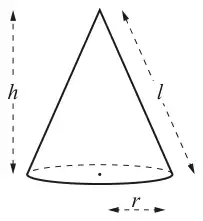
For a cone with base radius \(r\), height \(h\) and slant height \(l\), the following formulae are given.
Curved surface area, \(S = \pi rl\)
Volume, \(V = \frac{1}{3}\pi r^2h\)
A container is to be designed in the shape of an inverted cone with no lid. The base radius is \(r\) m and the volume is \(V\) m3.
The area of the material to be used for the cone is \(4\pi\) m2.
It is given that \(V\) has a maximum value for a certain value of \(r\).
Find the maximum value of \(V\), giving your answer correct to 3 significant figures. [5]
| Scheme | Marks | AO |
|---|---|---|
| An example of a correct method: \(l = \dfrac{4}{r}\) or \(l = \dfrac{4\pi}{r\pi}\) exactly (not \(lr = 4\)) | B1 | 3.1a |
| \((h = \sqrt{l^2 - r^2})\) \(h = \sqrt{\dfrac{16}{r^2} - r^2}\) or \(\dfrac{\sqrt{16 - r^4}}{r}\) oe | B1 | 1.1 |
| \(V = \dfrac{1}{3}\pi r^2\sqrt{\dfrac{16}{r^2} - r^2}\) or \(\dfrac{1}{3}\pi r^2\dfrac{\sqrt{16 - r^4}}{r}\) oe | M1 | 1.1 |
| \(\left(= \dfrac{\pi}{3}\sqrt{16r^2 - r^6}\right.\) AG) | A1 | 2.1 |
| [4] |
Notes
Other correct methods may be seen
eg \(lr = 4\): B1, find \(h\) ito \(l\) & \(r\): B1, Subst \(h\) & \(lr\) into \(V\): M1, convincing: A1
NB Must be clearly using this alternative method to score any marks on this scheme.
B1: Express \(l\) correctly in terms of \(r\)
May be implied
Allow \(l = \dfrac{4 - r^2}{r}\) oe B1
B1: Express \(h\) (or \(h^2\)) correctly in terms of \(r\) alone
\((h^2 = l^2 - r^2)\)
or \(h^2 = \dfrac{16}{r^2} - r^2\) or \(\dfrac{16 - r^4}{r^2}\)
M1: Sub their \(h\) (in terms of \(r\) alone) into \(\frac{1}{3}\pi r^2h\)
A1: Must see a correct previous expression in terms of \(r\) only, and the answer
| Scheme | Marks | AO |
|---|---|---|
| DR \(\dfrac{\mathrm{d}}{\mathrm{d}r}\left(\dfrac{\pi}{3}\sqrt{16r^2 - r^6}\right)\) | M1 | 1.1a |
| \(\dfrac{\pi(32r - 6r^5)}{3 \times 2\sqrt{16r^2 - r^6}} = 0\) oe (Their derivative = 0) | A1 | 2.1 |
| \(r = \dfrac{2}{\sqrt[4]{3}}\) or \(\sqrt[4]{\dfrac{16}{3}}\) oe or 1.52 (3 sf) Allow 1.5 or \(r^2 = \dfrac{4}{\sqrt{3}}\) | A1 | 1.1 |
| \(r = -\dfrac{2}{\sqrt[4]{3}}\) or \(-1.52\) invalid OR \(r = 0\) invalid or \(r \gt 0\) | B1f | 3.2a |
| \(\left(V_{\max} = \dfrac{\pi}{3}\sqrt{16 \times 1.51967^2 - 1.51967^6}\right)\) Max \(V = 5.20\) (3 sf) Allow 5.2 or a.r.t. 5.2 | A1 | 1.1 |
| [5] |
Notes
M1: Attempt differentiate \(V\) or \(\dfrac{V}{\pi}\) or \(3V\)
or \(\dfrac{3V}{\pi}\) or \(\sqrt{16r^2 - r^6}\) or \(16r^2 - r^6\)
A1: Correct derivative of one of the above
Condone missing brackets.
All subsequent marks can be scored even if this A1 not scored.
A1: Lose this mark if incorrect values of \(r\) also given, eg \(r = \pm 2\) obtained from \((16r^2 - r^6)^{-\frac{1}{2}} = 0\)
Allow without \(r = 0\)
B1f: Comment needed, about their negative \(r\) (ft) or about \(r = 0\)
A1: Condone \(V = 5.20\) m3
T & I: 5.20 (3sf) SC B2
5.2 (2 sf) SC B1