
June 2018 Paper 3 Q12
12 One end of a light inextensible string is attached to a particle \(A\) of mass \(m\) kg. The other end of the string is attached to a second particle \(B\) of mass \(\lambda m\) kg, where \(\lambda\) is a constant. Particle \(A\) is in contact with a rough plane inclined at \(30^\circ\) to the horizontal. The string is taut and passes over a small smooth pulley \(P\) at the top of the plane. The part of the string from \(A\) to \(P\) is parallel to a line of greatest slope of the plane. The particle \(B\) hangs freely below \(P\) (see diagram).
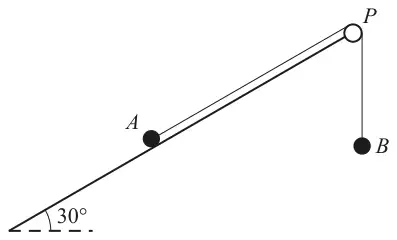
The coefficient of friction between \(A\) and the plane is \(\mu\).
| Scheme | Marks | AO |
|---|---|---|
| \(R = mg\cos 30\) | B1 | 3.3 |
| \(T = \frac{1}{4}mg\) | B1 | 1.1 |
| \(T + F - mg\sin 30 = 0\) | M1 A1 | 3.3 1.1 |
| \(F = \mu(mg\cos 30)\) | M1 | 3.3 |
| \(\dfrac{1}{4}mg + \mu\left(\dfrac{mg\sqrt{3}}{2}\right) - \dfrac{1}{2}mg = 0 \Rightarrow \mu = \ldots\) | M1 | 2.1 |
| \(\mu = \dfrac{\sqrt{3}}{6}\) | A1 | 2.2a |
| [7] |
Notes
B1: Resolving perpendicular to the plane
B1: Resolving vertically for \(B\)
M1: Resolving parallel to the plane – three terms – allow signs and sin/cos confusion
M1: Use of \(F = \mu R\)
M1: Deriving equation in \(\mu\) (and \(m\) and \(g\)) and attempt to solve for \(\mu\) – dependent on previous M marks and second B mark
| Scheme | Marks | AO |
|---|---|---|
| \(F = mg\sin 30 - \lambda mg\ (\gt 0)\) | M1 | 3.1a |
| \(F \gt 0 \Rightarrow \lambda \lt \dfrac{1}{2}\) | A1 | 2.2a |
| [2] |
Notes
M1: Resolving parallel to the plane with \(\lambda mg\)
| Scheme | Marks | AO |
|---|---|---|
| \(T - F - mg\sin 30 = m\left(\frac{1}{4}g\right)\) | M1 | 3.3 |
| \(2mg - T = 2m\left(\frac{1}{4}g\right)\) | B1 | 3.3 |
| \(2mg - F - mg\sin 30 = \frac{3}{4}mg\) | A1 | 1.1 |
| \(2mg - \mu(mg\cos 30) - mg\sin 30 = \frac{3}{4}mg\) | A1 | 2.1 |
| \(\mu = \dfrac{\sqrt{3}}{2}\) | A1 | 2.2a |
| [5] |
Notes
M1: N II parallel to the plane – four terms
Allow \(a\)
B1: N II for \(B\)
Allow \(a\)
A1: Correct method for eliminating \(T\)
A1: Correct use of \(F = \mu R\) and \(R = mg\cos 30\)