
June 2018 Paper 1 Q12
12 In this question you must show detailed reasoning.
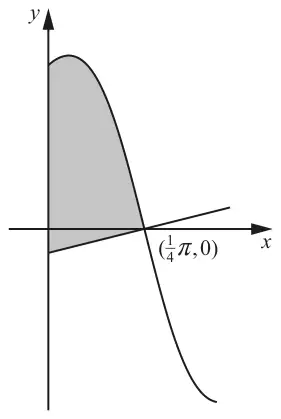
The diagram shows the curve \(y = \dfrac{4\cos 2x}{3 - \sin 2x}\), for \(x \geqslant 0\), and the normal to the curve at the point \((\frac{1}{4}\pi, 0)\). Show that the exact area of the shaded region enclosed by the curve, the normal to the curve and the \(y\)-axis is \(\ln\frac{9}{4} + \frac{1}{128}\pi^2\). [10]
| Scheme | Marks | AO |
|---|---|---|
| DR | ||
| \(\dfrac{\mathrm{d}y}{\mathrm{d}x} = \dfrac{(-8\sin 2x)(3 - \sin 2x) - (4\cos 2x)(-2\cos 2x)}{(3 - \sin 2x)^2}\) | M1 A1 | 3.1a 1.1 |
| EITHER when \(x = \frac{1}{4}\pi\), gradient \(= \dfrac{-16 - 0}{4} = -4\) OR \(\dfrac{(-8\sin\frac{\pi}{2})(3 - \sin\frac{\pi}{2}) - (4\cos\frac{\pi}{2})(-2\cos\frac{\pi}{2})}{(3 - \sin\frac{\pi}{2})^2} = -4\) | M1 | 2.4 |
| gradient of normal is \(\frac{1}{4}\) | B1ft | 2.1 |
| area of triangle is \(\frac{1}{2} \times \frac{1}{16}\pi \times \frac{1}{4}\pi\ (= \frac{1}{128}\pi^2)\) | M1 | 2.1 |
| \(\displaystyle\int \frac{4\cos 2x}{3 - \sin 2x}\,\mathrm{d}x = -2\ln|3 - \sin 2x|\) | M1* A1 | 3.1a 1.1 |
| \(\displaystyle\int_0^{\frac{1}{4}\pi} \frac{4\cos 2x}{3 - \sin 2x}\,\mathrm{d}x = (-2\ln 2) - (-2\ln 3)\) | M1d* | 2.1 |
| \(2\ln 3 - 2\ln 2 = \ln 9 - \ln 4 = \ln\frac{9}{4}\) OR \(2\ln 3 - 2\ln 2 = 2\ln\frac{3}{2} = \ln\frac{9}{4}\) | A1 | 1.1 |
| hence total area is \(\ln\frac{9}{4} + \frac{1}{128}\pi^2\) A.G. | A1 | 2.1 |
| [10] |
Notes
M1: Attempt use of quotient rule
Correct structure, including subtraction in numerator
Could be equivalent using the product rule
A1: Obtain correct derivative
Award A1 once correct derivative seen even subsequently spoiled by simplification attempt
M1: DR
Attempt to find gradient at \(\frac{1}{4}\pi\)
EITHER
State that \(x = \frac{1}{4}\pi\) is being used, and show their fraction with each term (including 0) explicitly evaluated before being simplified
ie \(x = \frac{1}{4}\pi\), gradient \(= -4\) is M0
OR
Substitute \(\frac{1}{4}\pi\) into their derivative and evaluate
B1ft: Correct gradient of normal
ft their gradient of tangent
M1: Attempt area of triangle
ie \(\frac{1}{2} \times \frac{1}{4}\pi \times (\text{their } y)\)
\(y\) coordinate could come from using equation of normal, \(y = \frac{1}{4}(x - \frac{1}{4}\pi)\), or from using gradient of normal
Could integrate equation of normal
M1*: Obtain integral of form \(k\ln|3 - \sin 2x|\)
Condone brackets not modulus
Allow any method, including substitution, as long as integral of correct form
A1: Obtain correct integral
Possibly with unsimplified coefficient
M1d*: Attempt use of limits
Using \(\frac{1}{4}\pi\) and 0; correct order and subtraction (oe if substitution used)
Must see a minimum of \(-2\ln 2 + 2\ln 3\)
A1: Correct area under curve
Must be exact
At least one log law seen to be used before final answer
A1: Obtain correct total area
Any equivalent exact form
AG so method must be fully correct
A0 if the gradient of \(-4\) results from an incorrect derivative having been used
A0 if negative area of triangle not dealt with convincingly