
October 2021 Paper 2 Q14
14.
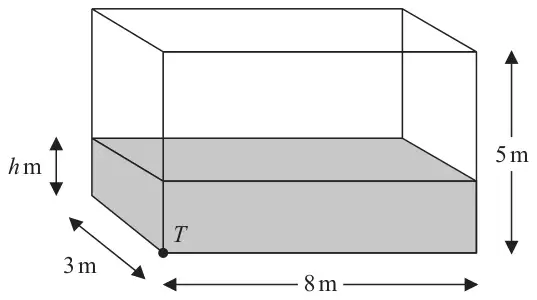
Water flows at a constant rate into a large tank.
The tank is a cuboid, with all sides of negligible thickness.
The base of the tank measures 8 m by 3 m and the height of the tank is 5 m.
There is a tap at a point \(T\) at the bottom of the tank, as shown in Figure 5.
At time \(t\) minutes after the tap has been opened
- the depth of water in the tank is \(h\) metres
- water is flowing into the tank at a constant rate of 0.48 m\(^3\) per minute
- water is modelled as leaving the tank through the tap at a rate of \(0.1h\) m\(^3\) per minute
Given that when the tap was opened, the depth of water in the tank was 2 m,
Given that the tap remains open,
| Scheme | Marks | AO |
|---|---|---|
| \(\dfrac{\mathrm{d}V}{\mathrm{d}t} = 0.48 - 0.1h\) | B1 | 3.1b |
| \(V = 24h \Rightarrow \dfrac{\mathrm{d}V}{\mathrm{d}h} = 24\) or \(\dfrac{\mathrm{d}h}{\mathrm{d}V} = \dfrac{1}{24}\) | B1 | 3.1b |
| \(\dfrac{\mathrm{d}h}{\mathrm{d}t} = \dfrac{\mathrm{d}V}{\mathrm{d}t} \times \dfrac{\mathrm{d}h}{\mathrm{d}V} = \dfrac{0.48 - 0.1h}{24}\) or e.g. \(\dfrac{\mathrm{d}V}{\mathrm{d}t} = \dfrac{\mathrm{d}V}{\mathrm{d}h}\dfrac{\mathrm{d}h}{\mathrm{d}t} \Rightarrow 0.48 - 0.1h = 24\dfrac{\mathrm{d}h}{\mathrm{d}t}\) | M1 | 2.1 |
| \(1200\dfrac{\mathrm{d}h}{\mathrm{d}t} = 24 - 5h\,*\) | A1* | 1.1b |
| (4) |
Notes
B1: Identifies the correct expression for \(\dfrac{\mathrm{d}V}{\mathrm{d}t}\) according to the model
B1: Identifies the correct expression for \(\dfrac{\mathrm{d}V}{\mathrm{d}h}\) according to the model
M1: Applies \(\dfrac{\mathrm{d}h}{\mathrm{d}t} = \dfrac{\mathrm{d}V}{\mathrm{d}t} \times \dfrac{\mathrm{d}h}{\mathrm{d}V}\) or equivalent correct formula with their \(\dfrac{\mathrm{d}V}{\mathrm{d}t}\) and \(\dfrac{\mathrm{d}V}{\mathrm{d}h}\) which may be implied by their working
A1*: Correct equation obtained with no errors
Note that: \(\dfrac{\mathrm{d}V}{\mathrm{d}t} = 0.48 - 0.1h \Rightarrow \dfrac{\mathrm{d}h}{\mathrm{d}t} = \dfrac{0.48 - 0.1h}{24} \Rightarrow 1200\dfrac{\mathrm{d}h}{\mathrm{d}t} = 24 - 5h\,*\) scores B1B0M0A0. There must be clear evidence where the “24” comes from and evidence of the correct chain rule being applied.
| Scheme | Marks | AO |
|---|---|---|
| \(1200\dfrac{\mathrm{d}h}{\mathrm{d}t} = 24 - 5h \Rightarrow \displaystyle\int \dfrac{1200}{24 - 5h}\,\mathrm{d}h = \int \mathrm{d}t\) \(\Rightarrow\) e.g. \(\alpha\ln(24 - 5h) = t\ (+c)\) oe or \(1200\dfrac{\mathrm{d}h}{\mathrm{d}t} = 24 - 5h \Rightarrow \dfrac{\mathrm{d}t}{\mathrm{d}h} = \dfrac{1200}{24 - 5h}\) \(\Rightarrow\) e.g. \(t\ (+c) = \alpha\ln(24 - 5h)\) oe | M1 | 3.1a |
| \(t = -240\ln(24 - 5h)\ (+c)\) oe | A1 | 1.1b |
| \(t = 0,\ h = 2 \Rightarrow 0 = -240\ln(24 - 10) + c \Rightarrow c = \ldots\ (240\ln 14)\) | M1 | 3.4 |
| \(t = 240\ln(14) - 240\ln(24 - 5h)\) | A1 | 1.1b |
| \(t = 240\ln\dfrac{14}{24 - 5h} \Rightarrow \dfrac{t}{240} = \ln\dfrac{14}{24 - 5h} \Rightarrow \mathrm{e}^{\frac{t}{240}} = \dfrac{14}{24 - 5h}\) \(\Rightarrow 14\mathrm{e}^{-\frac{t}{240}} = 24 - 5h \Rightarrow h = \ldots\) | ddM1 | 2.1 |
| \(h = 4.8 - 2.8\mathrm{e}^{-\frac{t}{240}}\) oe e.g. \(h = \dfrac{24}{5} - \dfrac{14}{5}\mathrm{e}^{-\frac{t}{240}}\) | A1 | 3.3 |
| (6) |
Notes
M1: Adopts a correct strategy by separating the variables correctly or rearranges to obtain \(\dfrac{\mathrm{d}t}{\mathrm{d}h}\) correctly in terms of \(h\) and integrates to obtain \(t = \alpha\ln(24 - 5h)\ (+c)\) or equivalent (condone missing brackets around the “\(24 - 5h\)”) and \(+\ c\) not required for this mark.
A1: Correct equation in any form and \(+\ c\) not required. Do not condone missing brackets unless they are implied by subsequent work.
M1: Substitutes \(t = 0\) and \(h = 2\) to find their constant of integration (there must have been some attempt to integrate)
A1: Correct equation in any form
ddM1: Uses fully correct log work to obtain \(h\) in terms of \(t\).
This depends on both previous method marks.
A1: Correct equation
Note that the marks may be earned in a different order e.g.:
\(t + c = -240\ln(24 - 5h) \Rightarrow -\dfrac{t}{240} + d = \ln(24 - 5h) \Rightarrow A\mathrm{e}^{-\frac{t}{240}} = 24 - 5h\)
\(t = 0,\ h = 2 \Rightarrow A = 14 \Rightarrow 14\mathrm{e}^{-\frac{t}{240}} = 24 - 5h \Rightarrow h = 4.8 - 2.8\mathrm{e}^{-\frac{t}{240}}\)
Score as M1 A1 as in main scheme then
M1: Correct work leading to \(A\mathrm{e}^{\alpha t} = 24 - 5h\) (must have a constant “\(A\)”)
A1: \(A\mathrm{e}^{-\frac{t}{240}} = 24 - 5h\)
ddM1: Uses \(t = 0,\ h = 2\) in an expression of the form above to find \(A\)
A1: \(h = 4.8 - 2.8\mathrm{e}^{-\frac{t}{240}}\)
| Scheme | Marks | AO |
|---|---|---|
Examples:
| M1 | 3.1b |
| A1 | 3.2a |
| (2) | ||
| (12 marks) |
Notes
M1: See scheme for some examples
A1: Makes a correct interpretation for their method.
There must be no incorrect working or contradictory statements.
This is not a follow through mark and if their equation in (b) is used it must be correct.