
October 2020 Paper 3 Q11
11
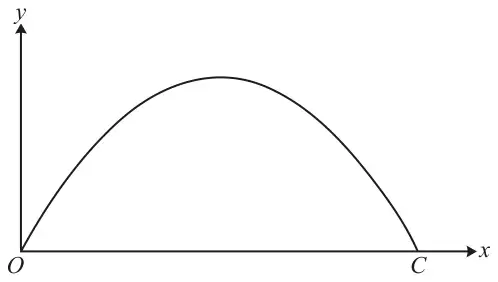
A particle \(P\) moves freely under gravity in the plane of a fixed horizontal axis \(Ox\), which lies on horizontal ground, and a fixed vertical axis \(Oy\). \(P\) is projected from \(O\) with a velocity whose components along \(Ox\) and \(Oy\) are \(U\) and \(V\), respectively. \(P\) returns to the ground at a point \(C\).
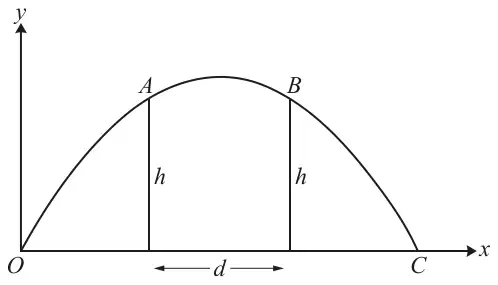
\(P\) passes through two points \(A\) and \(B\), each at a height \(h\) above the ground and a distance \(d\) apart, as shown in the diagram.
| Scheme | Marks | AO |
|---|---|---|
| \((OC =)\,Ut\) | B1 | 1.1 |
| \(0 = Vt - \tfrac{1}{2}gt^2 \Rightarrow t = \ldots\) | M1 | 3.3 |
| \(t = \dfrac{2V}{g}\) | A1 | 1.1 |
| \((OC =)\,\dfrac{2UV}{g}\) | A1 | 2.2a |
| [4] |
Notes
B1: Applies \(s = ut + 0.5at^2\) horizontally correctly with \(a = 0\)
M1: \(s = ut + 0.5at^2\) with \(s = 0\) and \(a = -g\) and solves for \(t\) or \(v = u + at\) vertically with \(v = 0\), \(u = V\) and time doubled
vertically – must be a complete method to find \(t\)
A1: Correct time
Ignore mention of \(t = 0\)
| Scheme | Marks | AO |
|---|---|---|
| Horizontal component is \((u_A =)\,U\) | B1 | 3.4 |
| Vertical component is \((v_A =)\,\sqrt{V^2 - 2gh}\) | B1 | 3.4 |
| [2] |
Notes
B1 (vertical component): oe Or \(V - gt\) provided \(t\) defined as the time of flight from \(O\) to \(A\)
| Scheme | Marks | AO |
|---|---|---|
| From \(A\) to \(B\) the time of flight \(T\) is \(\dfrac{d}{U}\) | B1ft | 1.1 |
| \(0 = v_A T - \tfrac{1}{2}gT^2 \Rightarrow v_A - \tfrac{1}{2}gT = 0\) Therefore \(\sqrt{V^2 - 2gh} - \tfrac{1}{2}gT = 0\) | M1 | 3.3 |
| \(\sqrt{V^2 - 2gh} - \tfrac{1}{2}g\left(\tfrac{d}{U}\right) = 0 \Rightarrow d = \dfrac{2U}{g}\sqrt{V^2 - 2gh}\) | A1 | 2.2a |
| [3] |
Notes
B1ft: Allow with their expression for the horizontal component
Or M1 for their \(d = \dfrac{2u_A v_A}{g}\) from (a) with their \(u_A\) and \(v_A\)
M1A1ft for \(d = \dfrac{2u_A v_A}{g}\) with their values (or vice-versa)
M1: Applies \(s = ut + 0.5at^2\) vertically with \(s = 0\) and uses vertical component from (b)
A1: oe
Full marks for correct answer with no working
| Scheme | Marks | AO |
|---|---|---|
| \(\dfrac{1}{2} = \dfrac{\left(\frac{gd}{2U}\right)}{U}\) or \(\dfrac{1}{2} = \dfrac{\sqrt{V^2 - 2gh}}{U}\) | M1* | 3.1b |
| \(U = \sqrt{gd}\) or \(U = 2\sqrt{V^2 - 2gh}\) | A1 | 1.1 |
| \(\sqrt{gd} = 2\sqrt{V^2 - 2gh}\) | M1dep* | 3.1a |
| \(gd = 4\left(V^2 - 2gh\right) \Rightarrow V = \tfrac{1}{2}\sqrt{g(8h + d)}\) | A1 | 2.2a |
| [4] |
Notes
M1*: Uses \(\tan\theta = \dfrac{v_A}{u_A}\) with their \(u_A\) and \(v_A\)
A1: A correct expression for \(U\) or \(U^2\)
M1dep*: Eliminate \(U\) and correct method to find \(V\)
A1: oe