
June 2018 Paper 3 Q5
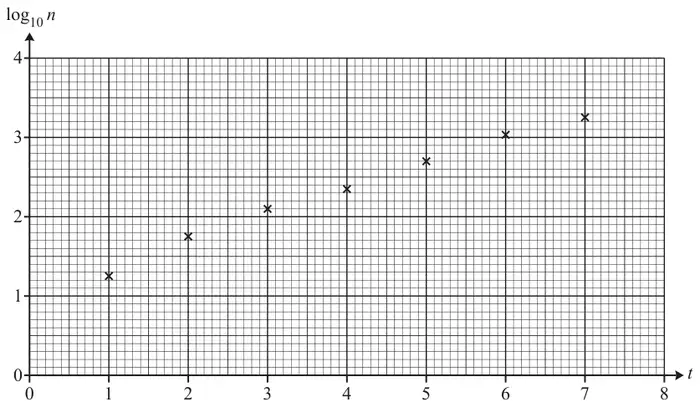
5 A social media website launched on 1 January 2017. The owners of the website report the number of users the site has at the start of each month. They believe that the relationship between the number of users, \(n\), and the number of months after launch, \(t\), can be modelled by \(n = a \times 2^{kt}\) where \(a\) and \(k\) are constants.
| Scheme | Marks | AO |
|---|---|---|
| \(\log_{10} n = \log_{10} a + kt\log_{10} 2\) | M1 | 1.1a |
| This is of form \(y = mx + c\) [with \(\log_{10} n\) as \(y\) and \(t\) as \(x\)] | E1 | 1.1 |
| [2] |
Notes
M1: AG
Allow \(t\log 2^k\)
| Scheme | Marks | AO |
|---|---|---|
| Reasonable line of best fit drawn (by eye) | B1 | 1.1a |
| Suitable method leading to \(a\) value eg use of intercept leading to \(0.9 < \log a < 1.2\) So \(7.94 < a < 15.85\) | M1 | 2.2a |
| Suitable method leading to \(k\) value eg \(k\log_{10} 2 =\) gradient \(\approx 0.33\) | M1 | 1.1 |
| \(k\) in range \(0 < k < 1.25\) and \(a\) in range \(7.94 < a < 15.85\) | A1 | 2.2a |
| [4] |
Notes
B1: With \(0.9 < c < 1.2\)
M1: May use 2 points from line or condone use of 2 given points
M1: Finding gradient of line or sub’n of \(t\) and \(\log n\)
A1: If gradient of exactly \(\frac{1}{3}\) used \(k = 1.10730936\ldots\)
(corrected from the printed mark scheme: the printed scheme shows the lower limit for \(a\) as 7.4 in both places; \(10^{0.9} = 7.94\))
| Scheme | Marks | AO |
|---|---|---|
| \(500000 = 10 \times 2^{1.1t}\) \(1.1t\log 2 = \log 50000\) | M1 | 3.4 |
| \(t = 14.2\) | A1 | 1.1 |
| \(t = 14\) is 1/3/18 | M1 | 3.4 |
| So 1/4/18 | A1 | 3.2a |
| [4] |
Notes
M1: Correct substitution
A1: Value of \(t\) (FT their \(a\) and \(k\))
For \(k = 1.10730936\ldots\) \(t = 14.1\) Same answer
M1: Translation into date
A1: Rounding up
| Scheme | Marks | AO |
|---|---|---|
| Suitable reason, e.g. The data are only for a short time scale and cannot extrapolate e.g. There will not be enough people for the growth to continue | E1 | 3.5b |
| [1] |