
June 2018 Paper 1 Q13
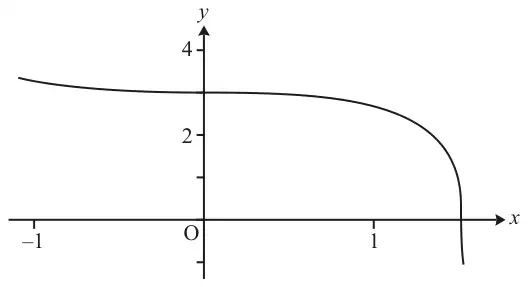
13 The function \(\mathrm{f}(x)\) is defined by \(\mathrm{f}(x) = \sqrt[3]{27 - 8x^3}\). Jenny uses her scientific calculator to create a table of values for \(\mathrm{f}(x)\) and \(\mathrm{f}^{\prime}(x)\).
| \(x\) | \(\mathrm{f}(x)\) | \(\mathrm{f}^{\prime}(x)\) |
|---|---|---|
| 0 | 3 | 0 |
| 0.25 | 2.9954 | –0.056 |
| 0.5 | 2.9625 | –0.228 |
| 0.75 | 2.8694 | –0.547 |
| 1 | 2.6684 | –1.124 |
| 1.25 | 2.2490 | –1.977 |
| 1.5 | 0 | ERROR |
The calculator gives 2.921 174 38 for \(\displaystyle\int_0^1 \sqrt[3]{27 - 8x^3}\,\mathrm{d}x\). The graph of \(y = \mathrm{f}(x)\) is shown in Fig. 13.
| Scheme | Marks | AO |
|---|---|---|
| \(\mathrm{f}^{\prime}(x) = \dfrac{1}{3}\left(27 - 8x^3\right)^{-\frac{2}{3}} \times \left(-24x^2\right)\) \(\left[= \dfrac{-8x^2}{\left(27 - 8x^3\right)^{\frac{2}{3}}}\right]\) | M1 A1 | 1.1a 1.1 |
| \(\mathrm{f}^{\prime}(1.5) = -\dfrac{8 \times 1.5^2}{0}\) and dividing by zero gives the error. | E1 | 2.4 |
| [3] |
Notes
M1: Using the chain rule
A1: Allow unsimplified
E1: Sufficient to say “can’t divide by zero” oe
| Scheme | Marks | AO |
|---|---|---|
| \(\left(27 - 8x^3\right)^{\frac{1}{3}} = 27^{\frac{1}{3}}\left(1 - \dfrac{8}{27}x^3\right)^{\frac{1}{3}}\) | B1 | 3.1a |
| \(= 3\left(1 + \left(\dfrac{1}{3}\right)\left(-\dfrac{8x^3}{27}\right) + \dfrac{\left(\frac{1}{3}\right)\left(-\frac{2}{3}\right)}{2!}\left(-\dfrac{8x^3}{27}\right)^2 + \ldots\right)\) | M1 | 1.1a |
| \(= 3 - \dfrac{8x^3}{27} - \dfrac{64x^6}{2187} + \ldots\) | A1 | 1.1b |
| [3] |
Notes
B1: Dealing with the 27 correctly
M1: Using the Binomial expansion substantially correctly
A1: Cao
| Scheme | Marks | AO |
|---|---|---|
| The binomial expansion is valid for \(\left|-8\dfrac{x^3}{27}\right| < 1\) | B1 | 2.4 |
| \(|x| < 1.5\) and the limits of the integral are completely in this interval. | E1 | 2.3 |
| [2] |
Notes
B1: Allow unsimplified but must use correct modulus notation or equivalent
E1: Must indicate that the limits of the integral lie in their interval for which the expansion is valid.
| Scheme | Marks | AO |
|---|---|---|
| \(\dfrac{0.25}{2}\left(3 + 2.6684 + 2\left(2.9954 + 2.9625 + 2.8694\right)\right)\) | B1 M1 | 1.1a 1.1b |
| \(= \dfrac{0.25}{2} \times 23.3224 = 2.9153\) | A1 | 1.1b |
| [3] |
Notes
B1: \(h = 0.25\) used
M1: For sum in the bracket – condone one slip.
A1: Allow for 2.92 or better
Values from candidates own calculators may differ in the last decimal place.
| Scheme | Marks | AO |
|---|---|---|
| There is area between the curve and the top of the trapezia, so some area is missing from the estimate. | E1 | 2.4 |
| [1] |
Notes
E1: Allow for any sensible explanation eg the trapezia are under the curve
“The curve is concave downwards” on its own is not quite enough