
June 2018 Paper 1 Q12
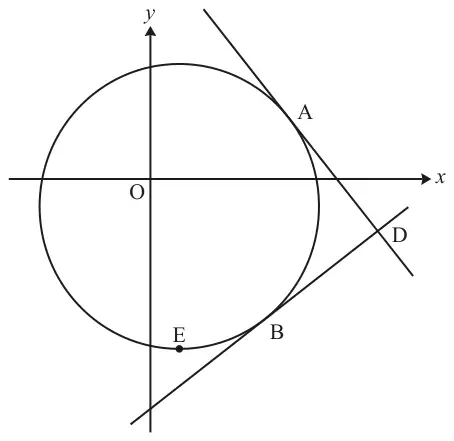
12 Fig. 12 shows the circle \((x-1)^2 + (y+1)^2 = 25\), the line \(4y = 3x - 32\) and the tangent to the circle at the point A \((5, 2)\). D is the point of intersection of the line \(4y = 3x - 32\) and the tangent at A.
| Scheme | Marks | AO |
|---|---|---|
| C is \((1, -1)\) | B1 | 1.1a |
| [1] |
Notes
B1: Cao
| Scheme | Marks | AO |
|---|---|---|
| (A) EITHER Substitute \(y = \dfrac{3}{4}x - 8\) into the equation of the circle \(\left(x - 1\right)^2 + \left(\dfrac{3}{4}x - 8 + 1\right)^2 = 25\) | M1 | 3.1a |
| \(x^2 - 8x + 16 = 0\) | M1 A1 | 1.1a 1.1b |
| EITHER \(\left(x - 4\right)^2 = 0\) OR Discriminant \(= (-8)^2 - 4 \times 1 \times 16 = 0\) So the equation has a repeated root so the line is a tangent | A1 | 2.2a |
| [4] | ||
| (B) \(x = 4\) and \(y = -5\) so B is \((4, -5)\) | B1 | 1.1a |
| [1] |
Notes
(A) AG
M1: Attempt to eliminate one variable
M1: Attempt to expand and collect terms to obtain 3 term quadratic expression
A1: A correct 3 term quadratic
A1: Clearly argued
OR (A)
| Scheme | Marks |
|---|---|
| OR Substitute \(x = \dfrac{4}{3}y - \dfrac{32}{3}\) into the equation of the circle \(\left(\dfrac{4}{3}y - \dfrac{32}{3} - 1\right)^2 + \left(y + 1\right)^2 = 25\) | M1 |
| \(y^2 + 10y + 25 = 0\) | M1 A1 |
| EITHER \(\left(y + 5\right)^2 = 0\) OR Discriminant \(= 10^2 - 4 \times 1 \times 25 = 0\) So the equation has a repeated root so the line is a tangent | A1 |
M1: Attempt to eliminate one variable
M1: Attempt to expand and collect terms to obtain 3 term quadratic expression
A1: A correct 3 term quadratic
A1: Clearly argued
(B)
B1: Cao
| Scheme | Marks | AO |
|---|---|---|
| \(\angle CAD = \angle CBD = 90^\circ\) (radius is perpendicular to the tangent) | B1 | 2.1 |
| Gradient of AC \(= \dfrac{2 - (-1)}{5 - 1} = \dfrac{3}{4}\) Gradient of BC \(= \dfrac{(-1) - (-5)}{1 - 4} = -\dfrac{4}{3}\) So AC is perpendicular to BC so \(\angle ACB = 90^\circ\) | B1 | 3.1a |
| So ADBC is a rectangle Either AC = BC radius [=5] Or AD = BD equal tangents so ADBC is a square. | B1 | 2.1 |
| [3] |
Notes
B1: Allow for one or other of these angles
B1: Complete proof
AG
Allow up to B1, B1 for any two of these three pieces of evidence. Allow the final B1 only when the proof is complete and clearly argued.
Alternative
| Scheme | Marks |
|---|---|
| \(\angle CAD = \angle CBD = 90^\circ\) (radius is perpendicular to the tangent) | B1 |
| Gradient of AC \(= \dfrac{2 - (-1)}{5 - 1} = \dfrac{3}{4}\) Gradient of BD is \(\dfrac{3}{4}\) So AC is parallel to BD So ADBC is a rectangle | B1 |
| AC = BC = radius so ADBC is a square. | B1 |
B1: Allow for one or other of these angles
B1: Complete proof
AG
Alternative
| Scheme | Marks |
|---|---|
| \(\angle CAD = 90^\circ\) (radius is perpendicular to the tangent) | B1 |
| AC = BC radius [=5] | B1 |
| Gradient of AC \(= \dfrac{2 - (-1)}{5 - 1} = \dfrac{3}{4}\) Equation of AD is \(y - 2 = -\dfrac{4}{3}(x - 5)\) So coordinates of D are (8, -2) Hence BD = 5 and AD = 5 So ABCD is a rhombus | B1 |
Gradient of AD must be found from the coordintes of A and C
B1: Complete proof
| Scheme | Marks | AO |
|---|---|---|
| E is the point (1, -6) | B1 | 2.1 |
EITHER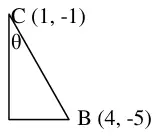 | M1 A1 | 3.1a 3.1a |
| OR \(BE = \sqrt{(4 - 1)^2 + \left(-5 - (-6)\right)^2} = \sqrt{10}\) Cosine rule in triangle BCE \(\cos BCE = \dfrac{5^2 + 5^2 - 10}{2 \times 5 \times 5}\left[= \dfrac{40}{50}\right]\) \(\angle BCE = 0.6435\ldots\) | (M1) (A1) | |
| OR M is the midpoint of BE M is (2.5, -5.5) \(BM = \sqrt{(4 - 2.5)^2 + \left(-5 - (-5.5)\right)^2} = \tfrac{1}{2}\sqrt{10}\) \(\angle BCM = \arcsin\left(\dfrac{\tfrac{1}{2}\sqrt{10}}{5}\right) = 0.32175\ldots\) \(\angle BCE = 0.6435\ldots\) | (M1) (A1) | |
| Area sector \(= \dfrac{1}{2}r^2\theta = \dfrac{1}{2} \times 25 \times 2 \times 0.32175\ldots\) \(= 8.04376\) | M1dep A1 | 1.1a 1.1b |
| [5] |
Notes
B1: May be implied
M1: Right-angled triangle formed and use of arctan
A1: oe
(M1): Using distance BC and the cosine rule
(A1): oe
(M1): Using trig in triangle BCM or ECM Allow for \(\angle BCM\)
(A1): Oe. Must be \(\angle BCE\)
M1dep: Using the sector area formula
A1: FT their \(\angle BCM\)