
June 2022 Paper 2 Q2
2.
| Scheme | Marks | AO |
|---|---|---|
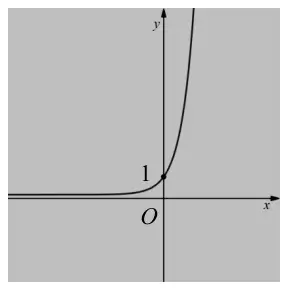 Correct shape or correct intercept – see notes Fully correct – see notes | B1 B1 | 1.2 1.1b |
| (2) |
Notes
Note that B0B1 is not possible in part (a)
(a) Axes do not need to be labelled. No sketch is no marks.
B1: Correct shape or correct intercept.
Shape: A positive exponential curve in quadrants 1 and 2 only, passing through a point on the positive \(y\)-axis. Must “level out” in quadrant 2 but not necessarily asymptotic to the \(x\)-axis and allow if the curve bends up slightly for \(x \lt 0\) but do not allow a clear “U” shape. It must not clearly “stop” on the \(x\)-axis to the left of the \(y\)-axis.
OR
Intercept: The intercept can be marked as 1 or \((0,\ 1)\) or \(y = 1\) or \((1,\ 0)\) as long as it is in the correct place. May also be seen away from the sketch but must be seen as \((0,\ 1)\) or possibly these coordinates in a table but it must correspond to the sketch. If there is any ambiguity, the sketch takes precedence.
B1: Fully correct.
Shape: A positive exponential curve in quadrants 1 and 2 only, passing through a point on the positive \(y\)-axis. The curve must appear to be asymptotic to the \(x\)-axis and it must level out at least half way below the intercept. Allow if the curve bends up slightly for \(x \lt 0\) but do not allow a clear “U” shape. The curve must not bend back on itself on the rhs of the \(y\)-axis. There must be no suggestion that the curve approaches another horizontal asymptote other than the \(x\)-axis e.g. a horizontal dotted line that the curve approaches.
AND
Intercept: As above
See practice items and below for some examples:
| Scheme | Marks | AO |
|---|---|---|
\(4^x = 100 \Rightarrow x = \log_4 100\) or e.g. \(x\log 4 = \log 100 \Rightarrow x = \dfrac{\log 100}{\log 4}\) | M1 | 1.1b |
| \(\Rightarrow (x =)\) awrt 3.32 | A1 | 1.1b |
| (2) | ||
| (4 marks) |
Notes
M1: Uses logs in an attempt to solve the equation. E.g. takes log base 4 and obtains \(x = \log_4 100\)
Alternatively takes logs (any base) to obtain \(x\log 4 = \log 100\) and proceeds to \(x = \dfrac{\log 100}{\log 4}\)
Allow if this subsequently becomes e.g. log 25 as long as \(\dfrac{\log 100}{\log 4}\) is seen but
\(x\log 4 = \log 100 \Rightarrow x = \log 25\) or \(x\log 4 = \log 100 \Rightarrow x = \log 100 - \log 4\) scores M0
A1: awrt 3.32. A correct answer only of awrt 3.32 scores M1A1
Note that a common incorrect answer is \(x = 3.218875\ldots\) and comes from ln 25 or ln 100 – ln4 and unless \(x = \dfrac{\ln 100}{\ln 4}\) is seen previously, this scores M0A0