
June 2022 Paper 1 Q13
13.
Show that\[S_n = \dfrac{n}{2}\left[2a + (n - 1)d\right]\] (3)
He saves £10 in week 1, £9.20 in week 2, £8.40 in week 3 and so on, so that the weekly amounts he saves form an arithmetic sequence.
Given that James takes \(n\) weeks to save exactly £64
| Scheme | Marks | AO |
|---|---|---|
| States that \(S = a + (a + d) + \ldots\ldots + (a + (n - 1)d)\) | B1 | 1.1a |
| \(\begin{aligned} S &= a + (a + d) + \ldots\ldots (a + (n - 1)d) \\ S &= \underline{(a + (n - 1)d) + (a + (n - 2)d) + \ldots\ldots + a} \end{aligned}\) | M1 | 3.1a |
| Reaches \(2S = n \times (2a + (n - 1)d)\) And so proves that \(S = \dfrac{n}{2}\left[2a + (n - 1)d\right]\) * | A1* | 2.1 |
| (3) |
Notes
B1: Correctly writes down an expression for the key terms \(S\) or \(S_n\) including \(S =\) or \(S_n =\)
Allow a minimum of 3 correct terms including the first and last terms, and no incorrect terms.
Score for \(S\) or \(S_n = a + (a + d) + \ldots\ldots + (a + (n - 1)d)\) with + signs, not commas
If the series contains extra terms that should not be there E.g
\(S = a + (a + d) + \ldots\ldots(\boldsymbol{a + nd}) + (a + (n - 1)d)\) score B0
M1: For the key step in reversing the terms and adding the two series.
Look for a minimum of two terms, including \(a\) and \(a + (n - 1)d\), the series reversed with evidence of adding, for example \(2S =\) Condone the extra incorrect terms (see above) appearing.
Can be scored when terms are separated by commas
A1*: Shows correct work (no errors) with all steps shown leading to given answer.
There should be no incorrect terms. A minimum of 3 terms should be shown in each sum
The solution below is a variation of this.
\[\begin{aligned} &S = a + (a + d) + \ldots\ldots + l \\ &S = l + (l - d) + \ldots\ldots + a \\ &2S = n(a + l) \\ &S = \dfrac{n}{2}(a + l) = \dfrac{n}{2}(a + a + (n - 1)d) = \dfrac{n}{2}(2a + (n - 1)d) \end{aligned}\]B1 and A1 are not scored until the last line, M scored on line 3
The following scores B1 M0 A0 as the terms in the second sum are not reversed
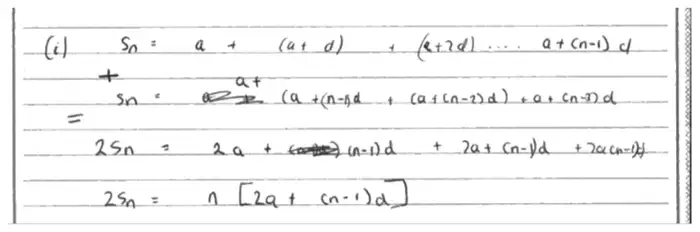
SC in (a) Scores B1 M0 A0.
They use \(0 + 1 + 2 + \ldots + (n - 1) = \dfrac{n(n - 1)}{2}\) which relies on the quoted proof.
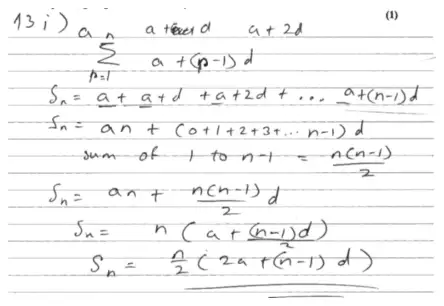
| Scheme | Marks | AO |
|---|---|---|
| \(S = 10 + 9.20 + 8.40 + \ldots\) | ||
| \(64 = \dfrac{n}{2}\left(20 - 0.8(n - 1)\right)\) o.e | M1 | 3.1b |
| \(\begin{aligned} 128 &= 20n - 0.8n^2 + 0.8n \\ 0.8n^2 - 20.8n + 128 &= 0 \\ n^2 - 26n + 160 &= 0 \ \ast \end{aligned}\) | A1* | 2.1 |
| (2) |
Notes
M1: Uses the information given to set up a correct equation in \(n\).
The values of \(S\), \(a\) and \(d\) need to be correct and used within a correct formula
Possible ways to score this include unsimplified versions \(64 = \dfrac{n}{2}\left(2 \times 10 + (n - 1) \times -0.8\right)\), \(64 = \dfrac{n}{2}\left(10 + 10 + (n - 1) \times -0.8\right)\) or versions using pence rather than £’s \(6400 = \dfrac{n}{2}\left(2000 + (n - 1) \times -80\right)\)
Allow recovery for both marks following \(64 = \dfrac{n}{2}\left(2 \times 10 + (n - 1) - 0.8\right)\) with an invisible \(\times\)
A1*: Proceeds without error to the given answer. (Do not penalise a missing final trailing bracket)
Look for at least a line with the brackets correctly removed as well as a line with the terms in \(n\) correctly combined
E.g. \(64 = \dfrac{n}{2}\left(20 + (n - 1) \times -0.8\right) \Rightarrow 64 = 10n - 0.4n^2 + 0.4n \Rightarrow 0.4n^2 - 10.4n + 64 = 0 \Rightarrow n^2 - 26n + 160 = 0\)
| Scheme | Marks | AO |
|---|---|---|
| \(n = 10,\ 16\) | B1 | 1.1b |
| (1) |
Notes
B1: \(n = 10,\ 16\)
| Scheme | Marks | AO |
|---|---|---|
10 weeks with a minimal correct reason. E.g.
| B1 | 2.3 |
| (1) | ||
| (7 marks) |
Notes
B1: Chooses 10 (weeks) and gives a minimal acceptable reason. The reason must focus on why the answer is 10 (weeks) rather than 16(weeks) or alternatively why it would not be 16 weeks.