
June 2019 Paper 1 Q12
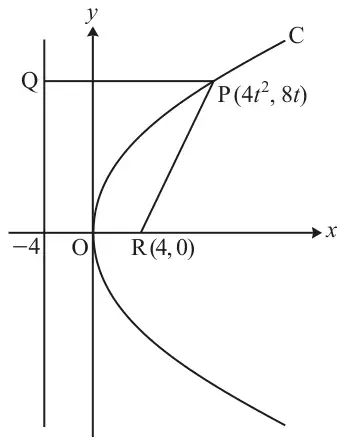
12 Fig. 12 shows a curve C with parametric equations \(x = 4t^2,\ y = 8t\). The point P, with parameter \(t\), is a general point on the curve. Q is the point on the line \(x + 4 = 0\) such that PQ is parallel to the \(x\)-axis. R is the point \((4, 0)\).
| Scheme | Marks | AO |
|---|---|---|
| \(x = 4t^2,\quad y = 8t\) \(\mathrm{PQ} = 4 + 4t^2\) | B1 | 2.1 |
| \(\mathrm{PR}^2 = (4t^2 - 4)^2 + (8t)^2\) | M1 | 2.1 |
| \(= 16t^4 + 32t^2 + 16\) | M1 | 2.1 |
| \(= (4 + 4t^2)^2 = \mathrm{PQ}^2\) So equidistant | A1 | 2.1 |
| [4] |
Notes
Due to the error on the paper, all candidates will get 4 marks for question 12(a) and all candidates will get 2 marks for 12 (b). The MS for the correct question is given for completeness.
(The question paper as sat printed \(y = 4t\); OCR’s post-exam correction changes it to \(y = 8t\), as shown here.)
M1: Use of distance formula
M1: Must show some algebraic manipulation
Correct expression for PR or PR2
A1: Conclusion comparing PQ and PR or PQ2 and PR2
| Scheme | Marks | AO |
|---|---|---|
| Substitute \(t = \dfrac{y}{8}\) to obtain \(x = 4\left(\dfrac{y}{8}\right)^2\) | M1 | 1.1a |
| \(y^2 = 16x\) | A1 | 1.1b |
| [2] |
Notes
M1: Rearranged equation must be used
allow use of \(t = \dfrac{\sqrt{x}}{2}\) oe used for M1A0.
A1: Allow any equivalent form including \(y = \pm 4\sqrt{x}\)