
June 2023 Paper 2 Q11
11.
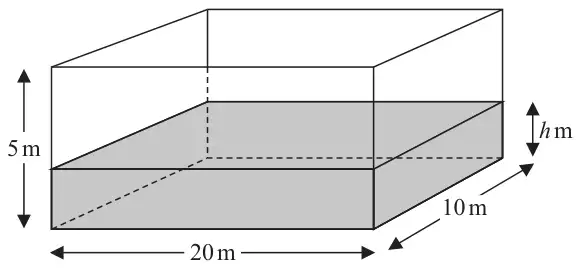
A tank in the shape of a cuboid is being filled with water.
The base of the tank measures 20 m by 10 m and the height of the tank is 5 m, as shown in Figure 1.
At time \(t\) minutes after water started flowing into the tank the height of the water was \(h\) m and the volume of water in the tank was \(V\ \mathrm{m}^3\)
In a model of this situation
- the sides of the tank have negligible thickness
- the rate of change of \(V\) is inversely proportional to the square root of \(h\)
Given that
- initially the height of the water in the tank was 1.44 m
- exactly 8 minutes after water started flowing into the tank the height of the water was 3.24 m
| Scheme | Marks | AO |
|---|---|---|
| \(\dfrac{\mathrm{d}V}{\mathrm{d}h} = 200\) oe e.g. \(\dfrac{\mathrm{d}h}{\mathrm{d}V} = \dfrac{1}{200}\) | B1 | 1.1b |
| \(\left(\dfrac{\mathrm{d}h}{\mathrm{d}t} =\right) \dfrac{\mathrm{d}h}{\mathrm{d}V} \times \dfrac{\mathrm{d}V}{\mathrm{d}t} = \dfrac{1}{200} \times \dfrac{k}{\sqrt{h}}\) | M1 | 3.1a |
| \(\dfrac{\mathrm{d}h}{\mathrm{d}t} = \dfrac{\lambda}{\sqrt{h}}\) * | A1* | 2.1 |
| (3) |
Notes
B1: For \(\dfrac{\mathrm{d}V}{\mathrm{d}h} = 200\) stated or used – may be implied by their chain rule attempt
M1: Requires:
- \(\frac{\mathrm{d}V}{\mathrm{d}h} = p,\ \ p \gt 1\)
- \(\dfrac{\mathrm{d}V}{\mathrm{d}t} = \pm\dfrac{k}{\sqrt{h}}\) or e.g. \(\dfrac{\mathrm{d}V}{\mathrm{d}t} = \pm\dfrac{1}{k\sqrt{h}}\) (or a suitable letter for k, which may be \(\lambda\), but must not be a number)
- application of the correct chain rule \(\left(\dfrac{\mathrm{d}h}{\mathrm{d}t} =\right) \dfrac{\mathrm{d}h}{\mathrm{d}V} \times \dfrac{\mathrm{d}V}{\mathrm{d}t}\) or any equivalent with \(\dfrac{\mathrm{d}V}{\mathrm{d}t} = \pm\dfrac{k}{\sqrt{h}}\) or \(\pm\dfrac{1}{k\sqrt{h}}\) and their \(\dfrac{\mathrm{d}V}{\mathrm{d}h}\) correctly placed. So \(\dfrac{\mathrm{d}h}{\mathrm{d}t} = \dfrac{\mathrm{d}h}{\mathrm{d}V} \times \dfrac{\mathrm{d}V}{\mathrm{d}t} = \dfrac{200k}{\sqrt{h}} = \dfrac{\lambda}{\sqrt{h}}\) scores M0 as \(\dfrac{\mathrm{d}h}{\mathrm{d}V}\) is incorrectly placed.
A1*: A rigorous argument with all steps shown and simplifies to achieve \(\dfrac{\mathrm{d}h}{\mathrm{d}t} = \dfrac{\lambda}{\sqrt{h}}\) with no errors.
Do not allow the use of \(\lambda\) for both constants. Allow use of e.g. \(\dfrac{\mathrm{d}V}{\mathrm{d}t} = \pm\dfrac{1}{k\sqrt{h}}\) for full marks.
e.g. \(\dfrac{\mathrm{d}V}{\mathrm{d}h} = 200,\ \ \dfrac{\mathrm{d}h}{\mathrm{d}t} = \dfrac{\mathrm{d}h}{\mathrm{d}V} \times \dfrac{\mathrm{d}V}{\mathrm{d}t} = \dfrac{1}{200} \times \dfrac{\lambda}{\sqrt{h}} = \dfrac{\lambda}{\sqrt{h}}\) scores B1M1A0* unless e.g. “let \(\lambda = \dfrac{\lambda}{200}\)” seen.
Allow correct work leading to e.g. \(\dfrac{\mathrm{d}h}{\mathrm{d}t} = \dfrac{1}{200} \times \dfrac{k}{\sqrt{h}} \rightarrow \dfrac{\lambda}{\sqrt{h}}\) or \(\dfrac{\mathrm{d}h}{\mathrm{d}t} = \dfrac{1}{200} \times \dfrac{k}{\sqrt{h}}\) so \(\lambda = \dfrac{k}{200}\)
There must be an attempt to link the \(\dfrac{\mathrm{d}h}{\mathrm{d}t}\) with the \(\dfrac{\lambda}{\sqrt{h}}\) which may be missing an = sign.
Allow an argument with \(\dfrac{\mathrm{d}V}{\mathrm{d}t} = -\dfrac{k}{\sqrt{h}}\) e.g. \(\dfrac{\mathrm{d}V}{\mathrm{d}h} = 200,\ \ \dfrac{\mathrm{d}h}{\mathrm{d}t} = \dfrac{\mathrm{d}h}{\mathrm{d}V} \times \dfrac{\mathrm{d}V}{\mathrm{d}t} = \dfrac{1}{200} \times -\dfrac{k}{\sqrt{h}} = \dfrac{\lambda}{\sqrt{h}}\)
Withhold this A mark if there are notational errors e.g. \(\dfrac{\mathrm{d}V}{\mathrm{d}t} = 200,\ \ \dfrac{\mathrm{d}h}{\mathrm{d}t} = \dfrac{\mathrm{d}h}{\mathrm{d}V} \times \dfrac{\mathrm{d}V}{\mathrm{d}t} = \dfrac{1}{200} \times \dfrac{k}{\sqrt{h}} = \dfrac{\lambda}{\sqrt{h}}\) scores B1(implied)M1A0*
| Scheme | Marks | AO |
|---|---|---|
| \(\dfrac{\mathrm{d}h}{\mathrm{d}t} = \dfrac{\lambda}{\sqrt{h}} \Rightarrow \displaystyle\int h^{\frac{1}{2}}\,\mathrm{d}h = \int \lambda\,\mathrm{d}t \Rightarrow \ldots h^{\frac{3}{2}} = \lambda t\{+c\}\) | M1 | 1.1b |
| \(\dfrac{2}{3}h^{\frac{3}{2}} = \lambda t\{+c\}\) oe e.g. \(\dfrac{h^{\frac{3}{2}}}{\frac{3}{2}} = \lambda t\{+c\}\) | A1 | 1.1b |
| \(\dfrac{2}{3}(1.44)^{\frac{3}{2}} = \lambda \times 0 + c \Rightarrow c = 1.152\ \left(= \dfrac{144}{125}\right)\) | dM1 | 3.4 |
| \(\dfrac{2}{3}(3.24)^{\frac{3}{2}} = \lambda \times 8 + \text{``}1.152\text{''} \Rightarrow \lambda = 0.342\ \left(= \dfrac{171}{500}\right)\) | ddM1 | 3.1b |
| \(h^{\frac{3}{2}} = 0.513t + 1.728\) oe e.g. \(h^{\frac{3}{2}} = \dfrac{513}{1000}t + \dfrac{216}{125}\) | A1 | 3.3 |
| (5) |
(b) Alternative:
| Scheme | Marks | AO |
|---|---|---|
| \(\dfrac{\mathrm{d}h}{\mathrm{d}t} = \dfrac{\lambda}{\sqrt{h}} \Rightarrow \dfrac{\mathrm{d}t}{\mathrm{d}h} = \dfrac{\sqrt{h}}{\lambda} \Rightarrow t = \ldots h^{\frac{3}{2}}\ (+c)\) | M1 | 1.1b |
| \(t = \dfrac{2h^{\frac{3}{2}}}{3\lambda}\ (+c)\) oe | A1 | 1.1b |
| \(0 = \dfrac{2(1.44)^{\frac{3}{2}}}{3\lambda} + c\) and \(8 = \dfrac{2(3.24)^{\frac{3}{2}}}{3\lambda} + c\) \(\Rightarrow \lambda = \ldots\left(\dfrac{171}{500}\right)\) or \(c = \ldots\left(-\dfrac{64}{19}\right)\) | dM1 | 3.4 |
| \(\Rightarrow \lambda = \ldots\left(\dfrac{171}{500}\right)\) and \(c = \ldots\left(-\dfrac{64}{19}\right)\) | ddM1 | 3.1b |
| \(h^{\frac{3}{2}} = 0.513t + 1.728\) oe e.g. \(h^{\frac{3}{2}} = \dfrac{513}{1000}t + \dfrac{216}{125}\) | A1 | 3.3 |
| (5) |
Notes
(b) Note that some candidates may work with e.g. \(\lambda = \dfrac{k}{200}\) or e.g. \(\lambda = 200k\) which is acceptable.
Candidates who do not have a \(\lambda\) e.g. assume \(\dfrac{\mathrm{d}h}{\mathrm{d}t} = \dfrac{1}{200\sqrt{h}}\) or e.g. \(\dfrac{\mathrm{d}h}{\mathrm{d}t} = \dfrac{200}{\sqrt{h}}\) then only the first 2 method marks are available (see note below). Condone use of other variables if the intention is clear but the final answer must be in terms of h and t.
M1: Separates the variables and integrates to obtain an equation of the form \(\ldots h^{\frac{3}{2}} = \lambda t\{+c\}\) oe
The constant of integration is not needed for this mark.
A1: \(\dfrac{2}{3}h^{\frac{3}{2}} = \lambda t(+c)\) oe. The constant of integration is not needed for this mark.
Condone spurious notation for this intermediate mark e.g. integral signs left in after integrating.
dM1: Substitutes \(t = 0\) and \(h = 1.44\) and attempts to find c.
It is dependent on the previous method mark.
Do not be concerned with the “processing” to find “c” as long as they are using \(t = 0\) and \(h = 1.44\)
May be implied by their value of c.
ddM1: Substitutes \(t = 8\) and \(h = 3.24\) and their c and attempts to find \(\lambda\). Do not be concerned with the “processing” to find \(\lambda\) as long as they are using \(t = 8\) and \(h = 3.24\).
It is dependent on both previous method marks.
A1: Correct equation in the correct form from correct work. \(h^{\frac{3}{2}} = 0.513t + 1.728\) or \(h^{\frac{3}{2}} = \dfrac{513}{1000}t + \dfrac{216}{125}\)
Must follow A1 earlier so do check if this has been obtained fortuitously. Allow 1.73 for 1.728
Note candidates who do not have a \(\lambda\) e.g. assume \(\dfrac{\mathrm{d}h}{\mathrm{d}t} = \dfrac{1}{200\sqrt{h}}\) or e.g. \(\dfrac{\mathrm{d}h}{\mathrm{d}t} = \dfrac{200}{\sqrt{h}}\) can use either \(t = 0\) and \(h = 1.44\) or \(t = 8\) and \(h = 3.24\) to find their constant of integration.
(b) Alternative:
M1: Finds the reciprocal of both sides and integrates to obtain an equation of the form \(t = \ldots h^{\frac{3}{2}}\ (+c)\)
A1: \(t = \dfrac{2h^{\frac{3}{2}}}{3\lambda}\ (+c)\) oe. The constant of integration is not needed for this mark.
dM1: Substitutes \(t = 0\) and \(h = 1.44\) and substitutes \(t = 8\) and \(h = 3.24\) and attempts to find \(\lambda\) or c.
It is dependent on the previous method mark.
Do not be concerned with the “processing” to find \(\lambda\) or c as long as they are using \(t = 0\) and \(h = 1.44\) and \(t = 8\) and \(h = 3.24\) and reach a value for \(\lambda\) or c. May be implied by their value(s).
ddM1: Complete attempt to find \(\lambda\) and c. It is dependent on both previous method marks.
Do not be concerned with the “processing” to find \(\lambda\) and c as long as they are using \(t = 0\) and \(h = 1.44\) and \(t = 8\) and \(h = 3.24\).
A1: Correct equation in the correct form. \(h^{\frac{3}{2}} = 0.513t + 1.728\) or \(h^{\frac{3}{2}} = \dfrac{513}{1000}t + \dfrac{216}{125}\)
Must follow A1 earlier so do check if this has been obtained fortuitously. Allow 1.73 for 1.728
Special Case:
Some candidates are using the given equation in part (b) to find the value of A and the value of B using the given conditions. May score a maximum of 00110. This should be marked as follows:
M0A0: (No attempt to integrate)
M1: Substitutes \(t = 0\) and \(h = 1.44\) to find a value for B
dM1: Substitutes \(t = 8\) and \(h = 3.24\) with their value of B to find a value for A
A0: Since they have not used the given model.
(Allow full recovery in (c) if this equation is correct)
| Scheme | Marks | AO |
|---|---|---|
| \(5^{\frac{3}{2}} = 0.513t + 1.728 \Rightarrow t = \ldots\) | M1 | 3.4 |
| \((t =)\) awrt 18.4 min | A1 | 3.2a |
| (2) | ||
| (10 marks) |
Notes
M1: Attempts to substitute \(h = 5\) into their equation which must be of the form \(h^{\frac{3}{2}} = At + B\) or possibly a rearranged equation e.g. \(h^{\frac{1}{2}} = \sqrt[3]{At + B}\) with values of A and B leading to a value for t.
Do not be concerned about the processing as long as they use \(h = 5\) and obtain a value for t even if t is negative.
A1: Awrt 18.4 minutes following a correct equation in (b).
The units are required but allow e.g. min, mins, but not just 18.4 and not m (which means metres)
Allow e.g. 18 minutes 25 seconds or 18 mins 26 secs
Note this may follow A0 in part (b) as they may have rearranged incorrectly in (b) but use a correct equation in (c) e.g. \(\dfrac{2}{3}h^{\frac{3}{2}} = \dfrac{171}{500}t + \dfrac{144}{125},\ \ h^{\frac{1}{2}} = \sqrt[3]{\dfrac{513}{1000}t + \dfrac{216}{125}}\) or may come from the special case.
Apply isw following a correct time and units, e.g., 18.4 followed by 18 mins.