
June 2021 Paper 3 Q5
5 A gardener is creating flowerbeds in the shape of sectors of circles.
The gardener uses an edging strip around the perimeter of each of the flowerbeds.
The cost of the edging strip is £1.80 per metre and can be purchased for any length.
One of the flowerbeds has a radius of 5 metres and an angle at the centre of 0.7 radians as shown in the diagram below.
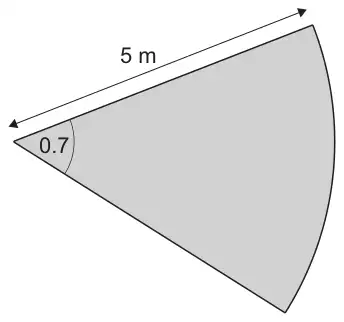
(a)
(i) Find the area of this flowerbed. [2 marks]
(ii) Find the cost of the edging strip required for this flowerbed. [3 marks]
(b) A flowerbed is to be made with an area of 20 m2
(i) Show that the cost, £\(C\), of the edging strip required for this flowerbed is given by\[C = \frac{18}{5}\left(\frac{20}{r} + r\right)\]
where \(r\) is the radius measured in metres. [3 marks]
(ii) Hence, show that the minimum cost of the edging strip for this flowerbed occurs when \(r \approx 4.5\)
Fully justify your answer. [5 marks]
| Scheme | Marks | AO |
|---|---|---|
| (i) Uses formula correctly for area of sector | M1 | 1.1a |
| Obtains 8.75 Condone incorrect or missing units | A1 | 1.1b |
| (2) | ||
| (ii) Uses formula for arc length | B1 | 1.1b |
| Obtains the perimeter by adding twice the radius to their arc length and multiplies their perimeter by 1.80 | M1 | 3.1b |
| Obtains correct cost £24.30 CAO | A1 | 3.2a |
| (3) |
Typical solution
(i)
\[A = \frac{1}{2} \times 5^2 \times 0.7\]\[= 8.75\ \text{m}^2\](ii)
\[P = 5 \times 0.7 + 2 \times 5\]\[= 13.5\]\[\text{Cost} = 13.5 \times 1.80\]\[= £24.30\]| Scheme | Marks | AO |
|---|---|---|
| (i) Forms at least one correct equation for area or perimeter May be embedded in the formulae for \(C\) | M1 | 3.3 |
| Eliminates \(\theta\) from two fully correct equations for area and perimeter to obtain an expression for \(P\) in terms of \(r\) | A1 | 3.1b |
| Completes argument to show the required result Accept 3.6 for \(\dfrac{18}{5}\) | R1 | 2.1 |
| (3) | ||
| (ii) Recognises the use differentiation in the model PI if \(\dfrac{\mathrm{d}C}{\mathrm{d}r}\) seen | B1 | 3.4 |
| Differentiates given model with at least one term correct Condone sign error OE | M1 | 1.1b |
| Explains that a minimum/stationary/turning point occurs when \(\dfrac{\mathrm{d}C}{\mathrm{d}r} = 0\) | E1 | 2.4 |
| Solves \(\dfrac{\mathrm{d}C}{\mathrm{d}r} = 0\) to find correct exact value or decimal value for \(r\) to at least two decimal places | A1 | 1.1b |
| Uses a gradient test or second derivative or sketches graph to determine nature of stationary point Completes argument to show minimum occurs when \(r \approx 4.5\) Must have shown \(r \approx 4.5\) in previous step | R1 | 2.1 |
| (5) | ||
| (13 marks) |
Typical solution
(i)
\[P = r\theta + 2r\]\[\frac{1}{2}r^2\theta = 20\]\[\Rightarrow \theta = \frac{40}{r^2}\]\[P = \frac{40}{r} + 2r\]\[C = \frac{40 \times 1.8}{r} + 2 \times 1.8r\]\[= \frac{72}{r} + \frac{18}{5}r\]\[= \frac{18}{5}\left(\frac{20}{r} + r\right)\](ii)
\[C = \frac{72}{r} + \frac{18}{5}r\]\[\frac{\mathrm{d}C}{\mathrm{d}r} = -\frac{72}{r^2} + \frac{18}{5}\]Minimum occurs when \(\dfrac{\mathrm{d}C}{\mathrm{d}r} = 0\)
\[-\frac{72}{r^2} + \frac{18}{5} = 0\]\[r^2 = 20\]\[r = \sqrt{20} \approx 4.472\ldots\]Hence \(r \approx 4.5\)
\[\frac{\mathrm{d}^2C}{\mathrm{d}r^2} = \frac{144}{r^3}\]When \(r = \sqrt{20}\), \(\dfrac{\mathrm{d}^2C}{\mathrm{d}r^2} \gt 0\)
Therefore minimum at \(r \approx 4.5\)