
October 2021 Paper 1 Q11
11
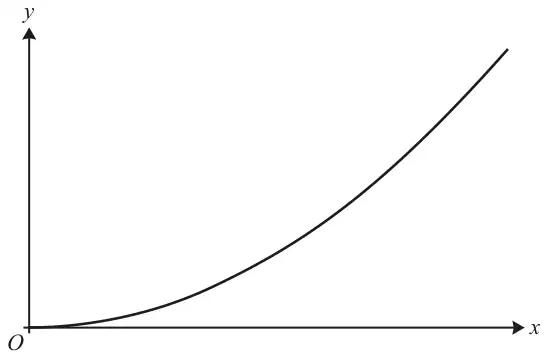
Find the exact area enclosed by the curve \(y = \dfrac{4x^3}{\sqrt{x^2 + 3}}\), the normal to this curve at the point \((1, 2)\) and the \(x\)-axis. [7]
| Scheme | Marks | AO |
|---|---|---|
| \(2u\,\mathrm{d}u = 2x\,\mathrm{d}x\) | B1 | 1.1a |
| \(\displaystyle\int \frac{4u(u^2 - 3)}{\sqrt{u^2}}\,\mathrm{d}u\) | M1* | 2.1 |
| \(\displaystyle\int (4u^2 - 12)\,\mathrm{d}u\) | A1 | 1.1 |
| \(\frac{4}{3}u^3 - 12u\ (+c)\) | M1dep* | 1.1 |
| \(\frac{4}{3}u(u^2 - 9) + c = \frac{4}{3}(x^2 - 6)\sqrt{x^2 + 3} + c\) A.G. | A1 | 2.1 |
| [5] |
Notes
B1: Any correct expression linking \(\mathrm{d}u\) and \(\mathrm{d}x\)
Could be \(\mathrm{d}u = \frac{1}{2}2x\left(x^2 + 3\right)^{-\frac{1}{2}}\mathrm{d}x\) or equiv in terms of \(u\)
M1*: Attempt to rewrite integrand in terms of \(u\)
Not just \(\mathrm{d}x = \mathrm{d}u\), unless from a clear attempt at \(\mathrm{d}u\) eg using \(u = x + \sqrt{3}\)
A1: Obtain correct integrand
Allow unsimplified expression
M1dep*: Attempt integration
Simplify to form that can be integrated, then increase all powers by 1
A1: Obtain given answer, with at least one intermediate step seen
Need evidence of common factor (in terms of \(u\) or \(x\)) being taken out
Condone omission of \(+c\)
| Scheme | Marks | AO |
|---|---|---|
| DR \(\frac{4}{3}\left(\left(-5 \times 2\right) - \left(-6 \times \sqrt{3}\right)\right)\) | M1 | 2.1 |
| \(= \frac{4}{3}\left(6\sqrt{3} - 10\right)\) or 0.523 | A1 | 1.1 |
| \(\dfrac{\mathrm{d}y}{\mathrm{d}x} = \dfrac{12x^2\left(x^2 + 3\right)^{\frac{1}{2}} - 4x^3.2x.\frac{1}{2}\left(x^2 + 3\right)^{-\frac{1}{2}}}{x^2 + 3}\) | M1 A1 | 3.1a 1.1 |
| at \(x = 1\), \(m = \frac{11}{2}\) hence \(m' = -\frac{2}{11}\) | M1 | 2.1 |
| \(y - 2 = -\frac{2}{11}(x - 1)\) when \(y = 0\), \(x = 12\) | M1 | 1.1 |
| area \(= 8\sqrt{3} - \frac{40}{3} + 11\) \(= 8\sqrt{3} - \frac{7}{3}\) | A1 | 3.1a |
| [7] |
Notes
M1: Attempt to use limits \(x = 0\) and \(x = 1\), or \(u = \sqrt{3}\) and \(u = 2\) in integral in terms of \(u\)
Correct order and subtraction
Attempt to use both limits in their integral to give two terms
DR so just stating decimal area is M0
Either using answer from (a) or their integration attempt with +2 or +3
A1: Obtain correct area under curve
Accept exact (inc unsimplified) or decimal
Using +2 gives \(\frac{4}{3}\left(4\sqrt{2} - 3\sqrt{3}\right)\) or 0.614
M1: Attempt derivative using the quotient rule
Or equiv with product rule
Need difference of two terms in numerator, at least one term correct, but allow subtraction in incorrect order
Using either +2 or +3 equation
A1: Obtain correct, unsimplified, derivative
With either +2 or +3
M1: Attempt gradient of normal at \(x = 1\)
Substitute \(x = 1\) and use negative reciprocal
Using +2 gives \(m' = -\frac{3}{32}\sqrt{3}\)
Can be with \(m\) found BC
M1: Attempt to find point of intersection of normal with \(x\)-axis
Attempt equation of normal with their gradient and either \((1, 2)\) or \(\left(1, \frac{4}{3}\sqrt{3}\right)\), and then use \(y = 0\) to find \(x\) intersection
A1: Obtain correct area
Allow any exact (including unsimplified) or decimal equivalent
From combining a correct area under curve and a correct area of triangle (either 11 or \(\frac{64}{9}\sqrt{3}\)), even if inconsistent
Can still get A1 following M0 for area under curve BC and/or \(m\) found BC