
June 2022 Paper 3 Q11
11
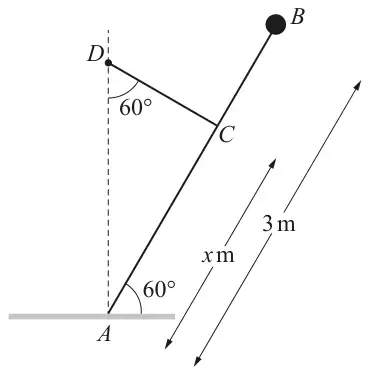
A uniform rod \(AB\) of mass 4 kg and length 3 m rests in a vertical plane with \(A\) on rough horizontal ground.
A particle of mass 1 kg is attached to the rod at \(B\). The rod makes an angle of 60° with the horizontal and is held in limiting equilibrium by a light inextensible string \(CD\). \(D\) is a fixed point vertically above \(A\) and \(CD\) makes an angle of 60° with the vertical. The distance \(AC\) is \(x\) m (see diagram).
The coefficient of friction between the rod and the ground is \(\dfrac{9\sqrt{3}}{35}\).
| Scheme | Marks | AO |
|---|---|---|
| Taking moments about \(A\) – correct number of terms, allow sin/cos confusion and sign errors – may take moments about another point (and resolve) but must end up after elimination with an equation in \(T\) and \(x\) only | M1 | 3.1b |
| \(4g\left(\frac{3}{2}\cos 60\right) + g(3\cos 60) = xT\) | A1 | 1.1 |
| \(T = \dfrac{9g}{2x}\) (N) | A1 | 2.2a |
| [3] |
Notes
M1: Dimensionally correct.
Must be \(xT\) and not \(xT\cos(\ldots)\) or \(xT\sin(\ldots)\)
A1: Correct equation in \(g\), \(x\) and \(T\) only – condone \(g\) replaced by 9.8
\(T\) is the tension in the string
A1: An answer of \(\frac{44.1}{x}\) (or with trigonometric terms) is A0 unless correct answer in terms of \(g\) seen
oe exact answers in terms of \(g\) and \(x\) (condone correct triple decker fractions)
For reference for parts (a) and (b):
Moments about \(C\): \(R_A(x\cos 60) + g(3 - x)\cos 60 = 4g(x - 1.5)\cos 60 + F_A(x\sin 60)\)
Moments about \(B\): \(T(3 - x) + R_A(3\cos 60) = 4g(1.5\cos 60) + F_A(3\sin 60)\)
Moments about midpoint of \(AB\): \(R_A(1.5\cos 60) + g(1.5\cos 60) = T(x - 1.5) + F_A(1.5\sin 60)\)
Resolving perpendicular to \(AB\): \(T + R_A\cos 60 = 4g\cos 60 + g\cos 60 + F_A\sin 60\)
Resolving parallel to \(AB\): \(R_A\sin 60 + F_A\cos 60 = 4g\sin 60 + g\sin 60\)
| Scheme | Marks | AO |
|---|---|---|
| Resolve vertically or horizontally – correct number of terms with the tension at \(C\) in terms of cos/sin, condone sign errors, allow sin/cos confusion but forces that require resolving must be (and correspondingly those that don’t require resolving e.g. the weights if resolving vertically, should not be resolved) | M1 | 3.3 |
| \(T\cos 60 + R_A = 4g + g\) \(\left(\Rightarrow R_A = 5g - \dfrac{9g}{4x}\right)\) \(F_A = T\sin 60\) \(\left(\Rightarrow F_A = \dfrac{9\sqrt{3}g}{4x}\right)\) | A1 | 1.1 |
| \(\dfrac{9\sqrt{3}g}{4x} = \dfrac{9\sqrt{3}}{35}\left(5g - \dfrac{9g}{4x}\right)\) | M1dep* | 3.4 |
| \(x = 2.2\) | A1 | 2.2a |
| [4] |
Notes
M1: Or obtain an equation in \(F_A\) and/or \(R_A\) in terms of \(T\) (or their \(T\)) only (see list of equations below)
A1: Both correct (unsimplified) – allow with \(T\) or their (possibly incorrect) \(T\) (oe eg two valid equations in \(R_A\) and \(F_A\))
\(R_A\) is the normal contact force at \(A\)
\(F_A\) is the frictional contact force at \(A\)
M1dep*: Use of \(F = \mu R\) with correct \(\mu\) to form an equation in \(x\) only – no forces missing from their \(R_A\) and \(F_A\) and all required forces resolved accordingly or not e.g. if resolving vertically the two weights should not contain sin/cos
A1: awrt 2.2
www
For reference for parts (a) and (b):
Moments about \(C\): \(R_A(x\cos 60) + g(3 - x)\cos 60 = 4g(x - 1.5)\cos 60 + F_A(x\sin 60)\)
Moments about \(B\): \(T(3 - x) + R_A(3\cos 60) = 4g(1.5\cos 60) + F_A(3\sin 60)\)
Moments about midpoint of \(AB\): \(R_A(1.5\cos 60) + g(1.5\cos 60) = T(x - 1.5) + F_A(1.5\sin 60)\)
Resolving perpendicular to \(AB\): \(T + R_A\cos 60 = 4g\cos 60 + g\cos 60 + F_A\sin 60\)
Resolving parallel to \(AB\): \(R_A\sin 60 + F_A\cos 60 = 4g\sin 60 + g\sin 60\)