
June 2022 Paper 3 Q5
5 In this question you must show detailed reasoning.
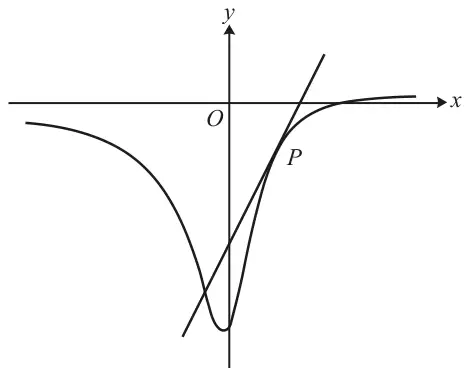
The diagram shows the curve with equation \(y = \dfrac{2x - 3}{4x^2 + 1}\). The tangent to the curve at the point \(P\) has gradient 2.
| Scheme | Marks | AO |
|---|---|---|
| DR \(y = (2x - 3)(4x^2 + 1)^{-1}\) \(\Rightarrow \dfrac{\mathrm{d}y}{\mathrm{d}x} = 2(4x^2 + 1)^{-1} + (2x - 3)(-1)(4x^2 + 1)^{-2}(8x)\) | M1* | 1.1 |
| \(y = \dfrac{2x - 3}{4x^2 + 1} \Rightarrow \dfrac{\mathrm{d}y}{\mathrm{d}x} = \dfrac{(4x^2 + 1)(2) - (2x - 3)(8x)}{(4x^2 + 1)^2}\) | A1 | 1.1 |
| \(\dfrac{2(1 + 12x - 4x^2)}{(4x^2 + 1)^2} = 2\) | M1dep* | 3.1a |
| \(1 + 12x - 4x^2 = (4x^2 + 1)^2 \Rightarrow 16x^4 + 12x^2 - 12x = 0\) | M1 | 1.1 |
| \(x(4x^3 + 3x - 3) = 0 \Rightarrow 4x^3 + 3x - 3 = 0\) as \(x \ne 0\) | A1 | 2.3 |
| [5] |
Notes
M1*: Attempt use of quotient rule or equivalent (e.g. product rule). Condone one incorrect term only (of the five terms) but must be subtraction in the numerator (but allow subtraction the wrong way round); condone absence of brackets; no denominator (if using quotient rule) is M0
By the five terms we mean the four in the numerator and the fifth is the term in the denominator
A1: cao must include brackets as necessary
Any correct equivalent form
M1dep*: Sets their derivative (in any form) equal to 2 (M0 if equating to normal gradient)
May equate at any stage (even after incorrect manipulation of their derivative)
M1: Multiply both sides by \((4x^2 + 1)^2\) and simplify (so combining like terms) to obtain a quartic equation (must be expanded with at least three terms – condone lack of = 0 if all terms on the same side) – allow sign errors/minor slips but the expansion of \((4x^2 + 1)^2\) must be three terms of the form \(16x^4 + ax^2 + 1\) where \(a = \pm 4, \pm 8\)
Dependent on both previous M marks
A1: AG with explicit rejection of \(x = 0\) – as a minimum must indicate that \(x\) cannot equal 0
Just cancelling \(x\) is A0
| Scheme | Marks | AO |
|---|---|---|
| DR Consider both \(\mathrm{f}(0.5)\) and \(\mathrm{f}(1)\) Where \(\mathrm{f}(x) = \pm(4x^3 + 3x - 3)\) | M1 | 1.1 |
| \(\mathrm{f}(0.5) = -1 \lt 0\) and \(\mathrm{f}(1) = 4 \gt 0\) (or \(\mathrm{f}(0.5) = 1 \gt 0\) and \(\mathrm{f}(1) = -4 \lt 0\)) Change of sign indicates that the \(x\)-coordinate lies between 0.5 and 1 | A1 | 2.4 |
| [2] |
Notes
M1: Working or correct answer for one value is sufficient evidence of correct method but both 0.5 and 1 must be seen
Just stating that \(\mathrm{f}(0.5) \lt 0\) and \(\mathrm{f}(1) \gt 0\) is M0
A1: Correct values together with explanation (change of sign) and correct conclusion (as a minimum ‘root’ oe)
Alternative
| Scheme | Marks |
|---|---|
| Considers both \(\mathrm{g}(0.5)\) and \(\mathrm{g}(1)\) where \(\mathrm{g}(x) = \dfrac{(4x^2 + 1)(2) - (2x - 3)(8x)}{(4x^2 + 1)^2}\) | M1 |
| \(\mathrm{g}(0.5) = 3 \gt 2\) and \(\mathrm{g}(1) = 0.72 \lt 2\) Values either side of 2 indicates that the \(x\)-coordinate lies between 0.5 and 1 | A1 |
M1: Must be using the correct derivative. Working or correct answer for one value is sufficient evidence of correct method but both 0.5 and 1 must be seen
Just stating that \(\mathrm{g}(0.5) \gt 2\) and \(\mathrm{g}(1) \lt 2\) is M0
A1: Correct values together with explanation (values either side of 2) and correct conclusion (as a minimum ‘root’ oe)
| Scheme | Marks | AO |
|---|---|---|
| DR Let \(\mathrm{h}(x) = \dfrac{3 - 4x^3}{3} \Rightarrow \mathrm{h}'(x) = -4x^2\) | B1* | 2.1 |
| As the root \(\alpha\) lies in the interval \((0.5, 1) \Rightarrow \mathrm{h}'(\alpha) \lt -1\) so iterative formula cannot converge to the \(x\)-coordinate of \(P\) | B1dep* | 2.2a |
| [2] |
Notes
B1*: Calculates correct derivative of rhs of given iterative formula
B1dep*: Correct explanation that any value in the given interval gives a gradient which is less than \(-1\)
No marks for just showing that the iteration doesn’t converge using different starting values
| Scheme | Marks | AO |
|---|---|---|
| DR \(\mathrm{f}(x_n) = 4x_n^3 + 3x_n - 3 \Rightarrow \mathrm{f}'(x_n) = 12x_n^2 + 3\) | B1 | 1.1 |
| \(x_{n+1} = x_n - \left\{\dfrac{4x_n^3 + 3x_n - 3}{12x_n^2 + 3}\right\}\) | M1 | 2.1 |
| \(x_0 = 0.5\), \(x_1 = \frac{2}{3}\) or 0.666666…, \(x_2 = \frac{29}{45}\) or 0.644444…, \((x_3 = 0.64395510\ldots)\) | A1 | 1.1 |
| \(x\) coordinate of \(P\) is 0.64395 | A1 | 2.2a |
| \(y\) coordinate of \(P\) is \(-0.64395\) | B1 | 1.1 |
| [5] |
Notes
B1: Correct derivative (possibly seen in N-R formula)
Condone \(x\) for \(x_n\) oe
M1: Correct N-R formula seen with correct \(\mathrm{f}(x_n)\) and their \(\mathrm{f}'(x_n)\) substituted
Condone \(x\) for \(x_n\) oe
A1: First two iterations correctly stated to at least 5 decimal places (or exact) (truncated or rounded)
The correct first two iterations can imply B1 M1
A1: Independent of previous A mark (but must have scored B1 M1) – must be stated to exactly 5 decimal places
This A mark does not imply the previous A mark
B1: Independent of all previous marks – must be stated to exactly 5 decimal places
The correct answers with no evidence of N-R (e.g. no iterations stated and no N-R formula) then B0M0A0A0B1 max.