
June 2022 Paper 3 Q7
7 A planet takes \(T\) days to complete one orbit of the Sun.
\(T\) is known to be related to the planet’s average distance \(d\), in millions of kilometres, from the Sun.
A graph of \(\log_{10} T\) against \(\log_{10} d\) is shown with data for Mercury and Uranus labelled.
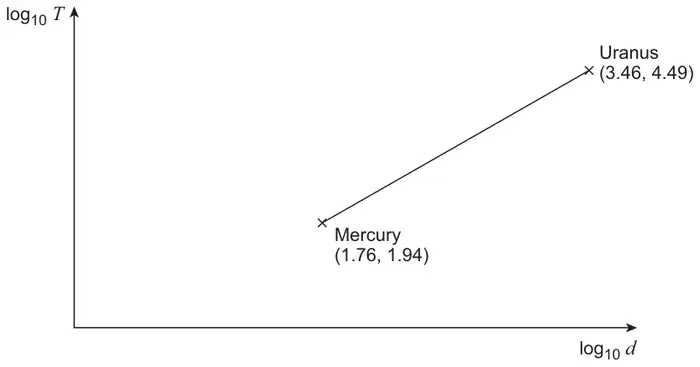
(a)
(i) Find the equation of the straight line in the form\[\log_{10} T = a + b\,\log_{10} d\]where \(a\) and \(b\) are constants to be found. [3 marks]
(ii) Show that\[T = \mathrm{K}d^{\mathrm{n}}\]where K and n are constants to be found. [2 marks]
(b) Neptune takes approximately 60 000 days to complete one orbit of the Sun.
Use your answer to 7(a)(ii) to find an estimate for the average distance of Neptune from the Sun. [2 marks]
| Scheme | Marks | AO |
|---|---|---|
| (i) Forms a correct expression for the gradient or sets up two correct simultaneous equations PI by \(a = -0.7\) or \(b = 1.5\) Ignore missing labels | M1 | 1.1a |
| Obtains \(a = -0.7\) or \(b = 1.5\) OE Ignore missing labels | A1 | 1.1b |
| Obtains \(a = -0.7\) and \(b = 1.5\) or seen in the logarithmic equation ISW | A1 | 1.1b |
| (3) | ||
| (ii) Uses one law of logarithm correctly Allow use of original equation without values for \(a\) and \(b\) If values are used, \(a \ne 0\) | M1 | 3.3 |
| Completes reasoned argument to obtain \(T = \mathrm{K}d^n\) with K = \(10^{-0.7}\) or AWRT 0.2 and \(n\) = 1.5 ISW Must come from correct working | R1 | 2.1 |
| (2) |
Typical solution
(i)
\[\frac{4.49 - 1.94}{3.46 - 1.76} = 1.5\]\[\log_{10} T - 1.94 = 1.5(\log_{10} d - 1.76)\]\[\log_{10} T = -0.7 + 1.5\,\log_{10} d\](ii)
\[\log_{10} T - \log_{10} d^{1.5} = -0.7\]\[\log_{10}\left(\frac{T}{d^{1.5}}\right) = -0.7\]\[\frac{T}{d^{1.5}} = 10^{-0.7}\]\[T = 10^{-0.7} \times d^{1.5}\]| Scheme | Marks | AO |
|---|---|---|
| Forms an equation using their answer to (a)(ii) with K > 0 and \(n \gt 0\) and \(T = 60\,000\) Must only have unknown \(d\) in the equation | M1 | 3.4 |
| Obtains AWRT 4500 million kilometres ACF with units For example
| A1 | 3.2a |
| (2) | ||
| (7 marks) |
Typical solution
\[60\,000 = 0.2 \times d^{1.5}\]\[d = 4488.5\]Average distance is approximately 4500 million kilometres