
June 2022 Paper 1 Q10
10 The diagram shows a sector of a circle \(OAB\).
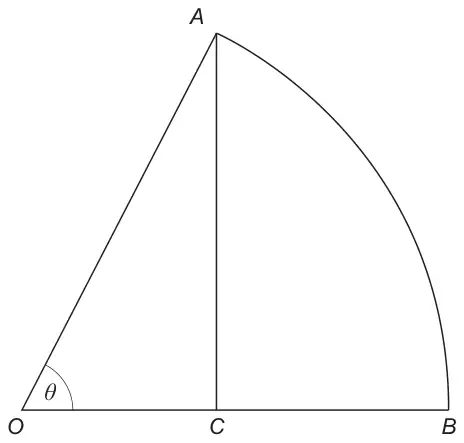
The point \(C\) lies on \(OB\) such that \(AC\) is perpendicular to \(OB\).
Angle \(AOB\) is \(\theta\) radians.
(a) Given the area of the triangle \(OAC\) is half the area of the sector \(OAB\), show that\[\theta = \sin 2\theta\] [4 marks]
(b) Use a suitable change of sign to show that a solution to the equation\[\theta = \sin 2\theta\]lies in the interval given by \(\theta \in \left[\dfrac{\pi}{5}, \dfrac{2\pi}{5}\right]\) [2 marks]
(c) The Newton-Raphson method is used to find an approximate solution to the equation\[\theta = \sin 2\theta\]
(i) Using \(\theta_1 = \dfrac{\pi}{5}\) as a first approximation for \(\theta\) apply the Newton-Raphson method twice to find the value of \(\theta_3\)
Give your answer to three decimal places. [3 marks]
(ii) Explain how a more accurate approximation for \(\theta\) can be found using the Newton-Raphson method. [1 mark]
(iii) Explain why using \(\theta_1 = \dfrac{\pi}{6}\) as a first approximation in the Newton-Raphson method does not lead to a solution for \(\theta\). [2 marks]
| Scheme | Marks | AO |
|---|---|---|
| Recalls or uses the area of sector = \(\dfrac{1}{2}r^2\theta\) \(r\) can be any letter or \(OA\) or \(OB\) or any consistent value throughout | B1 | 1.2 |
| Forms an equation relating the area of the triangle \(OAC\) and sector using \(\dfrac{1}{2}bh = k\dfrac{1}{2}r^2\theta\) where \(k \gt 0\) | M1 | 3.1a |
| Deduces area of triangle is \(\dfrac{1}{2}r\cos\theta \times r\sin\theta\) OE Must use trigonometry for height and base | B1 | 2.2a |
| Completes reasoned argument with clear use of double angle identity to show that \(\theta = \sin 2\theta\) or \(\sin 2\theta = \theta\) | R1 | 2.1 |
| (4) |
Typical solution
Area of sector = \(\dfrac{1}{2}r^2\theta\)
Area of triangle = \(\dfrac{1}{2}ab\sin C\)
Hence
\[\frac{1}{2}ab\sin C = \left(\frac{1}{2}\right)\frac{1}{2}r^2\theta\]\[\frac{1}{2}r^2\sin\theta\cos\theta = \frac{1}{2}\left(\frac{1}{2}r^2\theta\right)\]\[2\sin\theta\cos\theta = \theta\]\[\theta = \sin 2\theta\]| Scheme | Marks | AO |
|---|---|---|
| Rearranges to obtain \(\theta - \sin 2\theta = 0\) or \(\sin 2\theta - \theta = 0\) (which may be seen in conclusion) and evaluates \(\theta - \sin 2\theta\) or \(\sin 2\theta - \theta\) at \(\dfrac{\pi}{5}\) (0.6284) and \(\dfrac{2\pi}{5}\) (1.257) Evaluates using any two other appropriate values inside the interval but either side of root. | M1 | 1.1a |
| Completes reasoned argument with reference to change of sign and evidence of correct evaluation accepting values rounded or truncated to 1 sf Must refer to \(\dfrac{\pi}{5}\) and \(\dfrac{2\pi}{5}\) in the conclusion | R1 | 2.1 |
| (2) |
Typical solution
\[\theta = \sin 2\theta \Rightarrow \theta - \sin 2\theta = 0\]Let \(\mathrm{f}(\theta) = \theta - \sin 2\theta\)
\[\mathrm{f}\left(\frac{\pi}{5}\right) = -0.3227\ldots \lt 0\]\[\mathrm{f}\left(\frac{2\pi}{5}\right) = 0.6688\ldots \gt 0\]Hence solution lies between \(\dfrac{\pi}{5}\) and \(\dfrac{2\pi}{5}\)
| Scheme | Marks | AO |
|---|---|---|
| (i) Differentiates \(\sin 2\theta\) to obtain \(2\cos 2\theta\) OE PI by correct \(\theta_2\) or \(\theta_3\) PI by sight of \(2\cos\dfrac{2\pi}{5}\) | B1 | 1.1b |
| Obtains a correct expression for \(\theta_n - \dfrac{\theta_n - \sin 2\theta_n}{1 - 2\cos 2\theta_n}\) Accept use of ANS or \(\dfrac{\pi}{5}\) Condone missing or incorrect subscript PI by correct \(\theta_2\) or \(\theta_3\) AWRT \(\theta_2\) 1.473 | M1 | 1.1a |
| Obtains correct \(\theta_3\) AWRT \(\theta_3\) 1.041 | A1 | 1.1b |
| (3) | ||
| (ii) Explains that more iterations could be used Accept keep on using Newton Raphson, keep re-iterating | E1 | 2.4 |
| (1) | ||
| (iii) States that \(\mathrm{f}^{\prime}\left(\dfrac{\pi}{6}\right) = 0\) | E1 | 2.4 |
| Explains a general reason for the Newton Raphson iteration not to converge to a particular root Accept only
| E1 | 2.4 |
| (2) | ||
| (12 marks) |
Typical solution
(i)
\[\mathrm{f}(\theta) = \theta - \sin 2\theta\]\[\mathrm{f}^{\prime}(\theta) = 1 - 2\cos 2\theta\]\[\theta_{n+1} = \theta_n - \frac{\theta_n - \sin 2\theta_n}{1 - 2\cos 2\theta_n}\]\[\theta_2 = 1.4732575\ldots\]\[\theta_3 = 1.0413241\ldots\]\[\theta_3 = 1.041\](ii)
Use more iterations
(iii)
\[\mathrm{f}^{\prime}\left(\frac{\pi}{6}\right) = 0\]The value is on a stationary point