The questions in this section refer to the article on the Insert. You should read the article before attempting the questions.
The relevant parts of the article “Adding arctangents” are reproduced below; the line numbers are those printed on the Insert.
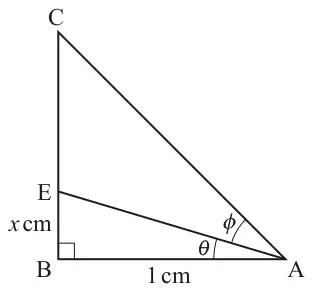
Fig. C2
Lines 18–19 Triangle ABC in Fig. C2 is the same as triangle ABC in Fig. C1 but E is a point on BC such that EB = \(x\) cm and \(\theta = \arctan x\).
Line 28 Suppose next that \(xy > 1\), and that \(x\) and \(y\) are both positive; in this case \(y > \dfrac{1}{x}\).
Line 29 For any positive \(x\), \(\arctan x + \arctan\left(\dfrac{1}{x}\right) = \dfrac{\pi}{2}\).
Line 30 \(y > \dfrac{1}{x} \Rightarrow \arctan y > \arctan\left(\dfrac{1}{x}\right)\) so it follows that \(\arctan x + \arctan y > \dfrac{\pi}{2}\).
(a) Use triangle ABE in Fig. C2 to show that \(\arctan x + \arctan\left(\dfrac{1}{x}\right) = \dfrac{\pi}{2}\), as given in line 29. [1]
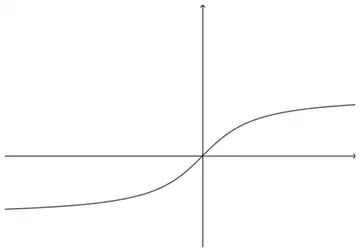
(b) Sketch the graph of \(y = \arctan x\). [1]
(c) What property of the arctan function ensures that \(y > \dfrac{1}{x} \Rightarrow \arctan y > \arctan\left(\dfrac{1}{x}\right)\), as given in line 30? [1]
Mark scheme (a)
Scheme
Marks
AO
\(\arctan\left(\dfrac{1}{x}\right) = \) angle BEA \(= \dfrac{\pi}{2} - \theta\) So \(\arctan x + \arctan\left(\dfrac{1}{x}\right) = \dfrac{\pi}{2}\)
E1
2.4
[1]
Notes
E1: Convincing explanation of given result Must relate to triangle. Do not need to mention angle BEA.