
June 2023 Paper 3 Q7
7 A new design for a company logo is to be made from two sectors of a circle, \(ORP\) and \(OQS\), and a rhombus \(OSTR\), as shown in the diagram below.
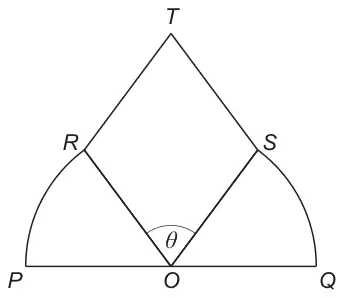
The points \(P\), \(O\) and \(Q\) lie on a straight line and the angle \(ROS\) is \(\theta\) radians.
A large copy of the logo, with \(PQ = 5\) metres, is to be put on a wall.
(a) Show that the area of the logo, \(A\) square metres, is given by\[A = \frac{25}{8}(\pi - \theta + 2\sin\theta)\] [4 marks]
(b)
(i) Show that the maximum value of \(A\) occurs when \(\theta = \dfrac{\pi}{3}\)
Fully justify your answer. [6 marks]
(ii) Find the exact maximum value of \(A\) [2 marks]
(c) Without further calculation, state how your answers to parts (b)(i) and (b)(ii) would change if \(PQ\) were increased to 10 metres. [2 marks]
| Scheme | Marks | AO |
|---|---|---|
| Forms an expression for the area of one sector or both sectors e.g \(\dfrac{1}{2}r^2\left(\dfrac{\pi - \theta}{2}\right)\) or \(r^2\left(\dfrac{\pi - \theta}{2}\right)\) or \(\dfrac{1}{2}r^2(\pi - \theta)\) OE Allow substitution of \(r\) = 2.5 Condone \(r\) = 5 Condone missing brackets | M1 | 3.1b |
| Forms an expression for the area of half rhombus or full rhombus e.g \(\dfrac{1}{2}r^2\sin\theta\) or \(r^2\sin\theta\) Allow substitution of \(r\) = 2.5 Condone \(r\) = 5 | M1 | 3.1b |
| Substitutes \(r\) = 2.5 to get a correct expression for area of both sectors or full rhombus Condone missing brackets | A1 | 1.1b |
| Completes reasoned argument by calculating correct total area with at least one correct intermediate step and no error seen to show the given result. AG Allow recovery of missing brackets | R1 | 2.1 |
| (4) |
Typical solution
Area of sectors =
\[2 \times \frac{1}{2}(2.5)^2\left(\frac{\pi - \theta}{2}\right)\]Area of rhombus =
\[2 \times \frac{1}{2}(2.5)^2\sin\theta\]\[A = (2.5)^2\left(\frac{\pi - \theta}{2}\right) + (2.5)^2\sin\theta\]\[A = \frac{25}{8}(\pi - \theta) + \frac{25}{4}\sin\theta\]\[A = \frac{25}{8}(\pi - \theta + 2\sin\theta)\]| Scheme | Marks | AO |
|---|---|---|
| (i) Differentiates wrt \(\theta\) Condone sign errors and omission of \(\dfrac{25}{8}\) | M1 | 3.1a |
| Obtains \(\dfrac{25}{8}(-1 + 2\cos\theta)\) OE | A1 | 1.1b |
| Explains maximum or stationary or turning occurs when \(\dfrac{\mathrm{d}A}{\mathrm{d}\theta} = 0\) Label \(\dfrac{\mathrm{d}A}{\mathrm{d}\theta}\) must be seen | E1 | 2.4 |
| Equates their \(\dfrac{25}{8}(-1 + 2\cos\theta)\) to 0 and rearranges to obtain a value for \(\cos\theta\) or \(\theta\) when cos is not seen Condone omission of \(\dfrac{25}{8}\) | M1 | 1.1a |
| Obtains \(\cos\theta = \dfrac{1}{2}\) or \(\cos^{-1}\left(\dfrac{1}{2}\right)\) OE and shows that \(\theta = \dfrac{\pi}{3}\) AG | A1 | 2.2a |
| Uses second derivative to obtain \(-\dfrac{25\sqrt{3}}{8}\) or AWRT \(-5\) and completes argument to show maximum occurs when \(\theta = \dfrac{\pi}{3}\) Allow gradient test To be awarded R1, marks M1A1M1A1 must be scored as the minimum | R1 | 2.4 |
| (6) | ||
| (ii) Substitutes \(\theta = \dfrac{\pi}{3}\) into \(A = \dfrac{25}{8}(\pi - \theta + 2\sin\theta)\) fully or AWFW [11.9, 12] | M1 | 3.4 |
| Obtains the correct exact area ACF with \(\sin\dfrac{\pi}{3}\) evaluated ISW | A1 | 1.1b |
| (2) |
Typical solution
(i)
\[\frac{\mathrm{d}A}{\mathrm{d}\theta} = -\frac{25}{8} + \frac{25}{4}\cos\theta\]Max area occurs when \(\dfrac{\mathrm{d}A}{\mathrm{d}\theta} = 0\)
\[-\frac{25}{8} + \frac{25}{4}\cos\theta = 0\]\[\frac{25}{4}\cos\theta = \frac{25}{8}\]\[\cos\theta = \frac{1}{2} \qquad \therefore \theta = \frac{\pi}{3}\]When \(\theta = \dfrac{\pi}{3}\)
\[\frac{\mathrm{d}^2A}{\mathrm{d}\theta^2} = -5.41 \lt 0 \text{ so maximum.}\](ii)
\[A = \frac{25}{8}\left(\pi - \frac{\pi}{3} + 2\sin\frac{\pi}{3}\right)\]\[= \frac{25}{8}\left(\frac{2\pi}{3} + \sqrt{3}\right)\]| Scheme | Marks | AO |
|---|---|---|
| States the angle would be the same or the angle will still be \(\dfrac{\pi}{3}\) or (b)(i) stays the same Condone the answer will be the same | E1 | 3.5c |
| States the area would be quadrupled or area is \(\dfrac{25}{2}\left(\dfrac{2\pi}{3} + \sqrt{3}\right)\) or their answer in (b)(ii) multiplied by 4 OE Allow (b)(ii) increased by scale factor of 4 | E1 | 3.5c |
| (2) | ||
| (14 marks) |
Typical solution
The angle would be the same.
The area would be quadrupled.