
June 2023 Paper 2 Q19
19 A wooden toy comprises a train engine and a trailer connected to each other by a light, inextensible rod.
The train engine has a mass of 1.5 kilograms.
The trailer has a mass 0.7 kilograms.
A string inclined at an angle of 40° above the horizontal is attached to the front of the train engine.
The tension in the string is 2 newtons.
As a result the toy moves forward, from rest, in a straight line along a horizontal surface with acceleration 0.06 m s−2 as shown in the diagram below.
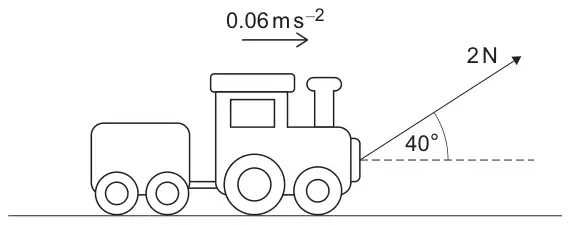
As it moves the train engine experiences a total resistance force of 0.8 N
As a result of this the train engine and trailer decelerate at a constant rate until they come to rest, having travelled a distance of \(h\) metres.
It can be assumed that the resistance forces remain unchanged.
| Scheme | Marks | AO |
|---|---|---|
| Resolves the 2 N force to obtain either \(2\cos 40\) AWRT 1.53 or \(2\sin 40\) AWRT 1.29 May be seen on the diagram. | M1 | 1.1a |
| Uses Newton’s 2nd Law to form a four term equation for the whole system. This may be seen with total resistance equivalent to \(0.8 + R\) or Uses Newton’s 2nd Law to form a three term equation for the trailer or a four term equation for the engine. Condone one incorrect sign. | M1 | 3.3 |
| Obtains a fully correct equation for the whole system. or Obtains two fully correct equations for the train engine and the trailer. For example: \(2\cos 40 - T - 0.8 = 0.09\) \(T - R = 0.042\) | A1 | 3.3 |
| Completes a reasoned argument to show that the given value for \(R\) is approximately 0.6 AG | R1 | 2.1 |
| (4) |
Typical solution
Use \(F = ma\) for system
\[2\cos 40 - (0.8 + R) = 2.2(0.06)\]\[1.53 - 0.8 - R = 0.132\]\[R \approx 0.6\text{ N}\]| Scheme | Marks | AO |
|---|---|---|
| (i) Forms an equation of motion without a driving force for the engine or the combined system. PI by \(a = \dfrac{7}{11}\) or \(-\dfrac{7}{11}\) | M1 | 3.3 |
| Obtains one of the following: \(\pm(T - 0.6) = 0.7a\) or \(\mp(0.8 + T) = 1.5a\) or \(\pm(0.8 + 0.6) = 2.2a\) Allow use of \(a = -\dfrac{7}{11}\) | M1 | 3.4 |
| Obtains a correct pair of equations of motion for the trailer and the engine which are both moving in the same direction. or Obtains \(a = -\dfrac{7}{11}\) and one fully correct equation of motion involving \(T\) | A1 | 1.1b |
| Finds \(T\) AWFW [0.15 , 0.16] | A1 | 1.1b |
| (4) | ||
| (ii) Obtains \(a = -\dfrac{7}{11}\) AWRT \(-0.64\) Condone missing or incorrect units | B1 | 3.1b |
| Selects an appropriate equation of constant acceleration to find \(s\) and substitutes \(u\) = 0.5 , \(v\) = 0 and their \(a\) Do not accept \(a = -g\) | M1 | 1.1a |
| Obtains required distance. AWRT 0.2 ISW | A1 | 1.1b |
| (3) |
Typical solution
(i)
\[-0.8 - T = 1.5a\]\[T - 0.6 = 0.7a\]\[T = \frac{17}{110}\text{ N}\](ii)
\[a = -\frac{7}{11}\]\[0 = 0.5^2 + 2ah\]\[h = \frac{11}{56} \approx 0.20\]| Scheme | Marks | AO |
|---|---|---|
| States one appropriate modelling assumption about the rod Accept Rod is rigid OE | E1 | 3.5b |
| (1) | ||
| (12 marks) |
Typical solution
The rod is horizontal.