
June 2023 Paper 3 Q12
12 In this question you should take the acceleration due to gravity to be \(10\,\mathrm{m\,s^{-2}}\).
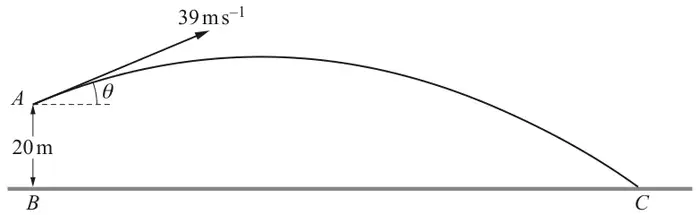
A small ball \(P\) is projected from a point \(A\) with speed \(39\,\mathrm{m\,s^{-1}}\) at an angle of elevation \(\theta\), where \(\sin\theta = \frac{5}{13}\) and \(\cos\theta = \frac{12}{13}\). Point \(A\) is \(20\,\mathrm{m}\) vertically above a point \(B\) on horizontal ground. The ball first lands at a point \(C\) on the horizontal ground (see diagram).
The ball \(P\) is modelled as a particle moving freely under gravity.
The time taken for \(P\) to travel from \(A\) to \(C\) is \(T\) seconds.
At the instant that \(P\) is projected, a second small ball \(Q\) is released from rest at \(B\) and moves towards \(C\) along the horizontal ground.
At time \(t\) seconds, where \(t \geqslant 0\), the velocity \(v\,\mathrm{m\,s^{-1}}\) of \(Q\) is given by
\(v = kt^3 + 6t^2 + \frac{3}{2}t,\)
where \(k\) is a positive constant.
| Scheme | Marks | AO |
|---|---|---|
| \(0 = (39\sin\theta)^2 + 2(-10)h\) | M1 | 3.3 |
| \(0 = \left(39 \times \frac{5}{13}\right)^2 + 2(-10)h\) | A1 | 1.1 |
| Max. height \(= 20 + h = 31.25\) (m) | A1 | 2.2a |
| [3] |
Notes
M1: Using \(v^2 = u^2 + 2as\) with \(v = 0\), \(a = \pm 10\) or \(\pm 9.8\) or \(\pm g\), and \(u = 39\sin\theta\) or \(u = 39\cos\theta\).
Accept any other complete method (using correct suvat equations) to find the maximum height e.g. \(0 = 39\sin\theta - 10t\) and with \(t\) then substituted into \(s = (39\sin\theta)t + 0.5(-10)t^2\)
Condone \(g = 9.8\) for full marks in (a) and (b)
A1: A correct equation with the correct value of sin substituted or for \(0 = (39\sin(22.6\ldots))^2 + 2(-10)h\)
Allow using \(g\) (and not replaced with 10 or 9.8) for this A mark
A1: www
- accept awrt 31.2 (using \(22.6\ldots\) as the angle and \(g = 10\))
- accept awrt 31.5 (coming from exact value of sin or \(22.6\ldots\) and \(g = 9.8\))
- condone 31.3 (3 sf)
| Scheme | Marks | AO |
|---|---|---|
| \(-20 = (39\sin\theta)T + \frac{1}{2}(-10)T^2\) | M1 | 3.3 |
| \(-20 = \left(39 \times \frac{5}{13}\right)T + \frac{1}{2}(-10)T^2\) | A1 | 1.1 |
| \(T = 4\) only | A1 | 1.1 |
| [3] |
Notes
M1: Applying \(s = ut + \frac{1}{2}at^2\) with \(s = \pm 20\), \(a = \pm 10\) or \(\pm 9.8\) or \(\pm g\) and \(u = 39\sin\theta\) or \(u = 39\cos\theta\)
Condone \(g = 9.8\) for full marks in (a) and (b)
Accept any other complete method to find \(T\)
A1: With correct value of sine or \(\sin(22.6)\)
Allow \(-20 = \left(39 \times \frac{5}{13}\right)T + \frac{1}{2}(-9.8)T^2\)
Allow using \(g\) (and not replaced with 10 or 9.8) for this A mark
A1: BC
- accept awrt 4.07 (using \(g = 9.8\) and exact value of sine)
- accept awrt 4.06 (using \(g = 9.8\) and \(22.6\ldots\))
- a value of \(4(.00\ldots)\) coming from \(3.998\ldots\) (using \(g = 10\) and \(22.6\ldots\) for sine)
Condone \(t = 4\)
| Scheme | Marks | AO |
|---|---|---|
Examples of possible limitations
| B1 | 3.5b |
| [1] |
Notes
B1: Allow any correct limitation
B0 if referring to
- Air resistance and/or wind (only)
- The ground is unlikely to be horizontal (only)
- The mass or weight or shape of \(P\) (only)
- The angle/heights/speeds may not be as quoted (only)
- Modelling the problem as 3D rather than in 2D (only)
If multiple limitations given, and any are incorrect, then B0
| Scheme | Marks | AO |
|---|---|---|
| \(a = 3kt^2 + 12t + \frac{3}{2}\) | M1 | 3.4 |
| \(BC = \left(39 \times \frac{12}{13}\right)\text{‘}T\text{’}\ (= 144)\) | M1* | 3.1b |
| \(s = \frac{1}{4}kt^4 + 2t^3 + \frac{3}{4}t^2\ (+c)\) | M1* | 2.1 |
| \(\frac{1}{4}k(4)^4 + 2(4)^3 + \frac{3}{4}(4)^2 = 144\) | M1dep* | 3.4 |
| \(k = \frac{1}{16}\) | A1 | 1.1 |
| \(a = 52.5\ (\mathrm{m\,s^{-2}})\) | A1 | 2.2a |
| [6] |
Notes
M1: Differentiate given \(v\) (at least two terms correct)
M1*: Applying \(s = ut\) horizontally to find distance \(BC\) with correct value of cos (or \(\cos(22.6\ldots)\)) and their value of \(T\) from (b)
Allow \(g = 9.8\) which if correct leads to \(146.34\ldots\)
M1*: Integrate given \(v\) (at least two terms correct)
M1dep*: Puts their integrated expression for \(s\), with \(t =\) their \(T\) from (b), equal to their distance for \(BC\) to form an equation in \(k\) only – dependent on the two previous M marks only
Must not include a \(+c\) unless dealt with as part of a definite integral. However, if a \(+c\) is included then subsequently ignored/set equal to zero without justification then give bod for this and any subsequent A marks (if earned)
A1: Correct exact value for \(k\) (oe e.g. 0.0625)
Final two marks can only be awarded if \(g = 10\) used
A1: oe