
June 2023 Paper 3 Q7
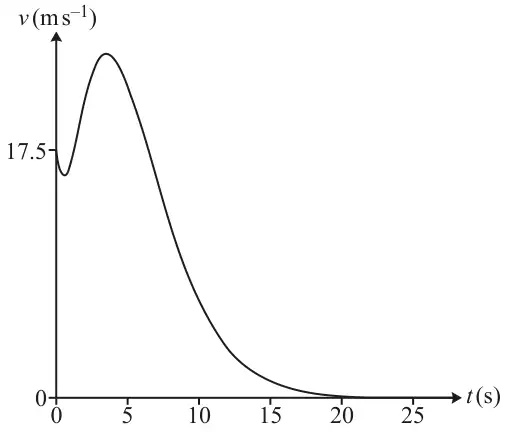
7 A car \(C\) is moving horizontally in a straight line with velocity \(v\,\mathrm{m\,s^{-1}}\) at time \(t\) seconds, where \(v \gt 0\) and \(t \geqslant 0\). The acceleration, \(a\,\mathrm{m\,s^{-2}}\), of \(C\) is modelled by the equation
\(a = v\left(\dfrac{8t}{7 + 4t^2} - \dfrac{1}{2}\right).\)
Find the times when the acceleration of \(C\) is zero. [3]
At \(t = 0\) the velocity of \(C\) is \(17.5\,\mathrm{m\,s^{-1}}\) and at \(t = T\) the velocity of \(C\) is \(5\,\mathrm{m\,s^{-1}}\).
\(T = 2\ln\left(\dfrac{7 + 4T^2}{2}\right).\) [6]
| Scheme | Marks | AO |
|---|---|---|
| DR \(\dfrac{8t}{7 + 4t^2} - \dfrac{1}{2} = 0 \Rightarrow 2(8t) - (7 + 4t^2) = 0\) | M1* | 1.1 |
| \(4t^2 - 16t + 7 = 0 \Rightarrow (2t - 1)(2t - 7) = 0\) | M1dep* | 1.1 |
| \(t = 0.5\) or \(t = 3.5\) | B1 | 1.1 |
| [3] |
Notes
M1*: Setting equation for \(a\) equal to zero and removing \(t^2\) correctly from the denominator e.g. \(8t - \frac{1}{2}(7 + 4t^2) = 0\) to obtain the equivalent of a 3TQ in \(t\) only
This mark can be implied by a correct 3TQ in \(t\)
M1dep*: Correct method for solving their 3TQ in \(t\)
If factorising: \(at^2 + bt + c \Rightarrow (mt + n)(pt + q)\) where \(a = mp\) and one of \(mq + np = b\) or \(c = nq\) so note that \(4t^2 - 16t + 7 = (t - 0.5)(t - 3.5)\) is M0 but e.g. \((-2t + 7)(2t - 1)\) is M1 bod
If using the formula: must apply the correct formula for their three-term quadratic in \(t\) (no errors)
If completing the square: The M mark is not awarded until correctly getting to the stage \(t - 2 = \pm\sqrt{\dfrac{9}{4}}\) for their 3TQ in \(t\) (must include \(\pm\) so implying two roots) with no errors (so consistent with applying the formula correctly)
Must see the method – the correct answers do not imply this mark therefore \(4t^2 - 16t + 7 = 0 \Rightarrow t = 0.5\) and 3.5 scores M1 M0 B1
As a minimum must see (if correct) \(\dfrac{16 \pm \sqrt{144}}{8}\)
B1: This mark is not dependent on the previous M mark(s)
So M1 M0 B1 is common or M0 M0 B1 if no working seen
| Scheme | Marks | AO |
|---|---|---|
| \(\dfrac{\mathrm{d}v}{\mathrm{d}t} = v\left(\dfrac{8t}{7 + 4t^2} - \dfrac{1}{2}\right)\) | B1* | 3.1b |
| \(\ln v =\) \(\ln(7 + 4t^2) - \frac{1}{2}t\ (+c)\) | B1dep* B1dep* | 1.1 1.1 |
| \(t = 0, v = 17.5 \Rightarrow c = \ln 17.5 - \ln 7\) | M1* | 3.1a |
| \(\ln 5 = \ln(7 + 4T^2) - \frac{1}{2}T + \ln\left(\dfrac{5}{2}\right)\) | M1dep* | 2.1 |
| \(\frac{1}{2}T = \ln\left[\dfrac{5(7 + 4T^2)}{2 \times 5}\right] \Rightarrow T = 2\ln\left(\dfrac{7 + 4T^2}{2}\right)\) | A1 | 2.2a |
| [6] |
Notes
B1*: Stating the correct differential equation
Possibly implied by correct separation of variables
B1dep*: Correct lhs
B1dep*: Correct rhs – not multiplied by \(v\) or 5 (or any other constant)
Condone lack of \(+c\) for both B marks
M1*: Uses correct initial conditions to find \(c\) from an equation of the form \(k_1\ln v = k_2\ln(7 + 4t^2) + k_3t + c\) (note that e.g. \(+\,c\) may appear on the lhs)
With non-zero values of \(k_i\) - accept any equivalent form e.g. \(v = A(7 + 4t^2)\mathrm{e}^{-0.5t}\) and then use initial conditions to find \(A\) (if correct then \(A = 2.5\))
M1dep*: Uses \(t = T\), \(v = 5\) to obtain an equation in \(T\) only – dependent on previous M mark
Condone use of \(t\) for \(T\) throughout the remainder of the question
A1: AG so at least one step of intermediate working from substitution of \(t = T\) and \(v = 5\)
Condone \(T = 2\ln\left|\dfrac{7 + 4T^2}{2}\right|\)
| Scheme | Marks | AO |
|---|---|---|
| \(T_{n+1} = 2\ln\left(\dfrac{7 + 4T_n^{\,2}}{2}\right)\) \(T_0 = 11.25\) \(T_1 = 11.09523175\ldots\) \(T_2 = 11.04058716\ldots\) \(T_3 = 11.02111643\ldots\) \(T_4 = 11.01415608\ldots\) \(T_5 = 11.011665\ldots\) | B1 | 1.1 |
| \(T = 11.01\) | B1 | 1.1 |
| [2] |
Notes
B1: Uses given result and given starting value to obtain correct \(T_1\) and \(T_2\) (so the first two iterations after the initial value of 11.25) to at least 4 sf (rot) – but all stated values in these two terms must be correct
B1: Must be stated to 4 sf only – not dependent on the first B mark – can be awarded if either of \(T_2\) and/or \(T_3\) incorrect (assume that the iterative process corrected itself or a slip in the candidate writing down an earlier value)
Must be clear that \(T\) is 11.01 (and not the final term shown in the iterative process) – this mark can be awarded from using alternative iterative methods e.g. Newton-Raphson
| Scheme | Marks | AO |
|---|---|---|
| \(11.01 - 3.5 = 7.51\) (s) | B1 | 2.2a |
| [1] |
Notes
B1: awrt 7.51
No follow through from incorrect earlier values