
October 2021 Paper 3 Mechanics Q3
3.
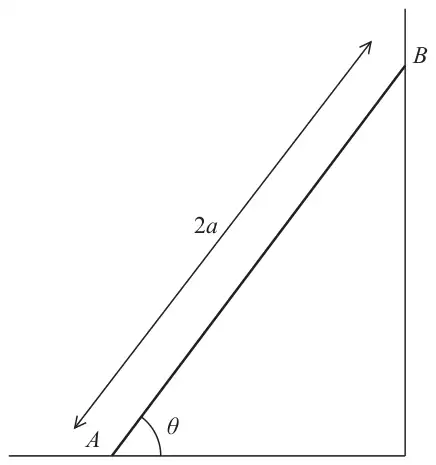
A beam \(AB\) has mass \(m\) and length \(2a\).
The beam rests in equilibrium with \(A\) on rough horizontal ground and with \(B\) against a smooth vertical wall.
The beam is inclined to the horizontal at an angle \(\theta\), as shown in Figure 2.
The coefficient of friction between the beam and the ground is \(\mu\)
The beam is modelled as a uniform rod resting in a vertical plane that is perpendicular to the wall.
Using the model,
A horizontal force of magnitude \(kmg\), where \(k\) is a constant, is now applied to the beam at \(A\).
This force acts in a direction that is perpendicular to the wall and towards the wall.
Given that \(\tan\theta = \dfrac{5}{4}\), \(\mu = \dfrac{1}{2}\) and the beam is now in limiting equilibrium,
| Scheme | Marks | AO |
|---|---|---|
| Part (a) is a ‘Show that..’ so equations need to be given in full to earn A marks | ||
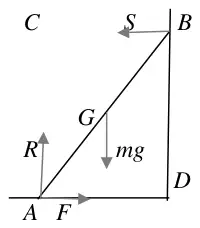 | ||
| Moments equation: (M1A0 for a moments inequality) | M1 | 3.3 |
| M\((A)\), \(mga\cos\theta = 2Sa\sin\theta\) M\((B)\), \(mga\cos\theta + 2Fa\sin\theta = 2Ra\cos\theta\) M\((C)\), \(F \times 2a\sin\theta = mga\cos\theta\) M\((D)\), \(2Ra\cos\theta = mga\cos\theta + 2Sa\sin\theta\) M\((G)\), \(Ra\cos\theta = Fa\sin\theta + Sa\sin\theta\). | A1 | 1.1b |
| \((\updownarrow)\ R = mg\) OR \((\leftrightarrow)\ F = S\) | B1 | 3.4 |
| Use their equations (they must have enough) and \(F \leqslant \mu R\) to give an inequality in \(\mu\) and \(\theta\) only (allow DM1 for use of \(F = \mu R\) to give an equation in \(\mu\) and \(\theta\) only) | DM1 | 2.1 |
| \(\mu \geqslant \dfrac{1}{2}\cot\theta\) * | A1* | 2.2a |
| (5) |
Notes
M1: Any moments equation with correct terms, condone sign errors and sin/cos confusion
A1: Correct equation
B1: Correct equation
DM1: Dependent on M1, for using their equations (they must have enough) and \(F \leqslant \mu R\) to give an inequality in \(\mu\) and \(\theta\) only
(allow M1 for use of \(F = \mu R\) to give an equation in \(\mu\) and \(\theta\) only)
A1*: Given answer correctly obtained with no wrong working seen (e.g. if they use \(F = \mu R\) anywhere, A0)
| Scheme | Marks | AO |
|---|---|---|
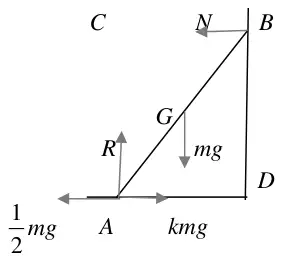 | ||
| Moments equation: | M1 | 3.4 |
| M\((A)\), \(mga\cos\theta = 2Na\sin\theta\) M\((B)\), \(mga\cos\theta + 2kmga\sin\theta = 2Ra\cos\theta + \dfrac{1}{2}mg2a\sin\theta\) M\((D)\), \(2Ra\cos\theta = mga\cos\theta + N2a\sin\theta\) M\((G)\), \(kmga\sin\theta + Na\sin\theta = \dfrac{1}{2}mga\sin\theta + Ra\cos\theta\) | A1 | 1.1b |
| S.C. M\((C)\), \(mga\cos\theta + \dfrac{1}{2}mg2a\sin\theta = kmg2a\sin\theta\) M1A1B1 \(1 + \dfrac{5}{4} = \dfrac{5k}{2}\) M1 \(k = 0.9\) A1 | ||
| \(N = kmg - F\) OR \(R = mg\) | B1 | 3.3 |
| Use their equations (they must have enough) to solve for \(k\) (numerical) | DM1 | 3.1b |
| \(k = 0.9\) oe | A1 | 1.1b |
| (5) | ||
| (10 marks) |
Notes
M1: Any moments equation with correct terms, condone sign errors
A1: Correct equation
B1: Correct equation
DM1: Dependent on M1, for using their equations (they must have enough) with trig substituted, to solve for \(k\), which must be numerical.
A1: cao